

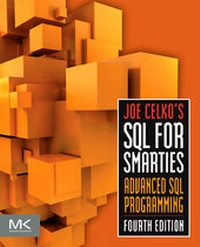
Joe Celko's SQL for Smarties
Advanced SQL Programming
4th Edition
Published on 22. November 2010
Book
Paperback/Softback
816 pages
978-0-12-382022-8 (ISBN)
Description
Joe Celkos SQL for Smarties: Advanced SQL Programming offers tips and techniques in advanced programming. This book is the fourth edition and it consists of 39 chapters, starting with a comparison between databases and file systems. It covers transactions and currency control, schema level objects, locating data and schema numbers, base tables, and auxiliary tables. Furthermore, procedural, semi-procedural, and declarative programming are explored in this book.
The book also presents the different normal forms in database normalization, including the first, second, third, fourth, fifth, elementary key, domain-key, and Boyce-Codd normal forms. It also offers practical hints for normalization and denormalization. The book discusses different data types, such as the numeric, temporal and character data types; the different predicates; and the simple and advanced SELECT statements. In addition, the book presents virtual tables, and it discusses data partitions in queries; grouping operations; simple aggregate functions; and descriptive statistics, matrices and graphs in SQL. The book concludes with a discussion about optimizing SQL. It will be of great value to SQL programmers.
The book also presents the different normal forms in database normalization, including the first, second, third, fourth, fifth, elementary key, domain-key, and Boyce-Codd normal forms. It also offers practical hints for normalization and denormalization. The book discusses different data types, such as the numeric, temporal and character data types; the different predicates; and the simple and advanced SELECT statements. In addition, the book presents virtual tables, and it discusses data partitions in queries; grouping operations; simple aggregate functions; and descriptive statistics, matrices and graphs in SQL. The book concludes with a discussion about optimizing SQL. It will be of great value to SQL programmers.
Reviews / Votes
"If you work with SQL in any way, shape, or form, the most recent edition of Joe Celko's SQL for Smarties needs to be on your bookshelf!" --Data Technology Today BlogMore details
Series
Edition
4th edition
Language
English
Place of publication
San Francisco
United States
Publishing group
Elsevier Science & Technology
Target group
Professional and scholarly
This book is intended for working SQL programmers, database administrators, database designers, database analysts, and application system developers as well as those who are developing new features for database management systems who want to know about user needs. This would include anyone working with electronic content in the relational database context but also XML. Web services, etc.
Illustrations
Illustrated
Dimensions
Height: 235 mm
Width: 191 mm
Weight
1350 gr
ISBN-13
978-0-12-382022-8 (9780123820228)
Copyright in bibliographic data and cover images is held by Nielsen Book Services Limited or by the publishers or by their respective licensors: all rights reserved.
Schweitzer Classification
Other editions
New editions
Book
12/2014
5th Edition
Morgan Kaufmann
€63.50
Shipment within 15-20 days
Additional editions
E-Book
05/2014
4th Edition
Morgan Kaufmann
€51.95
Available for download
Previous edition
Book
08/2005
3rd Edition
Morgan Kaufmann
€50.75
Article exhausted; check for reprint
Person
Joe Celko served 10 years on ANSI/ISO SQL Standards Committee and contributed to the SQL-89 and SQL-92 Standards. Mr. Celko is author a series of books on SQL and RDBMS for Elsevier/MKP. He is an independent consultant based in Austin, Texas. He has written over 1200 columns in the computer trade and academic press, mostly dealing with data and databases.
Content
Introduction
Chapter 1: Databases versus File Systems
Chapter 2: Transactions and Concurrency Control
Chapter 3: Schema Level Objects
Chapter 4: Locating Data and Special Numbers
Chapter 5: Base Tables and Related Elements
Chapter 6: Procedural, Semi-Procedural and Declarative Programming
Chapter 7: Procedural Constructs
Chapter 8: Auxiliary Tables
Chapter 9: Normalization
Chapter 10: Numeric Data Types
Chapter 11: Temporal Data Types
Chapter 12: Character Data Types
Chapter 13: NULLs -- Missing Data in SQL
Chapter 14: Multiple Column Data Elements
Chapter 15: Table Operations
Chapter 16: Comparison or Theta Operators
Chapter 17: Valued Predicates
Chapter 18: CASE Expressions
Chapter 19: LIKE and SIMILAR TO Predicates
Chapter 20: BETWEEN and OVERLAPS Predicates
Chapter 21: The [NOT] IN() Predicate
Chapter 22: EXISTS() Predicate
Chapter 23: Quantified Subquery Predicates
Chapter 24: The Simple SELECT Statement
Chapter 25: Advanced SELECT Statements
Chapter 26: Virtual Tables: VIEWs, Derived Tables, CTEs and MQTs
Chapter 27: Partitioning Data in Queries
Chapter 28: Grouping Operations
Chapter 29: Simple Aggregate Functions
Chapter 30: Advanced Grouping, Windowed Aggregation and OLAP in SQL
Chapter 31: Descriptive Statistics in SQL
Chapter 32: Sub-Sequences, Regions, Runs, Gaps, and Islands
Chapter 33: Matrices in SQL
Chapter 34: Set Operations
Chapter 35: Subsets
Chapter 36: Trees and Hierarchies in SQL
Chapter 37: Graphs in SQL
Chapter 38: Temporal Queries
Chapter 39: Optimizing SQL
Chapter 1: Databases versus File Systems
Chapter 2: Transactions and Concurrency Control
Chapter 3: Schema Level Objects
Chapter 4: Locating Data and Special Numbers
Chapter 5: Base Tables and Related Elements
Chapter 6: Procedural, Semi-Procedural and Declarative Programming
Chapter 7: Procedural Constructs
Chapter 8: Auxiliary Tables
Chapter 9: Normalization
Chapter 10: Numeric Data Types
Chapter 11: Temporal Data Types
Chapter 12: Character Data Types
Chapter 13: NULLs -- Missing Data in SQL
Chapter 14: Multiple Column Data Elements
Chapter 15: Table Operations
Chapter 16: Comparison or Theta Operators
Chapter 17: Valued Predicates
Chapter 18: CASE Expressions
Chapter 19: LIKE and SIMILAR TO Predicates
Chapter 20: BETWEEN and OVERLAPS Predicates
Chapter 21: The [NOT] IN() Predicate
Chapter 22: EXISTS() Predicate
Chapter 23: Quantified Subquery Predicates
Chapter 24: The Simple SELECT Statement
Chapter 25: Advanced SELECT Statements
Chapter 26: Virtual Tables: VIEWs, Derived Tables, CTEs and MQTs
Chapter 27: Partitioning Data in Queries
Chapter 28: Grouping Operations
Chapter 29: Simple Aggregate Functions
Chapter 30: Advanced Grouping, Windowed Aggregation and OLAP in SQL
Chapter 31: Descriptive Statistics in SQL
Chapter 32: Sub-Sequences, Regions, Runs, Gaps, and Islands
Chapter 33: Matrices in SQL
Chapter 34: Set Operations
Chapter 35: Subsets
Chapter 36: Trees and Hierarchies in SQL
Chapter 37: Graphs in SQL
Chapter 38: Temporal Queries
Chapter 39: Optimizing SQL