

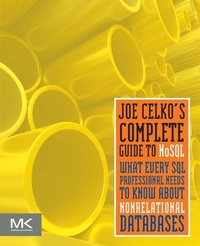
Joe Celko's Complete Guide to NoSQL
What Every SQL Professional Needs to Know about Non-Relational Databases
Published on 28. November 2013
Book
Paperback/Softback
244 pages
978-0-12-407192-6 (ISBN)
Description
Joe Celko's Complete Guide to NoSQL provides a complete overview of non-relational technologies so that you can become more nimble to meet the needs of your organization. As data continues to explode and grow more complex, SQL is becoming less useful for querying data and extracting meaning. In this new world of bigger and faster data, you will need to leverage non-relational technologies to get the most out of the information you have. Learn where, when, and why the benefits of NoSQL outweigh those of SQL with Joe Celko's Complete Guide to NoSQL.
This book covers three areas that make today's new data different from the data of the past: velocity, volume and variety. When information is changing faster than you can collect and query it, it simply cannot be treated the same as static data. Celko will help you understand velocity, to equip you with the tools to drink from a fire hose. Old storage and access models do not work for big data. Celko will help you understand volume, as well as different ways to store and access data such as petabytes and exabytes. Not all data can fit into a relational model, including genetic data, semantic data, and data generated by social networks. Celko will help you understand variety, as well as the alternative storage, query, and management frameworks needed by certain kinds of data.
This book covers three areas that make today's new data different from the data of the past: velocity, volume and variety. When information is changing faster than you can collect and query it, it simply cannot be treated the same as static data. Celko will help you understand velocity, to equip you with the tools to drink from a fire hose. Old storage and access models do not work for big data. Celko will help you understand volume, as well as different ways to store and access data such as petabytes and exabytes. Not all data can fit into a relational model, including genetic data, semantic data, and data generated by social networks. Celko will help you understand variety, as well as the alternative storage, query, and management frameworks needed by certain kinds of data.
Reviews / Votes
"The book summarizes various NoSQL topics to acquaint readers with both old and new data management issues outside the realm of the relational framework... I found it thought provoking and believe that it has a place on the data manager's bookshelf." --ComputingReviews.com, March 4, 2014More details
Language
English
Place of publication
San Francisco
United States
Publishing group
Elsevier Science & Technology
Target group
Professional and scholarly
Database Programmers
Product notice
Paperback (trade)
Illustrations
Illustrated
Dimensions
Height: 233 mm
Width: 189 mm
Thickness: 15 mm
Weight
513 gr
ISBN-13
978-0-12-407192-6 (9780124071926)
Copyright in bibliographic data and cover images is held by Nielsen Book Services Limited or by the publishers or by their respective licensors: all rights reserved.
Schweitzer Classification
Other editions
Additional editions

Joe Celko
Joe Celko's Complete Guide to NoSQL
What Every SQL Professional Needs to Know about Non-Relational Databases
E-Book
10/2013
Morgan Kaufmann
€34.95
Available for download
Person
Joe Celko served 10 years on ANSI/ISO SQL Standards Committee and contributed to the SQL-89 and SQL-92 Standards. Mr. Celko is author a series of books on SQL and RDBMS for Elsevier/MKP. He is an independent consultant based in Austin, Texas. He has written over 1200 columns in the computer trade and academic press, mostly dealing with data and databases.
Content
Chapter 1. NoSQL and Transaction ProcessingChapter 2. Columnar DatabasesChapter 3. Graph DatabasesChapter 4. The MapReduce Model Chapter 5. Streaming Databases and Complex EventsChapter 6. Key-Value Stores Chapter 7. Textbases Chapter 8.Geographical Data (GIS) Chapter 9. NoSQL Taxonomy? Steven Yen's Model with examples