

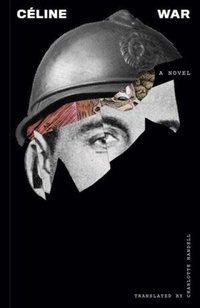
War
Published on 9. July 2024
Book
Paperback/Softback
144 pages
978-0-8112-3732-1 (ISBN)
Description
Celine had long claimed that Death on the Installment Plan was part of a trilogy, and that the manuscripts of War and London had been stolen by the Resistance from his apartment, when he fled for his life-an abhorred collaborator-from Paris. Few believed him, but then, mysteriously, the manuscripts came to light in 2020. Greeted rapturously in France ("a miracle," Le Monde; "the discovery of a great text," Le Point), War is sure to be more controversy abroad. Though much revered as "the most blackly humorous and disenchanted voice in all of French literature" (London Review of Books), Celine is also reviled for his infamous antisemitic wartime pamphlets.
War begins with Ferdinand waking in shock on the battlefield, grievously injured, with all his comrades sprawled out dead around him: it's a scene of visceral horror, carnage, and pain.
The novel's key idea-that trench warfare lodges itself in the soldier's head forever, goes on destroying him, cuts him off from those who have not been on the front, and makes the hypocrisies of their safe world repugnant-drives itself under the reader's skin, powered by the sheer velocity of Celine's voracious, gritty, raw, graphic style.
War begins with Ferdinand waking in shock on the battlefield, grievously injured, with all his comrades sprawled out dead around him: it's a scene of visceral horror, carnage, and pain.
The novel's key idea-that trench warfare lodges itself in the soldier's head forever, goes on destroying him, cuts him off from those who have not been on the front, and makes the hypocrisies of their safe world repugnant-drives itself under the reader's skin, powered by the sheer velocity of Celine's voracious, gritty, raw, graphic style.
Reviews / Votes
"A more intense realization of the horrors of the Great War has never been written. The novel emerges, inevitably, to much reverberating argument over the good and evil of Celine's oeuvre and its meanings, about whether his literary value can be separated from the vile anti-Semitism of his political pamphleteering, and how we should respond to the whole. [But] the line between Celine's pamphlets and Auschwitz is direct; to pretend that it's not is to sin against history. But no one can easily forget, in this new book as in the older ones, the intensity of Celine's realization of the inexpungible human emotions of hatred and horror. When it comes to Celine, then or now, an ability to admire, a refusal to censor, and a readiness to condemn, should be-must be-part of a single compound response. Evil genius demands no less." -- Adam Gopnik - The New Yorker "The shattered imagery, the dizzying jump-cuts between scenes and the heaving, roiling rhythm of the sentences create an overwhelming sensation of nausea. But unlike the metaphysical vertigo of Jean-Paul Sartre's 'Nausea' (1938), the sickness here is viscerally present." -- Sam Sacks - Wall Street Journal "Guerre is breathtaking. Its immediacy, its ostinato of physical pain, its lewd and desperate milieu of wounded soldiers in a field hospital behind the front lines, will either repel or draw you with its sardonic wit and glints of tenderness and trapdoor twists of narrative." -- World Literature Today "War has its own sinister charm, and it provides a further hallucinated contribution to Celine's case against war... In Search of Unlost Terror might be a title for the book." -- Michael Wood - London Review of Books "Inimitably rowdy: the missing link between the Marquis and Henry Miller. 'He drank coffee as if he were drinking gold.' You read that, and you could die happy." -- Michael Hofmann "Celine's furious style is in full force, and is well served by the brevity of the text. Devoted fans will rejoice." -- Publishers Weekly "War will be of lasting interest to both Celine completists and those who question whether art can, or should, be separated from the regrettable views and deeds of its creators. No one can doubt his talent and status as one of the 20th century's great stylists." -- Marcus Hijkoop - The Telegraph "A rare instance in which the novel lives up to the hype surrounding its rediscovery. Mandell deftly captures Celine's tone and rhythm while preserving the eccentricities that made him such a singular stylist. You get the sense that what you're reading isn't a simple transposition of words from one language into another, but precisely what Celine intended... a cautionary, timely and unflinching portrait of a civilization that still considers war an exciting spectator sport pitting Good against Evil." -- Jim Knipfel - Truthdig "A hallucinatory romp through the early days of the First World War." -- Charlie Taylor - Los Angeles Review of Books "War was to have been the second volume of a trilogy of novels provisionally entitled Childhood-War-London. It is an extraordinary work, hysterical in tone and demented in content. It is deeply disturbing and horribly compelling." -- John Banville - The GuardianMore details
Language
English
Place of publication
New York
United States
Product notice
Paperback (trade)
Unsewn / adhesive bound
Dimensions
Height: 204 mm
Width: 139 mm
Thickness: 11 mm
Weight
130 gr
ISBN-13
978-0-8112-3732-1 (9780811237321)
Copyright in bibliographic data and cover images is held by Nielsen Book Services Limited or by the publishers or by their respective licensors: all rights reserved.
Schweitzer Classification
Persons
Louis-Ferdinand Celine (1894-1961) was a French writer and doctor whose novels are antiheroic visions of human suffering. Accused of collaboration with the Nazis, Celine fled France in 1944 first to Germany and then to Denmark. Condemned by default (1950) in France to one year of imprisonment and declared a national disgrace, Celine returned to France after his pardon in 1951, where he continued to write until his death. His classic books include Journey to the End of the Night, Death on the Installment Plan, London Bridge, North, Rigadoon, Conversations with Professor Y, Castle to Castle, and Normance. A Chevalier de l'Ordre des Arts et des Lettres, Charlotte Mandell has translated over fifty books from the French, including works by Flaubert, Proust, and Genet. In 2001 she received a translation prize from the Modern Language Association for her translation of Faux Pas by Maurice Blanchot, in 2018 she won the National Translation Award in Prose for her translation of Compass by Mathias Enard, and in 2024 she received the Thornton Wilder Translation Prize from the Academy of Arts and Letters. She lives in the Hudson Valley with her husband, the poet Robert Kelly.