

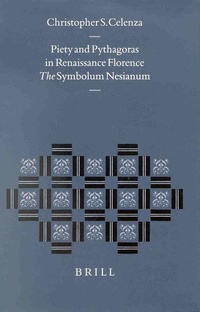
Piety and Pythagoras in Renaissance Florence: The Symbolum Nesianum
Published on 31. July 2001
Book
Leather / fine binding
256 pages
978-90-04-12211-6 (ISBN)
Description
This volume sheds light on the transitions in the intellectual life of Renaissance Florence in the last quarter of the fifteenth century. Its point of departure is a hitherto unedited Latin text, the Symbolum Nesianum, whose original version was written by Giovanni Nesi, a follower of the famous Platonist Marsilio Ficino and then of the austere, fiery reformer, Girolamo Savonarola.
The first part of the book presents a lengthy introductory study that illuminates the text's cultural context. The second part offers a critical edition, translation, and commentary for the text.
The book will be of use to historians and to all scholars interested in the culture of the city often called the cradle of the Renaissance as it underwent one of its most difficult times.
The first part of the book presents a lengthy introductory study that illuminates the text's cultural context. The second part offers a critical edition, translation, and commentary for the text.
The book will be of use to historians and to all scholars interested in the culture of the city often called the cradle of the Renaissance as it underwent one of its most difficult times.
Reviews / Votes
'This is an admirable work of interdisciplinary scholarship, which I highly recommend.'Richard K. Emmerson, The Catholic Historical Review, April 2003.
More details
Series
Language
English
Latin
Place of publication
Leiden
Netherlands
Target group
College/higher education
Professional and scholarly
Product notice
Cloth
With dust jacket
Dimensions
Height: 250 mm
Width: 169 mm
Thickness: 22 mm
Weight
599 gr
ISBN-13
978-90-04-12211-6 (9789004122116)
Copyright in bibliographic data and cover images is held by Nielsen Book Services Limited or by the publishers or by their respective licensors: all rights reserved.
Schweitzer Classification
Person
Christopher S. Celenza, Ph.D. (1995) in History, Duke University and in Classical Studies, University of Hamburg (2001). Professor of Romance Languages, Johns Hopkins University. He has held fellowships from Villa I Tatti, The American Academy in Rome, and the Fulbright Foundation and has published on cu Renaissance humanism and philosophy.
Content
Acknowledgements
Abbreviations
Introduction
Pythagoras, Pythagoreanism, and the Pythagorean Symbols: Antiquity Through Middle Fifteenth-Century Florence
Renaissance Florence and its Intellectual Currents: Marsilio Ficino and Angelo Poliziano
Giovanni Nesi and Pythagoras: Between Ficino and Savonarola
The European Context
Conclusion
THE SYMBOLUM NESIANUM
Latin Text and Translation
Commentary
Appendix I. Aurispa's Preface to his Translation of Hierocles' Commentum in Pythagorae versus aureos, Dedicated to Nicholas V: Text and Translation
Appendix II. Lelio Gregorio Giraldi's Comment on the Symbol: "Nudis pedibus sacrificandum": Text, Translation, and Commentary
Appendix III. Description of MS Florence BN II.I.158
Bibliography
Index Locorum Symboli Nesiani
Index Locorum Veteris Testamenti
Index Locorum Novi Testamenti
Index Locorum Antiquorum Gentilium
Index Locorum Patrum
Index Locorum Aetatis Mediae Scriptorum
Index Locorum Corporis Iuris Canonici
Index Locorum Aetatis Renatae Scriptorum
Indices to the Introductory Study
Index of Names
Index of Subjects
Index of Place Names
Abbreviations
Introduction
Pythagoras, Pythagoreanism, and the Pythagorean Symbols: Antiquity Through Middle Fifteenth-Century Florence
Renaissance Florence and its Intellectual Currents: Marsilio Ficino and Angelo Poliziano
Giovanni Nesi and Pythagoras: Between Ficino and Savonarola
The European Context
Conclusion
THE SYMBOLUM NESIANUM
Latin Text and Translation
Commentary
Appendix I. Aurispa's Preface to his Translation of Hierocles' Commentum in Pythagorae versus aureos, Dedicated to Nicholas V: Text and Translation
Appendix II. Lelio Gregorio Giraldi's Comment on the Symbol: "Nudis pedibus sacrificandum": Text, Translation, and Commentary
Appendix III. Description of MS Florence BN II.I.158
Bibliography
Index Locorum Symboli Nesiani
Index Locorum Veteris Testamenti
Index Locorum Novi Testamenti
Index Locorum Antiquorum Gentilium
Index Locorum Patrum
Index Locorum Aetatis Mediae Scriptorum
Index Locorum Corporis Iuris Canonici
Index Locorum Aetatis Renatae Scriptorum
Indices to the Introductory Study
Index of Names
Index of Subjects
Index of Place Names