

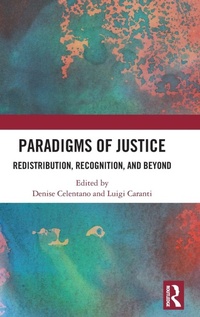
Paradigms of Justice
Redistribution, Recognition, and Beyond
1st Edition
Published on 29. October 2020
Book
Hardback
296 pages
978-1-138-59427-2 (ISBN)
Description
This book explores the relation between redistribution and recognition, two key paradigms in the contemporary discourse on justice. Combining insights from the traditions of critical social theory and analytical political philosophy, the volume offers a multifaceted exploration of this incredibly inspiring conceptual couple from a plurality of perspectives. The chapters engage with concepts such as universal basic income, property-owning democracy, poverty, equality, self-respect, pluralism, care, and work, all of which have an impact on individuals' recognition as well as on distributive policies.
An important contribution to the field of political and social philosophy, the volume will be useful to scholars and researchers of politics, law, human rights, economics, social justice, as well as policymakers.
An important contribution to the field of political and social philosophy, the volume will be useful to scholars and researchers of politics, law, human rights, economics, social justice, as well as policymakers.
More details
Language
English
Place of publication
London
United Kingdom
Publishing group
Taylor & Francis Ltd
Target group
College/higher education
Illustrations
2 s/w Abbildungen, 2 s/w Zeichnungen
2 Line drawings, black and white; 2 Illustrations, black and white
Dimensions
Height: 240 mm
Width: 161 mm
Thickness: 21 mm
Weight
614 gr
ISBN-13
978-1-138-59427-2 (9781138594272)
Copyright in bibliographic data and cover images is held by Nielsen Book Services Limited or by the publishers or by their respective licensors: all rights reserved.
Schweitzer Classification
Other editions
Additional editions
Book
09/2023
1st Edition
Routledge India
€68.70
Shipment within 15-20 days
E-Book
10/2020
1st Edition
Routledge India
€61.99
Available for download
E-Book
10/2020
1st Edition
Routledge India
€61.99
Available for download
Persons
Denise Celentano is Postdoctoral Fellow in Ethics and Economics at the Centre for Research on Ethics at the University of Montreal, Canada. She was previously a Berggruen Postdoctoral Fellow in Philosophy at New York University, US. Her research explores problems of social justice and equality, with a focus on work as an issue of justice.
Luigi Caranti is Professor of Political Philosophy at the Universita di Catania, Italy. He has worked as a researcher in various institutions including the School of International and Public Affairs at Columbia University, US, the Australian National University, and the Philipps-Universitaet - Marburg, Germany. His studies mainly concern the philosophy of Kant and he has contributed extensively to the theoretical, practical, aesthetic, and political dimensions of Kant's thought. Currently, his research focuses on the philosophical theory of human rights.
Luigi Caranti is Professor of Political Philosophy at the Universita di Catania, Italy. He has worked as a researcher in various institutions including the School of International and Public Affairs at Columbia University, US, the Australian National University, and the Philipps-Universitaet - Marburg, Germany. His studies mainly concern the philosophy of Kant and he has contributed extensively to the theoretical, practical, aesthetic, and political dimensions of Kant's thought. Currently, his research focuses on the philosophical theory of human rights.
Content
Introduction PART I The 'recognition side' of distributive justice 1. Basic income in the recognition order: respect, care, and esteem 2. Freedom, recognition, and the property-owning democracy: towards a predistributive model of justice 3. Redistribution, misrecognition, domination: a look at Brazilian society PART II Dimensions of equality 4. Redistribution and recognition from the point of view of real equality: Anderson and Honneth through the lens of Babeuf 5. Work justice beyond redistribution and recognition 6. Affective equality and social justice PART III Rethinking grammars of oppression and inclusion 7. Vulnerable political life: distributive justice, critical theory, and critical care ethics 8. Redistribution, recognition, and pluralism: a Rawlsian criticism of Fraser 9. The politics of white misrecognition and practices of racial inequality PART IV Moral economies of respect and esteem 10. A moral economy? Honneth, recognition, and the capitalist market 11. Social esteem between recognition and redistribution 12. Recognition vs redistribution: the case of self-respect