

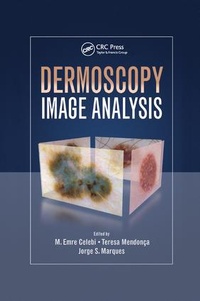
Dermoscopy Image Analysis
1st Edition
Published on 9. March 2018
Book
Paperback/Softback
508 pages
978-1-138-89287-3 (ISBN)
Description
Dermoscopy is a noninvasive skin imaging technique that uses optical magnification and either liquid immersion or cross-polarized lighting to make subsurface structures more easily visible when compared to conventional clinical images. It allows for the identification of dozens of morphological features that are particularly important in identifying malignant melanoma.
Dermoscopy Image Analysis summarizes the state of the art of the computerized analysis of dermoscopy images. The book begins by discussing the influence of color normalization on classification accuracy and then:
Investigates gray-world, max-RGB, and shades-of-gray color constancy algorithms, showing significant gains in sensitivity and specificity on a heterogeneous set of images
Proposes a new color space that highlights the distribution of underlying melanin and hemoglobin color pigments, leading to more accurate classification and border detection results
Determines that the latest border detection algorithms can achieve a level of agreement that is only slightly lower than the level of agreement among experienced dermatologists
Provides a comprehensive review of various methods for border detection, pigment network extraction, global pattern extraction, streak detection, and perceptually significant color detection
Details a computer-aided diagnosis (CAD) system for melanomas that features an inexpensive acquisition tool, clinically meaningful features, and interpretable classification feedback
Presents a highly scalable CAD system implemented in the MapReduce framework, a novel CAD system for melanomas, and an overview of dermatological image databases
Describes projects that made use of a publicly available database of dermoscopy images, which contains 200 high-quality images along with their medical annotations
Dermoscopy Image Analysis not only showcases recent advances but also explores future directions for this exciting subfield of medical image analysis, covering dermoscopy image analysis from preprocessing to classification.
Dermoscopy Image Analysis summarizes the state of the art of the computerized analysis of dermoscopy images. The book begins by discussing the influence of color normalization on classification accuracy and then:
Investigates gray-world, max-RGB, and shades-of-gray color constancy algorithms, showing significant gains in sensitivity and specificity on a heterogeneous set of images
Proposes a new color space that highlights the distribution of underlying melanin and hemoglobin color pigments, leading to more accurate classification and border detection results
Determines that the latest border detection algorithms can achieve a level of agreement that is only slightly lower than the level of agreement among experienced dermatologists
Provides a comprehensive review of various methods for border detection, pigment network extraction, global pattern extraction, streak detection, and perceptually significant color detection
Details a computer-aided diagnosis (CAD) system for melanomas that features an inexpensive acquisition tool, clinically meaningful features, and interpretable classification feedback
Presents a highly scalable CAD system implemented in the MapReduce framework, a novel CAD system for melanomas, and an overview of dermatological image databases
Describes projects that made use of a publicly available database of dermoscopy images, which contains 200 high-quality images along with their medical annotations
Dermoscopy Image Analysis not only showcases recent advances but also explores future directions for this exciting subfield of medical image analysis, covering dermoscopy image analysis from preprocessing to classification.
Reviews / Votes
"... demonstrates the significant advancements in dermoscopy image analysis techniques, involving image-preprocessing, lesion segmentation (or border detection), feature extraction, pattern analysis, lesion classification, and database construction. The approaches described are state of the art and the details are sine qua non. ... a good addition on the dermatologist and researcher's bookshelf, and pilots further research in this field."-Fengying Xie, Image Processing Center, Beihang University, Beijing, China
"... a comprehensive description of computerized image analysis that is definitely useful for researchers in this field as a starting point for future developments."
-Giuseppe Argenziano, Dermatology Unit, Second University of Naples, Italy
"... collect[s] high-quality research articles on dermoscopy image analysis. ... presents the latest state-of-the-art techniques for classifying benign and malignant skin lesions. A very interesting point that emerged from the literature review, as one author points out, is that all these computer-aided diagnosis (CAD) systems offer invaluable help to the general practitioner (GP) in an initial diagnosis of the lesions. The high level of performance of these systems can thus provide an accurate evaluation of skin lesions without having to refer to a dermatologist at this initial stage."
-Lucia Ballerini, University of Edinburgh, Scotland
"... deals with a very important and hot topic that attracts the interest of many researchers and doctors in the scientific community nowadays. ... well written and clear. It provides a good overview of the dermoscopy image analysis field, and it is useful for engineers and computer scientists interested in developing similar applications, since it includes in-depth technical descriptions."
-Ilias Maglogiannis, University of Piraeus, Greece
"... I definitely would like to have this book [on] my shelf. ... a valuable resource for researchers and graduate students of computer vision and medical image analysis interested in skin cancer detection methods for dermoscopic images. It covers fundamentals of the area by providing thorough treatments of the theory and the concepts while making the material accessible to the reader with examples that nicely illustrate the concepts."
-Jacob Scharcanski, Universidade Federal do Rio Grande do Sul, Brazil
"... provides a comprehensive, well-rounded coverage on the factors, challenges, and state-of-the-art solutions to the very difficult problem of dermascopy image analysis. ... a good reference to have in the libraries of researchers in this field."
-Alexander Wong, University of Waterloo, Ontario, Canada
More details
Series
Language
English
Place of publication
London
United Kingdom
Publishing group
Taylor & Francis Ltd
Target group
College/higher education
Dimensions
Height: 234 mm
Width: 156 mm
Weight
453 gr
ISBN-13
978-1-138-89287-3 (9781138892873)
Copyright in bibliographic data and cover images is held by Nielsen Book Services Limited or by the publishers or by their respective licensors: all rights reserved.
Schweitzer Classification
Other editions
Additional editions
M. Emre Celebi | Teresa Mendonca | Jorge S. Marques
Dermoscopy Image Analysis
Book
10/2015
1st Edition
CRC Press
€282.26
Article not available for order
M. Emre Celebi | Teresa Mendonca | Jorge S. Marques
Dermoscopy Image Analysis
E-Book
10/2015
CRC Press
€65.99
Available for download
M. Emre Celebi | Teresa Mendonca | Jorge S. Marques
Dermoscopy Image Analysis
E-Book
10/2015
1st Edition
CRC Press
€65.99
Available for download
Persons
M. Emre Celebi earned a B.Sc in computer engineering at the Middle East Technical University, Ankara, Turkey, in 2002. He earned M.Sc and Ph.D degrees in computer science and engineering at the University of Texas at Arlington, USA, in 2003 and 2006, respectively. A senior member of the IEEE and SPIE, he is currently an associate professor and the founding director of the Image Processing and Analysis Laboratory, Department of Computer Science, Louisiana State University, Shreveport, USA. Widely published, Dr. Celebi has worked on several projects funded by the U.S. National Science Foundation and National Institutes of Health.
Teresa F. Mendonca earned mathematics and Ph.D degrees at the University of Porto, Portugal, in 1980 and 1993, respectively. Currently, she is an assistant professor with the Mathematics Department, Faculty of Sciences, University of Porto, and a researcher at the Institute for Systems and Robotics-Porto. Her research interests are in the areas of identification, modeling, and control applied to the biomedical field. In recent years, she has been involved in projects for modeling and control in anesthesia and in medical image analysis.
Jorge S. Marques earned EE, Ph.D, and aggregation degrees at the Technical University of Lisbon, Portugal, in 1981, 1990, and 2002, respectively. Currently, he is an associate professor with the Electrical and Computer Engineering Department, Instituto Superior Tecnico, Lisbon, Portugal, and a researcher at the Institute for Systems and Robotics, Portugal. He was the co-chairman of the IAPR Conference IbPRIA 2005, president of the Portuguese Association for Pattern Recognition (2001-2003), and associate editor of the Statistics and Computing Journal, Springer. His research interests are in the areas of statistical image processing, medical image analysis, and pattern recognition.
Teresa F. Mendonca earned mathematics and Ph.D degrees at the University of Porto, Portugal, in 1980 and 1993, respectively. Currently, she is an assistant professor with the Mathematics Department, Faculty of Sciences, University of Porto, and a researcher at the Institute for Systems and Robotics-Porto. Her research interests are in the areas of identification, modeling, and control applied to the biomedical field. In recent years, she has been involved in projects for modeling and control in anesthesia and in medical image analysis.
Jorge S. Marques earned EE, Ph.D, and aggregation degrees at the Technical University of Lisbon, Portugal, in 1981, 1990, and 2002, respectively. Currently, he is an associate professor with the Electrical and Computer Engineering Department, Instituto Superior Tecnico, Lisbon, Portugal, and a researcher at the Institute for Systems and Robotics, Portugal. He was the co-chairman of the IAPR Conference IbPRIA 2005, president of the Portuguese Association for Pattern Recognition (2001-2003), and associate editor of the Statistics and Computing Journal, Springer. His research interests are in the areas of statistical image processing, medical image analysis, and pattern recognition.
Content
Toward a Robust Analysis of Dermoscopy Images Acquired under Different Conditions. A Bioinspired Color Representation for Dermoscopy Image Analysis. Where's the Lesion? Variability in Human and Automated Segmentation of Dermoscopy Images of Melanocytic Skin Lesions. A State-of-the-Art Survey on Lesion Border Detection in Dermoscopy Images. Comparison of Image Processing Techniques for Reticular Pattern Recognition in Melanoma Detection. Global Pattern Classification in Dermoscopic Images. Streak Detection in Dermoscopic Color Images Using Localized Radial Flux of Principal Intensity Curvature. Dermoscopy Image Assessment Based on Perceptible Color Regions. Improved Skin Lesion Diagnostics for General Practice by Computer-Aided Diagnostics. Accurate and Scalable System for Automatic Detection of Malignant Melanoma. Early Detection of Melanoma in Dermoscopy of Skin Lesion Images by Computer Vision-Based System. From Dermoscopy to Mobile Teledermatology. PH2: A Public Database for the Analysis of Dermoscopic Images.