

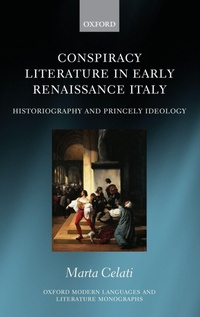
Conspiracy Literature in Early Renaissance Italy
Historiography and Princely Ideology
Published on 17. December 2020
Book
Hardback
308 pages
978-0-19-886362-5 (ISBN)
Description
Conspiracy has been a political phenomenon throughout history, relevant to any form of power from antiquity to the post-modern era. This means of resistance against power was prevalent during the Renaissance, and the Italian fifteenth century, in particular, can be regarded as an 'age of plots'. This book offers the first full-length investigation of Italian Renaissance literature on the topic of conspiracy. This literature covered a range of different genres and it enjoyed widespread diffusion during the second half of the fifteenth century, when the development of this literary production was connected with the affirmation of centralized political thought and princely ideology in Italian states. The centrality of conspiracies also emerges in the sixteenth century in Machiavelli's work, where the topic is closely interlaced with problems of building political consensus and management of power.
This volume presents case studies of the most significant humanist texts (representative of different states, literary genres, and of prominent authors--Alberti, Poliziano, Pontano--and minor, yet important, literati), and it also investigates Machiavelli's political and historical works. Through interdisciplinary analysis, this study traces the evolution of literature on plots in early Renaissance Italy. It points out the key function of the classical tradition and the recurring narrative approaches, the historiographical techniques, and the ideological angles that characterize the literary transfiguration of the topic. This volume also offers a reconsideration of the complex facets of humanist political literature that played a crucial role in the development of a new theory of statecraft.
This volume presents case studies of the most significant humanist texts (representative of different states, literary genres, and of prominent authors--Alberti, Poliziano, Pontano--and minor, yet important, literati), and it also investigates Machiavelli's political and historical works. Through interdisciplinary analysis, this study traces the evolution of literature on plots in early Renaissance Italy. It points out the key function of the classical tradition and the recurring narrative approaches, the historiographical techniques, and the ideological angles that characterize the literary transfiguration of the topic. This volume also offers a reconsideration of the complex facets of humanist political literature that played a crucial role in the development of a new theory of statecraft.
More details
Series
Language
English
Place of publication
Oxford
United Kingdom
Target group
Professional and scholarly
Illustrations
7 Illustrations
Dimensions
Height: 240 mm
Width: 161 mm
Thickness: 21 mm
Weight
628 gr
ISBN-13
978-0-19-886362-5 (9780198863625)
Copyright in bibliographic data and cover images is held by Nielsen Book Services Limited or by the publishers or by their respective licensors: all rights reserved.
Schweitzer Classification
Other editions
Additional editions
E-Book
12/2020
1st Edition
OUP eBook
€63.49
Available for download
E-Book
12/2020
1st Edition
OUP eBook
€63.49
Available for download
Person
Marta Celati is a Leverhulme Research Fellow at the University of Warwick, Centre for the Study of the Renaissance, and part-time Lecturer in Italian literature at the University of Oxford. She has worked as Teaching Fellow at the University of Pisa and in 2018 she was Frances Yates Fellow at the Warburg Institute. She was awarded a PhD in Italian Studies from the University of Oxford and a doctorate in Medieval and Humanist Philology from the University of Pisa. Her main research field is the Italian Renaissance, in particular political and historical literature. She has published a complete edition of Poliziano's Coniurationis commentarium (2015) and articles on various authors and topics, such as the classical legacy in humanist works, the art of printing in fifteenth-century Italy, and the interaction between literature and visual culture.
Content
Introduction
1: Orazio Romano's Porcaria: Humanist Epic as a Vehicle for Papal-Princely Ideology
2: Leon Battista Alberti's Porcaria coniuratio: The Epistle as Unresolved Reflection on the Political Plot
3: Giovanni Pontano's De bello Neapolitano: The Historia of the Conspiracy in Political Theory
4: Angelo Poliziano's Coniurationis commentarium: The Conspiracy Narrative as 'Official' Historiography
5: The Conspiracy Against the Prince: Political Perspectives and Literary Patterns in Texts on Plots
6: 'Congiure contro a uno principe': Machiavelli and Humanist Literature
Conclusion
1: Orazio Romano's Porcaria: Humanist Epic as a Vehicle for Papal-Princely Ideology
2: Leon Battista Alberti's Porcaria coniuratio: The Epistle as Unresolved Reflection on the Political Plot
3: Giovanni Pontano's De bello Neapolitano: The Historia of the Conspiracy in Political Theory
4: Angelo Poliziano's Coniurationis commentarium: The Conspiracy Narrative as 'Official' Historiography
5: The Conspiracy Against the Prince: Political Perspectives and Literary Patterns in Texts on Plots
6: 'Congiure contro a uno principe': Machiavelli and Humanist Literature
Conclusion