

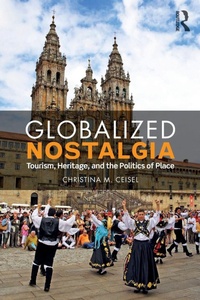
Globalized Nostalgia
Tourism, Heritage, and the Politics of Place
1st Edition
Published on 26. June 2018
Book
Paperback/Softback
152 pages
978-1-138-59353-4 (ISBN)
Description
In Globalized Nostalgia, Christina Ceisel shows how national identity is being remade for the global marketplace. Through media, cultural events, foodways, and personal narratives, we see how notions of the past are mobilized towards varied political, economic, and cultural ends.
In Galicia, Spain, Ceisel points towards tourism as one mode of cosmopolitan engagement, revisiting food festivals, wine tours, fishing excursions and reality television shows. She identifies globalized nostalgia as a feeling deeply connected to national identity - that these 'performances' of tourist activity rely on claims to an authentic past based on "heritage" for value to the consumer. While such strategies work to brand the nation, Ceisel demonstrates how they may also be employed towards emancipation and an inclusive participatory democracy.
Placing her own lived experience within the context of our historical present, relying on interpretive methods, including performance autoethnography, Ceisel highlights the tensions embedded in contemporary transnational cultural politics. Through the development of innovative methodological tools, Ceisel points towards new ways of thinking about the politics of belonging. Ultimately, Ceisel argues that we need to reorient our understandings of authenticity and heritage to accommodate the realities of hybridity and diaspora.
In Galicia, Spain, Ceisel points towards tourism as one mode of cosmopolitan engagement, revisiting food festivals, wine tours, fishing excursions and reality television shows. She identifies globalized nostalgia as a feeling deeply connected to national identity - that these 'performances' of tourist activity rely on claims to an authentic past based on "heritage" for value to the consumer. While such strategies work to brand the nation, Ceisel demonstrates how they may also be employed towards emancipation and an inclusive participatory democracy.
Placing her own lived experience within the context of our historical present, relying on interpretive methods, including performance autoethnography, Ceisel highlights the tensions embedded in contemporary transnational cultural politics. Through the development of innovative methodological tools, Ceisel points towards new ways of thinking about the politics of belonging. Ultimately, Ceisel argues that we need to reorient our understandings of authenticity and heritage to accommodate the realities of hybridity and diaspora.
More details
Series
Language
English
Place of publication
London
United Kingdom
Publishing group
Taylor & Francis Ltd
Target group
College/higher education
Illustrations
32 s/w Abbildungen, 32 s/w Photographien bzw. Rasterbilder
32 Halftones, black and white; 32 Illustrations, black and white
Dimensions
Height: 229 mm
Width: 152 mm
Thickness: 9 mm
Weight
251 gr
ISBN-13
978-1-138-59353-4 (9781138593534)
Copyright in bibliographic data and cover images is held by Nielsen Book Services Limited or by the publishers or by their respective licensors: all rights reserved.
Schweitzer Classification
Other editions
Additional editions
E-Book
06/2018
1st Edition
Routledge
€60.49
Available for download
E-Book
06/2018
1st Edition
Routledge
€60.49
Available for download
Book
06/2018
1st Edition
Routledge
€205.10
Shipment within 10-20 days
Person
Christina M. Ceisel is Assistant Professor of Communications at California State University, Fullerton. She holds her Ph.D. from the University of Illinois at Urbana-Champaign, and a M.A. from the University of Chicago.
Content
Preface
1. Introduction: The City of Culture
2. The Library and Archive of Galicia: Memory, Heritage, and History
3. Gaias Center Museum: Cultural Performances
4. Center for Creative Enterprising of Galicia: Transnational Commodity Culture
5. Centre for Cultural Innovation: Cultural Policymaking
6. Conclusion: Cantina
Bibliography
1. Introduction: The City of Culture
2. The Library and Archive of Galicia: Memory, Heritage, and History
3. Gaias Center Museum: Cultural Performances
4. Center for Creative Enterprising of Galicia: Transnational Commodity Culture
5. Centre for Cultural Innovation: Cultural Policymaking
6. Conclusion: Cantina
Bibliography