

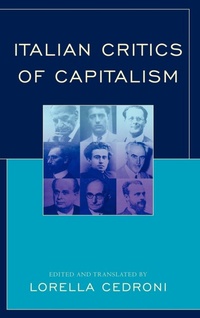
Italian Critics of Capitalism
Published on 31. March 2010
Book
Hardback
190 pages
978-0-7391-4234-9 (ISBN)
Description
Over the last hundred years the history of capitalism hardly supports the idea of a dynamic equilibrium between democracy and capitalism. The unprecedented triumph of global capitalism and its stronger power of transformation are changing the nature of political community and its institutions, transforming the conditions of democratic politics and governance. The writings collected in this volume present leading statements of theories of democracy and capitalism in Italy starting from Vilfredo Pareto who firstly focused on the transformation of democracy into a plutocracy in which vested interests use the government as a tool for their own profit, until Norberto Bobbio who expressed a strong defence of democracy and a deep critique of capitalism.
As Marx, Weber, and Schumpeter-from different perspectives-have pointed out capitalism rather then just an economic mode of organization, is a "mentality", a "social logic", a "form of living", that influences and reshapes political structures, and culture. The globalized economic order is challenging the foundations and political principles upon which liberal democracy is based. Global markets have unleashed economic forces that are becoming too powerful for democratic institutions to control. Even if the formal elements of democracy still survive, the "government by the people, for the people" is declining; elections, debates, parties, are evacuated, and bypassed by new, less accountable processes.
As Marx, Weber, and Schumpeter-from different perspectives-have pointed out capitalism rather then just an economic mode of organization, is a "mentality", a "social logic", a "form of living", that influences and reshapes political structures, and culture. The globalized economic order is challenging the foundations and political principles upon which liberal democracy is based. Global markets have unleashed economic forces that are becoming too powerful for democratic institutions to control. Even if the formal elements of democracy still survive, the "government by the people, for the people" is declining; elections, debates, parties, are evacuated, and bypassed by new, less accountable processes.
Reviews / Votes
Lorella Cedroni's book offers an excellent opportunity for English-speaking readers to follow the dialog between Italian intellectuals about the relationship (positive or negative) between capitalism and democracy. Cedroni has skillfully drawn out the main themes and positions in this debate, illustrating them with essays by such writers as Pareto, Gramsci, and Bobbio. -- Martin Staniland, University of PittsburghMore details
Language
English
Place of publication
United States
Publishing group
Bloomsbury Publishing Plc
Target group
Professional and scholarly
Dimensions
Height: 235 mm
Width: 157 mm
Thickness: 15 mm
Weight
434 gr
ISBN-13
978-0-7391-4234-9 (9780739142349)
Copyright in bibliographic data and cover images is held by Nielsen Book Services Limited or by the publishers or by their respective licensors: all rights reserved.
Schweitzer Classification
Other editions
Additional editions
Persons
Lorella Cedroni is an associate professor of Political Philosophy at the University of Rome.
Content
Chapter 1 IntroductionTheories of Democracy and Capitalism in Twentieth-Century Italy
Chapter 2 Chapter 1: The Transformation of Democracy and the Plutocratic Cycle
Chapter 3 Chapter 2: The Mystification of Capitalism
Chapter 4 Chapter 3: Economy of Competition and Historical Capitalism
Chapter 5 Chapter 4: The Revolution Against Capital and the Crisis of the Capitalist System
Chapter 6 Chapter 5: Liberal Socialism and Modern Capitalist Society
Chapter 7 Chapter 6: The Reform of Society in the European Perspective
Chapter 8 Chapter 7: Capital
Chapter 9 Chapter 8: The Autonomous Order of Economy
Chapter 10 Chapter 9: The Economic and Political Powers in the Capitalistic System
Chapter 11 Chapter 10: The Future of Democracy and Capitalism
Chapter 12 Chapter 11: The Capitalist Actors and Their Social Role
Chapter 13 Chapter 12: Toward a New Critique of Capitalism
Chapter 14 Chapter 13: Rethinking Democracy in the Age of Globalization
Chapter 2 Chapter 1: The Transformation of Democracy and the Plutocratic Cycle
Chapter 3 Chapter 2: The Mystification of Capitalism
Chapter 4 Chapter 3: Economy of Competition and Historical Capitalism
Chapter 5 Chapter 4: The Revolution Against Capital and the Crisis of the Capitalist System
Chapter 6 Chapter 5: Liberal Socialism and Modern Capitalist Society
Chapter 7 Chapter 6: The Reform of Society in the European Perspective
Chapter 8 Chapter 7: Capital
Chapter 9 Chapter 8: The Autonomous Order of Economy
Chapter 10 Chapter 9: The Economic and Political Powers in the Capitalistic System
Chapter 11 Chapter 10: The Future of Democracy and Capitalism
Chapter 12 Chapter 11: The Capitalist Actors and Their Social Role
Chapter 13 Chapter 12: Toward a New Critique of Capitalism
Chapter 14 Chapter 13: Rethinking Democracy in the Age of Globalization