

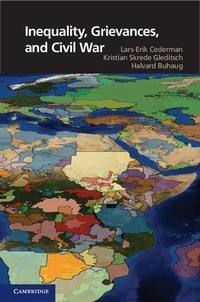
Inequality, Grievances, and Civil War
Published on 26. August 2013
Book
Hardback
276 pages
978-1-107-01742-9 (ISBN)
Description
This book argues that political and economic inequalities following group lines generate grievances that in turn can motivate civil war. Lars-Erik Cederman, Kristian Skrede Gleditsch, and Halvard Buhaug offer a theoretical approach that highlights ethnonationalism and how the relationship between group identities and inequalities are fundamental for successful mobilization to resort to violence. Although previous research highlighted grievances as a key motivation for political violence, contemporary research on civil war has largely dismissed grievances as irrelevant, emphasizing instead the role of opportunities. This book shows that the alleged non-results for grievances in previous research stemmed primarily from atheoretical measures, typically based on individual data. The authors develop new indicators of political and economic exclusion at the group level, and show that these exert strong effects on the risk of civil war. They provide new analyses of the effects of transnational ethnic links and the duration of civil wars, and extended case discussions illustrating causal mechanisms.
Reviews / Votes
'The role of grievances in insurgency and civil war has had a roller coaster career since the 1970s. Once regarded as prime causes of these conflicts, grievances subsequently were shelved in favor of factors like resources, political opportunities, and state capacity. Inequality, Grievances, and Civil War makes a persuasive case that the literature has thrown the baby out with the bath water. Based on the methodologically sophisticated analysis of comprehensive new cross-national databases, Cederman and his associates reinstate the causal priority of shared grievances in explaining civil war - an achievement that has profound policy implications. A must-read for scholars of civil conflict.' Michael Hechter, Arizona State University and the University of Copenhagen 'The cross-national study of civil wars built its initial reputation on two striking claims. First, civil conflict is driven more by opportunities and less by grievances. Second, ethnic diversity is not a driver of violent civil conflict. A long and inconclusive debate followed and several major studies were conducted to probe these initial findings. Inequality, Grievances, and Civil War provides very robust evidence in support of the claim that grievances do matter after all and that ethnicity is a key driver of conflict when conceptualized in terms of the inequalities between ethnic groups. This is a major contribution that will shape research on civil conflict in a decisive way.' Stathis Kalyvas, Yale University, Connecticut 'Over the past many years, political scientists and economists have tried to evaluate group-level grievances through demographic measures such as fractionalization and polarization. Cederman, Gleditsch, and Buhaug first show why these measures fail to capture the force of political and economic exclusion and the logic of nationalism. Then they create new conceptualizations and corresponding measures, and collect a massive amount of appropriate and detailed data to test their hypotheses. The end result is a convincing argument that specifies the power of ethnic group grievances in the onset of conflict as well as its duration and outcomes. For both substantive and methodological reasons, this book should be required reading in classes on ethnic politics and ethnic conflict.' Roger Petersen, Arthur and Ruth Sloan Professor of Political Science, Massachusetts Institute of Technology 'In contrast to many contemporary analyses of violent conflict, this brilliant book takes the expressed motives of conflict participants seriously as well as the evident identity basis of most civil wars. It confirms the view that political and economic horizontal inequalities are a fundamental cause of conflict. The book is a refreshing challenge to both those who take a Hobbesian view of human nature and those who assume that individual greed is an all-embracing motive.' Frances Stewart, University of OxfordMore details
Series
Language
English
Place of publication
Cambridge
United Kingdom
Target group
Professional and scholarly
Illustrations
17 Tables, unspecified; 39 Line drawings, unspecified
Dimensions
Height: 235 mm
Width: 157 mm
Thickness: 21 mm
Weight
603 gr
ISBN-13
978-1-107-01742-9 (9781107017429)
Copyright in bibliographic data and cover images is held by Nielsen Book Services Limited or by the publishers or by their respective licensors: all rights reserved.
Schweitzer Classification
Other editions
Additional editions
Lars-Erik Cederman | Kristian Skrede Gleditsch | Halvard Buhaug
Inequality, Grievances, and Civil War
Book
08/2013
Cambridge University Press
€36.80
Shipment within 15-20 days
Lars-Erik Cederman
Inequality, Grievances, and Civil War
E-Book
08/2013
Cambridge University Press
€24.49
Available for download
Lars-Erik Cederman | Kristian Skrede Gleditsch | Halvard Buhaug
Inequality, Grievances, and Civil War
E-Book
06/2013
1st Edition
Cambridge University Press
€29.49
Available for download
Persons
Lars-Erik Cederman is Professor of International Conflict Research at the Center for Comparative and International Studies at ETH Zuerich. His research interests include conflict processes related to ethnicity, nationalism, democratization and state formation. He is the author of Emergent Actors in World Politics: How States and Nations Develop and Dissolve (1997), the editor of Constructing Europe's Identity: The External Dimension (2001) and co-editor of New Systems Theories of World Politics (with Mathias Albert and Alexander Wendt, 2010). He is the winner of the 2012 and 2002 American Political Science Association's Heinz I. Eulau Awards (in 2012 with Kristian Skrede Gleditsch and Nils B. Weidmann), the 2000 Furniss Award for Emergent Actors in World Politics, and the Horace H. Rackham Distinguished Dissertation Award from the University of Michigan. Kristian Skrede Gleditsch is Professor in the Department of Government, University of Essex, and a Research Associate at the Centre for the Study of Civil War, Peace Research Institute Oslo. His research interests include conflict and cooperation, democratization, and spatial dimensions of social and political processes. He is the author of All International Politics is Local: The Diffusion of Conflict, Integration, and Democratization (2002) and Spatial Regression Models (2008), as well as numerous journal articles. He is the winner of the 2012 American Political Science Association's Heinz I. Eulau Award (with Lars-Erik Cederman and Nils B. Weidmann), the 2011 International Association for Conflict Management outstanding article in the field award (with David E. Cunningham and Idean Salehyan), the 2007 Karl Deutsch Award from International Studies Association, and the 2000 American Political Science Association's Helen Dwight Reid Award. Halvard Buhaug is Research Professor at the Peace Research Institute Oslo (PRIO) and Professor of Political Science at the Norwegian University of Science and Technology. He is also coordinator of PRIO's Research Group on the Environment. His research interests include use of geographic information systems in conflict research, local dimensions of armed conflict, and security implications of climate change. In 2006, he received the Royal Norwegian Society of Sciences and Letters award for excellent research by young scholars in human sciences for work on geographical aspects of civil war. Recent academic publications include articles in the Journal of Conflict Resolution, Global Environmental Change, International Security, International Studies Quarterly, International Organization, Political Geography, and Proceedings of the National Academy of Sciences of the USA.
Content
1. Introduction; Part I. Theories and Concepts: 2. Inequality and grievances in the civil war literature; 3. From horizontal inequality to civil war via grievances; Part II. Analyzing the Outbreak of Civil War: 4. Political exclusion and civil war; 5. Economic inequality and civil war; 6. Transborder ethnic kin and civil war; 7. Country-level inequalities and civil war; Part III. Beyond Civil War Onset: 8. Political exclusion and the duration and outcomes of civil war; 9. Conclusions for theory and policy.