

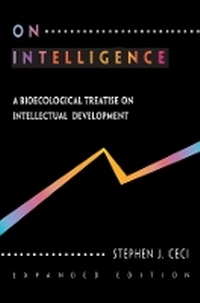
On Intelligence
A Biological Treatise on Intellectual Development, Expanded Edition
2nd Edition
Published on 1. September 1996
Book
Paperback/Softback
312 pages
978-0-674-63456-5 (ISBN)
Description
Ceci argues that traditional conceptions of intelligence ignore the role of society in shaping intelligence and underestimate the intelligence of non-Western societies. He puts forth a "bio-ecological" framework of individual differences in intellectual development that is intended to address some of the major deficiencies of extant theories of intelligence. The focus is on alternative interpretations of phenomena that emerge when implicit assumptions of intelligence researchers are challenged.
Reviews / Votes
An exciting book as well as an important one...It strikes a fatal blow to the idea that a construct of general intelligence can play an important role in our efforts to understand why people differ in their intellectual abilities. -- Michael J. A. Howe * British Journal of Educational Psychology * A very ambitious book...Ceci himself eschews the word intelligence, preferring the term cognitively complex behavior...The efficiency of Ceci's cognitive processing of all this knowledge is unmatched. Certainly, if we equate intelligence with cognitively complex behavior, whatever Ceci's own feeling about the term, [this book] is probably the most intelligent book on the topic. -- Carmi Schooler * Applied Cognitive Psychology Journal * Densely packed with important information and fascinating insights. -- Richard K. Wagner * Merrill-Palmer Quarterly *More details
Edition
2nd Enlarged edition
Language
English
Place of publication
Cambridge, Mass
United States
Target group
College/higher education
Professional and scholarly
Edition type
Enlarged edition
Illustrations
9 line illustrations, 4 tables
Dimensions
Height: 235 mm
Width: 156 mm
Weight
499 gr
ISBN-13
978-0-674-63456-5 (9780674634565)
Copyright in bibliographic data and cover images is held by Nielsen Book Services Limited or by the publishers or by their respective licensors: all rights reserved.
Schweitzer Classification
Other editions
Additional editions
E-Book
07/2009
Harvard University Press
€33.49
Available for download
Person
Stephen J. Ceci is Helen L. Carr Professor of Psychology at Cornell University.
Content
Preface, 1996 Preface to the Original Edition Acknowledgments PART 1: SOCIAL CONTEXT AND INTELLECTUAL DEVELOPMENT 1. Why a Treatise on Intelligence? Five Easy Facts Old Wine in New Bottles? Traditional Psychological Theories of Intelligence About the Rest of This Book 2. Toward an Inductive Theory of Intellectual Complexity Toward a Developmental Framework Terminological Considerations Elaborated Knowledge Structures Versus Cognitive Processes Knowledge Versus Intelligence 3. Mismatches Between Intelligent Peformance and IQ Cultural Anthropology Grocery Shopping Dairy Workers !Kung San Hunters Experimental Psychology Cupcake Baking Capturing Butterflies City Manager A Day at the Races 4. A Social-Organizational Analysis of Intellectual Development Social Class and IQ Motivational Values Inculcated Through Parenting SAT Scores and Academic Achievement Income and SATs: One Interpretation Income and SATs: An Alternate Interpretation The Terman Study of Genius The Validity of IQ Convergence from Recent Life Course Analyses Thirtysomething: To Be Born Rich or Smart 5. The Impact of Schooling on Intelligence Correlation Between IQ and Years in School Influence of Summer Vacation on IQ Continuous Impact of Schooling on IQ Impact of Delayed Schooling on IQ School Achievement versus Aptitude Influence of Early Termination of Schooling on IQ Influence of Northern Schooling on Black IQ Influence of Early School Entry on Cognitive Development Influence of Intergenerational Changes in Schooling Quality of Schooling Schooling and Information Processing Perceptual Abilities Concept Formation Memory Other Cognitive Skills Taking Stock PART 2: THE BIOECOLOGICAL FRAMEWORK 6. The Role of Context in Shaping Multiple Intelligences Contextualism and Intelligence Cognitive Molecules Out of Context Culture's Role A Bioecological Theoretical Framework Introducing the Bioecological View Multiple Cognitive Potentials Pitting g Against a Multiple Potential Perspective Central Processing Capacity The Problem with Factors Contexts of Crystallization Motives as Crystallizing Agents Environmental Challenges Knowledge versus Intelligence Some Illustrative Anecdotes Knowledge and Process in Symbiosis 7. A Model of Cognitive Complexity Evaluating the Bioecological Framework vis--a--vis Classic Forms of Evidence: The Case of Heritability Genetics Methods of Estimating h2 The Stability, Nature, and Meaning of h2 The Assumption of Additivity Differences Between Correlations and Means Confounding Genetic and Ecological Sources of Shared Variance 8. The Fallacy: Biology = IQ = Intelligence = Singularity of Mind = Real--World Success Cross--Task Commonality The Role of Task Complexity g and job Success Positive Manifold Same--Different Judgments The Role of Practice Age of Aquisition and Memory 9. How Abstract Is Intelligence? The Relationship Between Intelligence and Abstraction Transfer Within and Across Domains Abstractness Defined The Role of Knowledge in Abstraction Race and Abstraction: The Jensen Study Generality The Effect of Training on Transfer Transfer and Cross-Task Correlations The Problem of Problem Isomorphs 10. Taking Stock of the Options Contrasting the Bioecological Framework with Existing Theories Contextualist Theories Information Processing Theory Structural Theories: Piaget's Theory and Case's Theory Case's Theory of Intellectual Development Knowledge-based Theories of Intellectual Development Theories of Multiple Intelligences Sternberg1s Triarchic Theory Modularity Theories Caveat Lector Epilogue Endnotes References Subject Index