

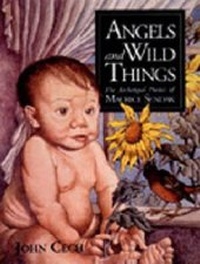
Angels and Wild Things
The Archetypal Poetics of Maurice Sendak
Published on 8. January 1996
Book
Hardback
304 pages
978-0-271-00949-0 (ISBN)
Description
Over the course of more than eighty books that he has written and illustrated in a career that has spanned four decades, Maurice Sendak has become the most influential and, at times, the most controversial creator of works for children. Each of the books in his trilogy-Where the Wild Things Are, In the Night Kitchen, and Outside Over There-has been precedent-setting, dramatically expanding the boundaries of subject matter and images that have been conventionally accepted in books for younger children. In this first comprehensive reading of Sendak's key works, John Cech considers the symbolic child who has appeared and developed in Sendak's books and remains at the center of his vision.
By fusing biographical, historical, cultural, and literary materials with the insights of depth psychology and archetypal theory, this study traces the evolution of Sendak's work-from its first, bold steps in the 1950s, to its liberating breakthroughs of the 1960s and early 1970s, to the rich complexity of his most recent books. Though touching on many of the works that Sendak has been involved with, Cech concentrates on those books that Sendak has both written and illustrated. It is in these books that we can see most clearly the poesis of Sendak's art, the alchemy of his creative process that has woven together the remembrances of his own things past, the spirit of his times, the history of children's literature, and Sendak's animating concern with the archetypal figure of the child-a symbol of creative potential, emotional vitality, and spiritual renewal.
By fusing biographical, historical, cultural, and literary materials with the insights of depth psychology and archetypal theory, this study traces the evolution of Sendak's work-from its first, bold steps in the 1950s, to its liberating breakthroughs of the 1960s and early 1970s, to the rich complexity of his most recent books. Though touching on many of the works that Sendak has been involved with, Cech concentrates on those books that Sendak has both written and illustrated. It is in these books that we can see most clearly the poesis of Sendak's art, the alchemy of his creative process that has woven together the remembrances of his own things past, the spirit of his times, the history of children's literature, and Sendak's animating concern with the archetypal figure of the child-a symbol of creative potential, emotional vitality, and spiritual renewal.
Reviews / Votes
"John Cech has written an extremely valuable and critically important book which is both thoughtful and timely. Given the place of Sendak in children's literature, Cech's book will become a standard work of criticism in the field."-Jan Susina, Illinois State UniversityMore details
Language
English
Place of publication
Pennsylvania
United States
Target group
College/higher education
Professional and scholarly
Illustrations
13 Halftones, color; 119 Halftones, black and white
Dimensions
Height: 279 mm
Width: 216 mm
Thickness: 23 mm
Weight
1560 gr
ISBN-13
978-0-271-00949-0 (9780271009490)
Copyright in bibliographic data and cover images is held by Nielsen Book Services Limited or by the publishers or by their respective licensors: all rights reserved.
Schweitzer Classification
Other editions
New editions
Book
06/2013
2nd Edition
Pennsylvania State University Press
€40.84
Article not available at the moment
Person
John Cech is Associate Professor of English at the University of Florida, editor of American Writers for Children, 1900-1960, volume 22 in the Dictionary of Literary Biography series, and a past president of the Children's Literature Association. His two most recent children's books are Django (with Sharon McGinley-Nally) and Jacque-Henri Lartigue: Boy with a Camera (1994).