

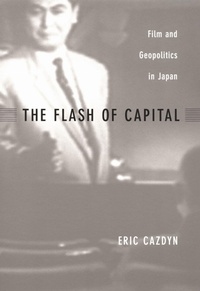
The Flash of Capital
Film and Geopolitics in Japan
Will be published approx. on 4. November 2002
Book
Hardback
328 pages
978-0-8223-2912-1 (ISBN)
Description
The Flash of Capital analyzes the links between Japan's capitalist history and its film history, illuminating what these connections reveal about film culture and everyday life in Japan. Looking at a hundred-year history of film and capitalism, Eric Cazdyn theorizes a cultural history that highlights the spaces where film and the nation transcend their customary borders-where culture and capital crisscross-and, in doing so, develops a new way of understanding historical change and transformation in modern Japan and beyond.
Cazdyn focuses on three key moments of historical contradiction: colonialism, post-war reconstruction, and globalization. Considering great classics of Japanese film, documentaries, works of science fiction, animation, and pornography, he brings to light cinematic attempts to come to terms with the tensions inherent in each historical moment-tensions between the colonizer and the colonized, between the individual and the collective, and between the national and the transnational. Paying close attention to political context, Cazdyn shows how formal inventions in the realms of acting, film history and theory, thematics, documentary filmmaking, and adaptation articulate a struggle to solve implacable historical problems. This innovative work of cultural history and criticism offers explanations of historical change that challenge conventional distinctions between the aesthetic and the geopolitical.
Cazdyn focuses on three key moments of historical contradiction: colonialism, post-war reconstruction, and globalization. Considering great classics of Japanese film, documentaries, works of science fiction, animation, and pornography, he brings to light cinematic attempts to come to terms with the tensions inherent in each historical moment-tensions between the colonizer and the colonized, between the individual and the collective, and between the national and the transnational. Paying close attention to political context, Cazdyn shows how formal inventions in the realms of acting, film history and theory, thematics, documentary filmmaking, and adaptation articulate a struggle to solve implacable historical problems. This innovative work of cultural history and criticism offers explanations of historical change that challenge conventional distinctions between the aesthetic and the geopolitical.
Reviews / Votes
"Cazdyn's work is original, unique, and provocative. He asks hard questions, makes surprising connections, and as a result forces us to rethink the relationship of the aesthetic and the social in Japanese modernity."-Mitsuhiro Yoshimoto, author of Kurosawa: Film Studies and Japanese Cinema"This book redesigns the way in which Japanese cinema must be approached, taking into account the 'longer term' dynamics of economic formations as well as the way Japan is stitched into 'global' contemporary processes."-Paul Willemen, author of Looks and Frictions: Essays in Cultural Studies and Film Theory
More details
Series
Language
English
Place of publication
North Carolina
United States
Target group
Professional and scholarly
Product notice
Cloth over boards
Illustrations
72 illus.
Dimensions
Height: 238 mm
Width: 156 mm
Thickness: 29 mm
Weight
630 gr
ISBN-13
978-0-8223-2912-1 (9780822329121)
Copyright in bibliographic data and cover images is held by Nielsen Book Services Limited or by the publishers or by their respective licensors: all rights reserved.
Schweitzer Classification
Other editions
Additional editions
E-Book
11/2002
1st Edition
De Gruyter
€208.99
Available for download
Person
Eric Cazdyn is Assistant Professor of East Asian Studies, Film, and Comparative Literature at the University of Toronto.
Content
Illustrations
Acknowledgments
Introduction
I. Relation: Film, Capital, Transformation
II. Historiography: Nation, Narrative, Capital
III. Adaptation: Origin, Nation, Aesthetic
IV. Acting: Structure, Agent, Amateur
V. Pornography: Totality, Reality Culture, Films of History
VI. Re-reading: Canon, Body, Geopolitics
Epilogue
Notes
References
Index
Acknowledgments
Introduction
I. Relation: Film, Capital, Transformation
II. Historiography: Nation, Narrative, Capital
III. Adaptation: Origin, Nation, Aesthetic
IV. Acting: Structure, Agent, Amateur
V. Pornography: Totality, Reality Culture, Films of History
VI. Re-reading: Canon, Body, Geopolitics
Epilogue
Notes
References
Index