

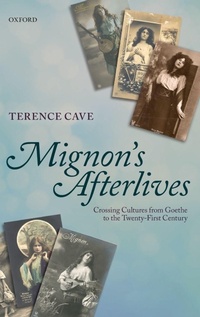
Mignon's Afterlives
Crossing Cultures from Goethe to the Twenty-First Century
Published on 22. September 2011
Book
Hardback
328 pages
978-0-19-960480-7 (ISBN)
Description
By tracing the afterlives of Mignon, an apparently minor character in Goethe's novel Wilhelm Meisters Lehrjahre, Terence Cave explores a phenomenal success story in the history of literature and music, and more broadly of cultural history. Mignon steps out of the shadow of its protagonist Wilhelm and fashions a destiny of her own: she becomes the object of an obsessive interest that reached its peak in the later nineteenth century but continues to reverberate into the twenty-first century.
Mignon reappears - often as a character bearing a different name but sharing an unmistakable family resemblance with her - in a wide range of different literary works from Goethe himself via the German Romantic Novel, Mme de Stael, George Sand, Nerval and Baudelaire, Walter Scott and George Eliot to Gerhart Hauptmann and Angela Carter. Her songs, set by dozens of composers from Reichardt and Beethoven to Wolf, reverberated through the drawing-rooms and concert-halls of nineteenth-century Europe. She is the heroine of the most popular French opera of the late nineteenth century, and she has featured in a number of films. She is fascinating because she is poised on the threshold between childhood and adolescence, aphasia and expressive power, words and music; she is a wanderer who has lost her home, an exile who has been abducted and abused; and the many stories in which her life is reenacted provide a litmus test for key cultural values of the nineteenth and twentieth centuries.
Mignon reappears - often as a character bearing a different name but sharing an unmistakable family resemblance with her - in a wide range of different literary works from Goethe himself via the German Romantic Novel, Mme de Stael, George Sand, Nerval and Baudelaire, Walter Scott and George Eliot to Gerhart Hauptmann and Angela Carter. Her songs, set by dozens of composers from Reichardt and Beethoven to Wolf, reverberated through the drawing-rooms and concert-halls of nineteenth-century Europe. She is the heroine of the most popular French opera of the late nineteenth century, and she has featured in a number of films. She is fascinating because she is poised on the threshold between childhood and adolescence, aphasia and expressive power, words and music; she is a wanderer who has lost her home, an exile who has been abducted and abused; and the many stories in which her life is reenacted provide a litmus test for key cultural values of the nineteenth and twentieth centuries.
Reviews / Votes
delightfully informative, leisurely, and sophisticated ... the scope of the investigation is impressively broad * David Baguley, French Studies *More details
Language
English
Place of publication
Oxford
United Kingdom
Target group
Professional and scholarly
Illustrations
Frontispiece and 16 pp plates
Dimensions
Height: 240 mm
Width: 161 mm
Thickness: 22 mm
Weight
663 gr
ISBN-13
978-0-19-960480-7 (9780199604807)
Copyright in bibliographic data and cover images is held by Nielsen Book Services Limited or by the publishers or by their respective licensors: all rights reserved.
Schweitzer Classification
Person
Terence Cave is Emeritus Professor of French Literature in the University of Oxford and Emeritus Research Fellow of St John's College, Oxford. He is a Fellow of the British Academy and Honorary Fellow of Gonville and Caius College, Cambridge, and of Queen Mary, University of London, and he holds an Honorary D.Litt. at the University of London (Royal Holloway). He is known for his studies The Cornucopian Text: Problems of Writing in the French Renaissance (Clarendon Press, 1979) and Recognitions: A Study in Poetics (Oxford University Press, 1988), but has written widely on early modern French literature and on the history of poetics. In 2009 he was awarded the Balzan Prize for Literature since 1500, and he is currently director of the Balzan interdisciplinary project Literature as an Object of Knowledge based at the St John's College Research Centre in Oxford. In the context of that project, he is exploring the value of cognitive approaches to literary study.
Content
LIST OF ILLUSTRATIONS; PREFACE; INTRODUCTION