

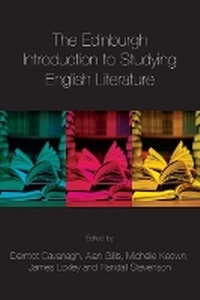
The Edinburgh Introduction to Studying English Literature
Published on 13. April 2010
Book
Paperback/Softback
248 pages
978-0-7486-4025-6 (ISBN)
Description
What does university study of English Literature involve today? How should students read literary texts? Answers to these questions have substantially changed and developed over recent decades, often in response to advances in literary theory.In the light of this and other recent developments, the Edinburgh Introduction provides a new, updated guide for students beginning their study of literature today. Recent developments in theory are explained throughout, but they are not the only focus of attention. Instead, the emphasis is on clear, pragmatic explanation of critical practices, and of literary forms, styles and techniques. These explanations are carefully illustrated through examples taken from readily-available works - usually ones included in the Norton or other major anthologies. Each chapter is written by an experienced academic and teacher from Edinburgh University's Department of English Literature, recently reaffirmed as one of the best in the United Kingdom.The result is an unbeatable resource for new students: a well-stocked toolbox, offering foundational introductions to ways literary texts can be approached, and to the critical, formal and historical understanding this requires. New students will find essential insights on every page, guiding their understanding for years to come and thoroughly opening up for them all the imaginative promise of literary study. Key Features:* An up-to-the minute foundational guide for new students * Comprehensive range of literary forms, styles and critical strategies introduced* Careful exemplification, demonstrating reading strategies at work * Based on successful introductory courses in one of the UK's leading university literature departments* The texts discussed in the book generally appear in the Norton Anthology of English Literature
Reviews / Votes
An up-to-date guide for students Each chapter is contributed by leading scholars from the University of Edinburgh. Times Higher Education An up-to-date guide for students Each chapter is contributed by leading scholars from the University of Edinburgh.More details
Language
English
Place of publication
Edinburgh
United Kingdom
Target group
College/higher education
Dimensions
Height: 234 mm
Width: 156 mm
Weight
382 gr
ISBN-13
978-0-7486-4025-6 (9780748640256)
Copyright in bibliographic data and cover images is held by Nielsen Book Services Limited or by the publishers or by their respective licensors: all rights reserved.
Schweitzer Classification
Other editions
New editions
Dermot Cavanagh | Alan Gillis | Michelle Keown
The Edinburgh Introduction to Studying English Literature
Book
04/2014
2nd Edition
Edinburgh University Press
€25.50
Shipment within 15-20 days
Persons
Dermot Cavanagh is Senior Lecturer in English at the University of Edinburgh. His interests centre on early modern political theatre, especially its relationship to late medieval drama and poetry. He is the author of Language and Politics in the Sixteenth-Century History Play (Palgrave Macmillan, 2003) and co-editor of Shakespeare's Histories and Counter-Histories (Manchester University Press, 2006). Alan Gillis teaches creative writing as well as modern and contemporary poetry at the University of Edinburgh. Alan Gillis's first book of poetry Somebody, Somewhere (Gallery Press, 2004) was shortlisted for the Irish Times Award and won The Rupert and Eithne Strong Award for Best First Collection in Ireland. His second book Hawks and Doves (Gallery Press, 2007) was a Poetry Book Society Recommendation and was shortlisted for the T. S. Eliot Prize. As a critic, he is author of Irish Poetry of the 1930s (Oxford University Press, 2005) and is currently co-editing The Oxford Handbook of Modern Irish Poetry. Michelle Keown is Lecturer in English Literature and the University of Edinburgh and specialises in Postcolonial literature and theory, particularly that of the Pacific region. She has published widely on Maori and Pacific writing and is the author of Postcolonial Pacific Writing: Representations of the Body (Routledge, 2005) and Pacific Islands Writing: The Postcolonial Literatures of Aotearoa/New Zealand and Oceania (Oxford University Press, 2007). She is co-editor (with David Murphy and James Procter) of Comparing Postcolonial Diasporas (Palgrave, 2009) and has edited (with Stuart Murray) a special issue of the Journal of New Zealand Literature (no. 21, 2003) focusing upon diasporic connections between Aotearoa/New Zealand and the UK. James Loxley works on Renaissance and early modern poetry and drama, especially the work of Ben Jonson; the literature and political discourse of the civil war period and the writing of Andrew Marvell; and contemporary literary theory, particularly issues of performativity. Randall Stevenson is Professor of Twentieth-Century Literature at the University of Edinburgh. Born in the north of Scotland, grew up in Glasgow and studied in the universities of Edinburgh and Oxford. Lectured on modern literature in 15 countries in Europe and in Nigeria, South Korea and Egypt. General Editor of the Edinburgh History of Twentieth-Century Literature in Britain series.
Editor
Senior Lecturer in EnglishUniversity of Edinburgh
Lecturer in English Literature and Creative WritingUniversity of Edinburgh
Lecturer in English LiteratureUniversity of Edinburgh
Senior Lecturer in English LiteratureUniversity of Edinburgh
Professor of Twentieth-Century LiteratureUniversity of Edinburgh
Content
Section I; Introductory, ed. James Loxley; 1. What is Literature?, Alex Thomson; 2. English Literary Studies: Origins and Nature, Bob Irvine; 3. Kinds of Literature, David Salter; Section II - Poetry, ed. Alan Gillis; 1. Poetry: An Introduction, Alan Gillis; 2. Metre and Rhythm, Lee Spinks; 3. Poetic Imagery, Sarah Dunnigan; 4. Verse Forms, Penny Fielding; 5. Vernacular Poetry, Colin Nicholson; 6. Poetry and History, Greg Walker; Section III - Narrative, ed. Michelle Keown; 1. Kinds of Fiction, Aaron Kelly; 2. Prose/Short Story, Ken Millard; 3. Narrators, Michele Mendelssohn; 4. Narrative Language, Keith Hughes; 5. Constructing Character, Raj Chakraborti; 6. Life Writing, Laura Marcus; Section IV - Drama, ed. Dermot Cavanagh; 1. Introducing Drama, Roger Savage; 2. Text and Performance, Olga Taxidou; 3. Comedy, Jonathan Wild; 4. Tragedy, Simon Malpas; 5. History and Politics, Dermot Cavanagh; 6. Gender and Performance, Suzanne Trill; Annotated Bibliography; Index.