

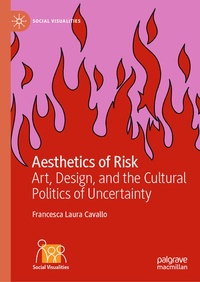
Aesthetics of Risk
Description
This book explores the central role of art and design in shaping risk perceptions and behaviours. Guidance, warnings, and protocols of risk management shape how possible futures are imagined and governed. How is this imperative to manage risk transforming contemporary visual language? Are its rhetorics of danger, reassurance, and rationality convincing us that we are prepared-and at what cost? Through the analysis of artworks, warnings, pre-enactments, and data visualisations, the book examines the aesthetic dimension of risk as a diagnostic framework for articulating, narrating, and living with uncertainty. Bringing visual culture into dialogue with risk studies, it reimagines fairer, engaging, and trustworthy ways of communicating and preparing for risk.
Reviews / Votes
"Risk is as much a sensory and aesthetic experience as it is an anticipatory condition. In
Aesthetics of Risk
, Francesca Laura Cavallo eloquently demonstrates how perceptions of safety or threats materialise across aesthetic dimensions, from safety manuals and data visualisations to survival guides and instructions for surviving disasters. This is an essential contribution to broadening our understandings of risk landscapes." (Jennifer Gabrys, Professor, University of Cambridge, UK)
"
Aesthetics of Risk
by Francesca Laura Cavallo faces forwards as well as looking back. It offers a sense of how the future of risk and its management (perhaps still conceived as the making of safe spaces) can be harnessed to, or at least comprehended by, modes of accommodation and social amelioration. It questions how we might shore-up 'the predictive vocabulary of risk' against both the predatory and unknowable." (John C. Welchman, Distinguished Professor of Art History, University of California, USA)
"Risk is hard to define yet is often best conveyed via visual language. This essential book provides a critical review of scholars and practitioners approaches to risks by examining visual aesthetics and performative rhetoric throughout history, right though to contemporary existential risks. By working across disciplinary silos and a wide range of artists and tools ranging from Marina Abramovic, to Atomic Radiation Guides, to Bloomberg, this book presents a compelling argument on the importance of the framing and perception of risk, that ultimately shape our future, and the need to create dialogue to support understanding and relevance." (Carina Fearnley, Professor in Warnings and Science Communication, University College of London, UK)
"This book is a startling rendition of and an essential contribution to risk exploration and analysis. Its brilliant intellectual and visual melding innovatively relates risk and art, demanding that the reader seek to understand and create better futures in which risks are aesthetically reimagined and thus managed better for everyone." (Ilan Kelman, Professor of Disasters and Health, University College London, UK and UiT The Arctic University of Norway)
"Francesca Cavallo highlights a repressed underpinning of creative endeavor: the calculation of permissible expenditure by which danger is reified and transformed into its opposite, "risk." Demonstrating the unsettling pervasiveness of risk assessment not only among the gatekeeping institutions of the art world but also, in its extreme extension, within the micro-expenditures that make up everyday activity and interaction, Cavallo reveals ours to be a risk-management society, in which danger's rightful role in our lives-the right to make sacrifices without a guaranteed outcome-is increasingly being eradicated. Cavallo's practice thus helps make sense of the dead, relentlessly "safe" character of everyday life under neoliberalism-a mood so at odds with its reality of extreme involuntary danger-creating a small space in which another, more authentically risky way of life becomes momentarily imaginable." (Abraham Adams, Artforum Contributor)
More details
Person
Francesca Laura Cavallo is Co-Investigator on the AHRC-funded project Scoring Warnings at the Royal College of Art, UK. An art historian, curator, and interdisciplinary researcher, she teaches across the Schools of Arts and Humanities and Communication. Her research explores how art intersects with the activation, management, and perception of risk, engaging critically with contemporary art, curatorial practice, and risk theory.
Content
Chapter 1: Introduction.- Chapter 2: What is Risk?.- Chapter 3: Aesthetics of Risk.- Chapter 4: Risk in Contemporary Art.- Chapter 5: The Construction of Safety.- Chapter 6: Between Fear and Reassurance.- Chapter 7: A Manual for Every Disaster.- Chapter 8: How to Provoke an Accident.- Chapter 9: Rehearsing Disasters.- Chapter 10: Charting Probabilities.- Chapter 11: Computing Futures.- Chapter 12: Conclusion.