

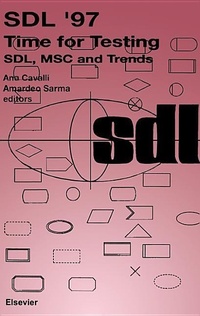
SDL '97: Time for Testing
SDL, MSC and Trends
Published on 18. August 1997
Book
Hardback
551 pages
978-0-444-82816-3 (ISBN)
Description
As Cavalli and Sarma astutely remarked in the introduction to this volume, it is quite remarkable that SDL '97 may have the first participant younger than SDL itself. SDL '97 provides the opportunity to reflect the course SDL has taken and why it has been successful over two decades where other languages addressing the same market have failed.SDL now also has a permanent companion in MSC (Message Sequence Charts). MSC today is a language in its own right and has its areas of application both in conjunction with SDL and independently or in combination with other techniques. MSC has strong structuring concepts to specify message sequences for large systems and can be used to develop scenarios, which is extremely useful for test and design environments. The SDL Forum today really is the SDL and MSC Forum.
More details
Language
English
Place of publication
Oxford
United Kingdom
Publishing group
Elsevier Science & Technology
Target group
Professional and scholarly
Product notice
sewn/stitched
Cloth over boards
Dimensions
Height: 236 mm
Width: 158 mm
Thickness: 34 mm
Weight
1066 gr
ISBN-13
978-0-444-82816-3 (9780444828163)
Copyright in bibliographic data and cover images is held by Nielsen Book Services Limited or by the publishers or by their respective licensors: all rights reserved.
Schweitzer Classification
Other editions
Additional editions
E-Book
08/1997
1st Edition
Elsevier
from
€270.00
Available for download
Persons
Content
I. Applications (I). Designing a multi-user software environment for development and analysis using a combination of OMT and SDL92 (C.G.N. Macario et al.). SDL-based modelling and design of IN/UMTS handover functionality (A. Alonistioti et al.). An SDL-based platform for the simulation of communication networks using dynamic block instantiations (A. Iselt, A. Autenrieth). II. Performance Analysis. SPEET SDL performance evaluation tool (M. Steppler, M. Lott). Performance analysis of TCP's flow control mechanisms using queueing SDL (J. Hintelmann, R. Westerfeld). Tuning development of distributed real-time systems with SDL: Current experience and future issues (R. Gerlich). III. Verification and Validation (I). Telephone feature verification: Translating SDL to TLA+ (D. Mery, P. Gibson). Simulation of IP mobility support: An experiment in mobile protocol specification with SDL (M. Toro). Experiences with ISDN validation models in SDL and proposal for new SDL features (N. Fischbeck). Design for testability of communication protocols based on SDL language (K. Karoui et al.). IV. MSC (I). The MSC-96 distillery (O. Haugen). Switching software test environment using MSC (S. Shiba et al.). Deriving an SDL specification with a given architecture from a set of MSCs (G. Robert et al.). MSC'96 and beyond - a critical look (S. Loidl et al.). V. SDL and MSC in International Organizations. SDL and MSC in international organizations: ITU-T (R. Reed). VI. Testing. Towards the industrial use of validation techniques and automatic test generation methods for SDL specifications (A. Ek et al.). Automating the process of test derivation from SDL specifications (G. v. Bochmann et al.). Test generation for the SSCOP-ATM networks protocol (A. Cavalli et al.). VII. MSC (II). High-level message sequence charts (S. Mauw, M. Reniers). An annotational extension of message sequence charts to support performance engineering (N. Faltin et al.). MSCs at Siemens A/S - towards the usage of MSC-96 (A. Nyeng, S. Gundersen). VIII. SDL and Other Languages (I). Automated iteration between OMT and SDL (K. Verschaeve). Introducing SDL in the development of CORBA-compliant applications (J. Carracedo et al.). A practical experience on validating GDMO-based information models with SDL'88 and SDL'92 (S. Tata et al.). IX. Code Generation. Combining SDL and C (P.-O. Haokansson et al.). Derivation of efficient implementations from SDL specifications employing data referencing, integrated packet framing and activity threads (R. Henke et al.). Industrial strength code generation from SDL (N. Mansurov et al.). X. SDL and Other Languages (II). Is open-EDI a potential area for use of SDL? (O. Troulet-Lambert). The unification of OMT, SDL and IDL for service creation (E. Inocencio et al.). Combining object-oriented and real-time programming from an OMT and SDL design (V. Perrier, N. Dervaux). XI. Verification and Validation (II). Interconnecting the ObjectGeode and Caesar-Alderbaran toolsets (A. Kerbrat et al.). Specifying the steam-boiler case study with SDL (F.A. Boudjelalet al.). The SDL specification of the sliding window protocol revisited (C. Facchi et al.). XII. Applications (II). Configuring communication protocols using SDL patterns (B. Geppert et al.). Code generation using GEODE: A case study (R. Singh, J. Serviss). Author index.