

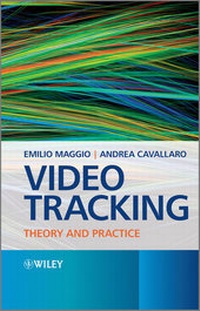
Video Tracking
Theory and Practice
Will be published approx. on 14. January 2011
Book
Hardback
292 pages
978-0-470-74964-7 (ISBN)
Description
Video Tracking provides a comprehensive treatment of the fundamental aspects of algorithm and application development for the task of estimating, over time, the position of objects of interest seen through cameras. Starting from the general problem definition and a review of existing and emerging video tracking applications, the book discusses popular methods, such as those based on correlation and gradient-descent. Using practical examples, the reader is introduced to the advantages and limitations of deterministic approaches, and is then guided toward more advanced video tracking solutions, such as those based on the Bayes' recursive framework and on Random Finite Sets.
Key features:
* Discusses the design choices and implementation issues required to turn the underlying mathematical models into a real-world effective tracking systems.
* Provides block diagrams and simil-code implementation of the algorithms.
* Reviews methods to evaluate the performance of video trackers - this is identified as a major problem by end-users.
The book aims to help researchers and practitioners develop techniques and solutions based on the potential of video tracking applications. The design methodologies discussed throughout the book provide guidelines for developers in the industry working on vision-based applications. The book may also serve as a reference for engineering and computer science graduate students involved in vision, robotics, human-computer interaction, smart environments and virtual reality programmes
Reviews / Votes
"The design methodologies discussed throughout the book provide guidelines for developers in the industry working on vision-based applications. The book may also serve as a reference for engineering and computer science graduate students involved in vision, robotics, human-computer interaction, smart environments and virtual reality programs." (Zentralblatt MATH, 2011) "While technical, the text is clearly written and supported by exceptional illustrations." (Booknews, 1 June 2011)More details
Product info
gebunden
Edition
1. Auflage
Language
English
Place of publication
New York
United States
Target group
College/higher education
Product notice
sewn/stitched
Cloth over boards
Dimensions
Height: 235 mm
Width: 157 mm
Thickness: 20 mm
Weight
582 gr
ISBN-13
978-0-470-74964-7 (9780470749647)
Schweitzer Classification
Other editions
Additional editions
E-Book
07/2011
Wiley
€99.99
Available for download
E-Book
11/2010
Wiley
€99.99
Available for download
Persons
Dr Emilio Maggio, Vicon, UK
Dr Maggio is Computer Vision Scientist at Vicon, the motion capture worldwide market leader. From 2004 - 2008 he was a Ph.D. student at the Department of Electronic Engineering, Queen Mary, University of London. In 2005 and again in 2007 he was awarded the best student paper prize at ICASSP. Dr Maggio has acted as a reviewer for the IEEE Transactions on Circuits and Systems for Video Technology, the International Journal of Image and Graphics and ACM Multimedia. Dr Andrea Cavallaro, School of Electronic Engineering and Computer Science, Queen Mary, University of London, UK
Dr Cavallaro is Reader in Multimedia Signal Processing at Queen Mary, University of London. He is the author of more than 70 papers, including 5 book chapters. He is an elected member of the IEEE Signal Processing Society, Multimedia Signal Processing Committee. He has been a member of the organizing/ technical committee for several international conferences such as Technical Chair of EUSIPCO 08 and General Chair of the IEEE International Conference on Advanced Video and Signal based Surveillance (AVSS 2007), with General Chair positions being held for forthcoming 2009 conferences such as BMVC 09. He has been guest editor of several special issues, including 'Multi-sensor object detection and tracking', Signal, Image and Video Processing (Springer). Dr Cavallaro was awarded the Royal Academy of Engineering teaching prize in 2007.
Dr Maggio is Computer Vision Scientist at Vicon, the motion capture worldwide market leader. From 2004 - 2008 he was a Ph.D. student at the Department of Electronic Engineering, Queen Mary, University of London. In 2005 and again in 2007 he was awarded the best student paper prize at ICASSP. Dr Maggio has acted as a reviewer for the IEEE Transactions on Circuits and Systems for Video Technology, the International Journal of Image and Graphics and ACM Multimedia. Dr Andrea Cavallaro, School of Electronic Engineering and Computer Science, Queen Mary, University of London, UK
Dr Cavallaro is Reader in Multimedia Signal Processing at Queen Mary, University of London. He is the author of more than 70 papers, including 5 book chapters. He is an elected member of the IEEE Signal Processing Society, Multimedia Signal Processing Committee. He has been a member of the organizing/ technical committee for several international conferences such as Technical Chair of EUSIPCO 08 and General Chair of the IEEE International Conference on Advanced Video and Signal based Surveillance (AVSS 2007), with General Chair positions being held for forthcoming 2009 conferences such as BMVC 09. He has been guest editor of several special issues, including 'Multi-sensor object detection and tracking', Signal, Image and Video Processing (Springer). Dr Cavallaro was awarded the Royal Academy of Engineering teaching prize in 2007.
Content
Foreword.
About the authors.
Preface.
Acknowledgments.
Notations.
Acronyms.
1 What is video tracking?
1.1 Introduction.
1.2 The design of a video tracker.
1.3 Problem formulation.
1.4 Interactive versus automated tracking.
1.5 Summary.
2 Applications.
2.1 Introduction.
2.2 Media production and augmented reality.
2.3 Medical applications and biological research.
2.4 Surveillance and business intelligence.
2.5 Robotics and unmanned vehicles.
2.6 Tele-collaboration and interactive gaming.
2.7 Art installations and performances.
2.8 Summary.
References.
3 Feature extraction.
3.1 Introduction.
3.2 From light to useful information.
3.3 Low-level features.
3.4 Mid-level features.
3.5 High-level features.
3.6 Summary.
References.
4 Target representation.
4.1 Introduction.
4.2 Shape representation.
4.3 Appearance representation.
4.4 Summary.
References
5 Localisation.
5.1 Introduction.
5.2 Single-hypothesis methods.
5.3 Multi-hypothesis methods.
5.4 Summary.
References.
6 Fusion.
6.1 Introduction.
6.2 Fusion strategies.
6.3 Feature fusion in a Particle Filter.
6.4 Summary.
References.
7 Multi-target management.
7.1 Introduction.
7.2 Measurement validation.
7.3 Data association.
7.4 Random Finite Sets for tracking.
7.5 Probabilistic Hypothesis Density filter.
7.6 The Particle PHD filter.
7.7 Summary.
References.
8 Context modeling.
8.1 Introduction.
8.2 Tracking with context modelling.
8.3 Birth and clutter intensity estimation.
8.4 Summary.
References.
9 Performance evaluation.
9.1 Introduction.
9.2 Analytical vs. empirical methods.
9.3 Ground truth.
9.4 Evaluation scores.
9.5 Comparing trackers.
9.6 Evaluation protocols.
9.7 Datasets.
9.8 Summary.
References.
Epilogue.
Further reading.
Appendix A: Comparative results.
A.1 Single versus structural histogram.
A.1.1 Experimental setup.
A.1.2 Discussion.
A.2 Localisation algorithms.
A.2.1 Experimental setup.
A.2.2 Discussion.
A.3 Multi-feature fusion.
A.3.1 Experimental setup.
A.3.2 Reliability scores.
A.3.3 Adaptive versus non-adaptive tracker.
A.3.4 Computational complexity.
A.4 PHD filter.
A.4.1 Experimental setup.
A.4.2 Discussion.
A.4.3 Failure modalities.
A.4.4 Computational cost.
A.5 Context modelling.
A.5.1 Experimental setup.
A.5.2 Discussion.
References.
Index.