

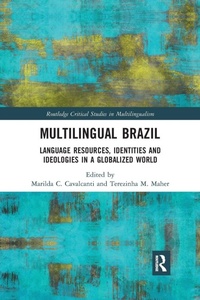
Multilingual Brazil
Language Resources, Identities and Ideologies in a Globalized World
1st Edition
Published on 31. March 2021
Book
Paperback/Softback
260 pages
978-0-367-36589-9 (ISBN)
Description
This book brings together cutting edge work by Brazilian researchers on multilingualism in Brazil for an English-speaking readership in one comprehensive volume. Divided into five sections, each with its own introduction, tying together the themes of the book, the volume charts a course for a new sociolinguistics of multilingualism, challenging long-held perceptions about a monolingual Brazil by exploring the different policies, language resources, ideologies and social identities that have emerged in the country's contemporary multilingual landscape. The book elucidates the country's linguistic history to demonstrate its evolution to its present state, a country shaped by political, economic, and cultural forces both locally and globally, and explores different facets of today's multilingual Brazil, including youth on the margins and their cultural and linguistic practices; the educational challenges of socially marginalized groups; and minority groups' efforts to strengthen languages of identity and belonging. In addition to assembling linguistic research done in Brazil previously little known to an English-speaking readership, the book incorporates theoretical frameworks from other disciplines to provide a comprehensive picture of the social, political, and cultural dynamics at play in multilingual Brazil. This volume is key reading for researchers in linguistic anthropology, sociolinguistics, applied linguistics, cultural studies, and Latin American studies.
Reviews / Votes
"[Multilingual Brazil] is an excellent entrance into the complex sociolinguistic contextx of Brazil and it presents different approaches, methodologies and theoretical frameworks...its historical perspective helps us understand how we got where we are, especeially in relation to policies in language and education, as well as in the dynamics of identities." - Beatriz Gabbiani, Journal of SociolinguisticsMore details
Series
Language
English
Place of publication
London
United Kingdom
Publishing group
Taylor & Francis Ltd
Target group
College/higher education
Illustrations
56 s/w Abbildungen, 14 s/w Photographien bzw. Rasterbilder, 42 s/w Tabellen
42 Tables, black and white; 14 Halftones, black and white; 56 Illustrations, black and white
Dimensions
Height: 229 mm
Width: 152 mm
Thickness: 15 mm
Weight
399 gr
ISBN-13
978-0-367-36589-9 (9780367365899)
Copyright in bibliographic data and cover images is held by Nielsen Book Services Limited or by the publishers or by their respective licensors: all rights reserved.
Schweitzer Classification
Other editions
Additional editions
Marilda C. Cavalcanti | Terezinha M. Maher
Multilingual Brazil
Language Resources, Identities and Ideologies in a Globalized World
Book
10/2017
1st Edition
Routledge
€206.60
Shipment within 10-20 days
Marilda C. Cavalcanti | Terezinha M. Maher
Multilingual Brazil
Language Resources, Identities and Ideologies in a Globalized World
E-Book
09/2017
Routledge
€63.49
Available for download
Marilda C. Cavalcanti | Terezinha M. Maher
Multilingual Brazil
Language Resources, Identities and Ideologies in a Globalized World
E-Book
09/2017
Routledge
€63.49
Available for download
Persons
Marilda C. Cavalcanti is Professor at the Department of Applied Linguistics at the Universidade Estadual de Campinas (UNICAMP) in Brazil, where she is also a CNPq/Brazil researcher.
Terezinha Machado Maher is Associate Professor at the Department of Applied Linguistics at the Universidade Estadual de Campinas (UNICAMP) in Brazil, where she teaches graduate and undergraduate courses in bilingual education and language and diversity.
Terezinha Machado Maher is Associate Professor at the Department of Applied Linguistics at the Universidade Estadual de Campinas (UNICAMP) in Brazil, where she teaches graduate and undergraduate courses in bilingual education and language and diversity.
Content
1 Contemporary Brazilian perspectives on multilingualism: An introduction Marilda C. Cavalcanti and Terezinha M. Maher Section I : Politics, language ideologies and the changing shape of language policy processes Introduction: Distinctive and common features of Brazilian language and education policy in the Latin American context Rainer Enrique Hamel 2 Changing policies and language ideologies with regard to the Indigenous languages in Brazil Jose Ribamar Bessa Freire 3 Shifting discourses about language and identity among Indigenous teachers in western Amazonia in the wake of policy change Terezinha M. Maher 4 From foreign languages to Brazilian languages, from one-language-one nation ideology to inclusive coofficialization policy: The case of Hunsrueckisch and Pommersch Gilvan Mueller de Oliveira Section II: Language-in-education: a dominant monolingual ideology in tension with multilingual practices Introduction: Political-ideological issues within Brazilian debates and policies on multilingual and multicultural education Ines Signorini 5 Representations of Deaf identities and communicative repertoires: Conversations with Deaf teachers Ivani Rodrigues Silva and Wilma Favorito 6 The languages on the Brazilian border: Documenting urban diversity, researching school and classroom practice, working towards change Rosangela Morello 7 A multilingual life in transit between two monolingual orders: A 'Braziguayan' student, her linguistic repertoire and her translingual practices Maria Elena Pires-Santos Section III : Local/Global trajectories Introduction: Local/global trajectories - Historical and ethnographic perspectives Marilyn Martin-Jones 8 The ongoing mobilities of Japanese-Brazilians: language ideology, identities and language education Leiko Matsubara Morales, Ayako Akamine and Maria Emiko Suzuki 9 Language, literacy and religion in the shaping of the identities and social networks of Ukrainians in Brazil Neiva M. Jung and Jakeline A. Semechechem 10 Diverse migration trajectories, diverse linguistic repertoires, local and transnational ties: Arabic speakers in Foz do Iguacu Regina Coeli Machado e Silva Section IV: Representation/performance of diversities Introduction: Representation/Performance of diversities: Reflections on the 'multi-' Lynn Mario T. Menezes de Souza 11 Guarani/Portuguese/Castellano rap on the borderland: transidiomaticity, indexicalities and text spectacularity Luiz Paulo Moita-Lopes 12 Multiliteracies and multilingualism in Brazilian youth culture: The case of anime music video editing Roxane Rojo and Eduardo de Moura Almeida Section V: Internationalization and new diversities in higher education: Policies and practices 'on the ground' Introduction: Affordances and consequences of internationalization in higher education: lessons from Brazilian case studies Feliciano Chimbutane 13 Portuguese as an additional language: global trends in local actions Margarete Schlatter and Pedro de Moraes Garcez 14 Narrating lived experiences from the margins: the voices of two undergraduate students from the Democratic Republic of Congo at a Brazilian university Ana Cecilia C. Bizon and Marilda C. Cavalcanti Afterword: Policies, Identities, Trajectories and Practices of Multilingual Brazil Nancy H. Hornberger