

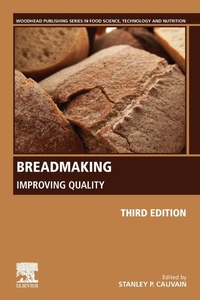
Breadmaking
Improving Quality
3rd Edition
Published on 26. November 2020
Book
Paperback/Softback
766 pages
978-0-08-102519-2 (ISBN)
Description
Bread Making: Improving Quality quickly established itself as an essential purchase for baking professionals and researchers in this area. Fully revised and updated and with new chapters on Flour Lipids, and the dietary and nutritional quality of bread, this new edition provides readers with the information they need on the latest developments in bread making science and practice
The book opens with two introductory chapters providing an overview of the breadmaking process. Part one focuses on the impacts of wheat and flour quality on bread, covering topics such as wheat chemistry, wheat starch structure, grain quality assessment, milling and wheat breeding. Part two covers dough development and bread ingredients, with chapters on dough aeration and rheology, the use of redox agents and enzymes in breadmaking and water control, among other topics. In part three, the focus shifts to bread sensory quality, shelf life and safety. Topics covered include bread aroma, staling and contamination. Finally, part four looks at particular bread products such as high fiber breads, those made from partially baked and frozen dough and those made from non-wheat flours
With its distinguished editor and international team of contributors, Bread Making: Improving Quality, Third Edition, continues to serve as the standard reference for researchers and professionals in the bread industry and all those involved in academic research on breadmaking science and practice.
The book opens with two introductory chapters providing an overview of the breadmaking process. Part one focuses on the impacts of wheat and flour quality on bread, covering topics such as wheat chemistry, wheat starch structure, grain quality assessment, milling and wheat breeding. Part two covers dough development and bread ingredients, with chapters on dough aeration and rheology, the use of redox agents and enzymes in breadmaking and water control, among other topics. In part three, the focus shifts to bread sensory quality, shelf life and safety. Topics covered include bread aroma, staling and contamination. Finally, part four looks at particular bread products such as high fiber breads, those made from partially baked and frozen dough and those made from non-wheat flours
With its distinguished editor and international team of contributors, Bread Making: Improving Quality, Third Edition, continues to serve as the standard reference for researchers and professionals in the bread industry and all those involved in academic research on breadmaking science and practice.
More details
Series
Edition
3rd edition
Language
English
Place of publication
Cambridge
United Kingdom
Publishing group
Elsevier Science & Technology
Target group
Professional and scholarly
College/higher education
Researchers and professionals in the bread industry
Product notice
Paperback (trade)
Dimensions
Height: 229 mm
Width: 152 mm
Thickness: 39 mm
Weight
1007 gr
ISBN-13
978-0-08-102519-2 (9780081025192)
Copyright in bibliographic data and cover images is held by Nielsen Book Services Limited or by the publishers or by their respective licensors: all rights reserved.
Schweitzer Classification
Other editions
Additional editions
E-Book
11/2020
3rd Edition
Woodhead Publishing
€305.00
Available for download
Previous edition
Book
08/2016
2nd Edition
Woodhead Publishing Ltd
€256.89
Article exhausted; check for reprint
Person
Prof. Cauvain is owner of BakeTran, a renowned independent Baking Industry Consultancy in Witney, UK. He was a director of Cereals & Cereal Processing Division at CCFRA until December 2004. A leading authority in the bread and baking industry, Stanley was also President of the International Association for Cereal Science and Technology between 2004 and 2006. He is a frequent Woodhead Publishing Limited author having written or edited six titles previously.
Content
1. An Introduction and Overview of Breadmaking
Part One: Wheat and Flour Quality
2. The Chemistry and Biochemistry of Wheat
3. Techniques for Analyzing Wheat Proteins
4. Wheat Proteins and Bread Quality
5. Wheat Starch Structure and Bread Quality
6. Flour lipids, fats and emulsifiers
7. Milling and Flour Quality
8. Wheat Breeding and Quality Evaluation
9. Improving Wheat Protein Quality for Breadmaking: the Role of Biotechnology
10. Acrylamide
Part Two: Dough Development and Particular Bread Ingredients
11. Bread Aeration and Dough Rheology: An Overview
12. The Molecular Basis of Bread Dough Rheology
13. Redox Agents and Other Improvers in Breadmaking
14. Applications of Enzymes in Breadmaking
15. Water Control in Breadmaking
Part Three: Bread Sensory Quality, Shelf Life, and Safety
16. Bread Aroma
17. Application of Texture Analysis to Dough and Bread
18. Mould Prevention in Bread
19. Bread Staling
Part Four: Particular Bread Products
20. Improving the Quality of Bread Made from Partially Baked, Refrigerated, and Frozen Dough
21. Improved Nutritional and Dietary Quality of Breads
22. The Quality of Breads Made with Non-wheat Flours
23. Formulating breads for specific dietary requirements
24. The future for breadmaking
Part One: Wheat and Flour Quality
2. The Chemistry and Biochemistry of Wheat
3. Techniques for Analyzing Wheat Proteins
4. Wheat Proteins and Bread Quality
5. Wheat Starch Structure and Bread Quality
6. Flour lipids, fats and emulsifiers
7. Milling and Flour Quality
8. Wheat Breeding and Quality Evaluation
9. Improving Wheat Protein Quality for Breadmaking: the Role of Biotechnology
10. Acrylamide
Part Two: Dough Development and Particular Bread Ingredients
11. Bread Aeration and Dough Rheology: An Overview
12. The Molecular Basis of Bread Dough Rheology
13. Redox Agents and Other Improvers in Breadmaking
14. Applications of Enzymes in Breadmaking
15. Water Control in Breadmaking
Part Three: Bread Sensory Quality, Shelf Life, and Safety
16. Bread Aroma
17. Application of Texture Analysis to Dough and Bread
18. Mould Prevention in Bread
19. Bread Staling
Part Four: Particular Bread Products
20. Improving the Quality of Bread Made from Partially Baked, Refrigerated, and Frozen Dough
21. Improved Nutritional and Dietary Quality of Breads
22. The Quality of Breads Made with Non-wheat Flours
23. Formulating breads for specific dietary requirements
24. The future for breadmaking