

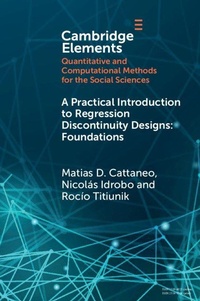
A Practical Introduction to Regression Discontinuity Designs
Foundations
Published on 13. February 2020
Book
Paperback/Softback
120 pages
978-1-108-71020-6 (ISBN)
Description
In this Element and its accompanying second Element, A Practical Introduction to Regression Discontinuity Designs: Extensions, Matias Cattaneo, Nicolas Idrobo, and Rociio Titiunik provide an accessible and practical guide for the analysis and interpretation of regression discontinuity (RD) designs that encourages the use of a common set of practices and facilitates the accumulation of RD-based empirical evidence. In this Element, the authors discuss the foundations of the canonical Sharp RD design, which has the following features: (i) the score is continuously distributed and has only one dimension, (ii) there is only one cutoff, and (iii) compliance with the treatment assignment is perfect. In the second Element, the authors discuss practical and conceptual extensions to this basic RD setup.
More details
Series
Language
English
Place of publication
Cambridge
United Kingdom
Target group
Professional and scholarly
Product notice
Paperback (trade)
Illustrations
Worked examples or Exercises; 7 Tables, black and white; 21 Plates, color; 1 Halftones, black and white
Dimensions
Height: 223 mm
Width: 149 mm
Thickness: 7 mm
Weight
168 gr
ISBN-13
978-1-108-71020-6 (9781108710206)
Copyright in bibliographic data and cover images is held by Nielsen Book Services Limited or by the publishers or by their respective licensors: all rights reserved.
Schweitzer Classification
Other editions
Additional editions
E-Book
02/2020
Cambridge University Press
€14.49
Available for download
Matias D. Cattaneo | Nicolas Idrobo | Rocio Titiunik
A Practical Introduction to Regression Discontinuity Designs
Foundations
E-Book
01/2020
Cambridge University Press
€15.49
Available for download
Persons
Content
1. Introduction; 2. The sharp RD design; 3. RD plots; 4. The continuity-based approach to RD analysis; 5. Validation and falsification of the RD design; 6. Final remarks.