

Electrochemical Power Sources: Fundamentals, Systems, and Applications
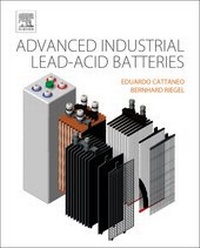
Advanced Industrial Lead-Acid Batteries
Published on 1. March 2025
Book
Hardback
670 pages
978-0-444-63252-4 (ISBN)
Description
Advanced Industrial Lead-Acid Batteries, written for technologists and engineers, presents a detailed account of the different types of reserve and motive power industrial lead-acid batteries, also including recent developments and new applications. Lead-acid batteries (LAB) for reserve and motive power applications have, in recent years, undergone an evolutionary process triggered by novel developments in telecommunication, information technology, material handling, and renewable energy applications. This book details those advances, giving users the latest information on this rapidly advancing field.
More details
Language
English
Place of publication
Oxford
United Kingdom
Publishing group
Elsevier Science & Technology
Target group
Professional and scholarly
Chemists, electrochemists, chemical engineers and material scientists in academia, government and corporate labs contacting research on electrochemical energy storage devices.
Illustrations
Approx. 190 illustrations
Dimensions
Height: 235 mm
Width: 191 mm
ISBN-13
978-0-444-63252-4 (9780444632524)
Copyright in bibliographic data and cover images is held by Nielsen Book Services Limited or by the publishers or by their respective licensors: all rights reserved.
Schweitzer Classification
Other editions
Additional editions
Eduardo Cattaneo | Bernhard Riegel | Jürgen Garche
Electrochemical Power Sources: Fundamentals, Systems, and Applications
Advanced Industrial Lead-Acid Batteries
E-Book
03/2025
Elsevier
€190.00
Available for download
Persons
Eduardo Cattaneo received a PhD in solid state physics from the University of Cologne. After working as a postgraduate at the physical-chemistry institute of the University of Bonn he joined in 1988 the R&D staff of HOPPECKE Batteries.He has more than 20 years R&D experience on battery technology including published works on continuous casting of lead grids, continuous plate making, lead alloys corrosion, VRLA batteries and anodic stability of electrolytes for Lithium-ion cells Bernhard Riegel received his PhD in inorganic chemistry at the University of Stuttgart. He worked in his postgraduate time at the Max Planck Institute for Solid state chemistry in Stuttgart, the University of Texas at Austin, followed by the Center of Solar Energy and Hydrogen Research in Ulm (ZSW).Since 2001 he is working for HOPPECKE batteries with the responsibility as the director for Research and Development.His major R&D experiences are in the field of electrochemistry of lead-acid, alkaline and Li-Ion batteries. Juergen Garche,
Institute of Theoretical Chemistry, University of Ulm, Ulm, Germany
Juergen Garche graduated in chemistry at the Dresden University of Technology (DTU) in Germany in 1967. He was awarded his PhD in theoretical electrochemistry in 1970 and his habilitation in applied electrochemistry in 1980 from the same university. He worked at the DTU in the Electrochemical Power Sources Group for many years in different projects, mainly related to conventional batteries, before he moved 1991 to the Centre for Solar Energy and Hydrogen Research (ZSW) in Ulm, where he was, until 2004, the Head of the Electrochemical Energy Storage and Energy Conversion Division.
He was Professor of Electrochemistry at Ulm University and Guest Professor at Shandong University - China, 2005, Sapienca University Roma - Italy, 2009, 2013, 2016, and 2023, TUM-CREATE - Singapore, 2014, 2015, 2016- 2016, Dalian Institute of Chemical Physics - China, 2016, CNR Institute for Advanced Energy Technologies, Messina - Italy, 2019. After he retired from the ZSW he founded in 2004 the consulting firm Fuel Cell and Battery Consulting (FCBAT). Since 2015 he is senior professor at Ulm University. He has published more than 300 papers, 10 patents, and 11 books, among others as editor-in-chief of the first edition of Encyclopedia of Electrochemical Power Sources. He is listed in "World's most Influential Scientific Minds? by Thomas Reuters (2014) and in the book "Profiles of 93 Influential Electrochemists? (2015).
Institute of Theoretical Chemistry, University of Ulm, Ulm, Germany
Juergen Garche graduated in chemistry at the Dresden University of Technology (DTU) in Germany in 1967. He was awarded his PhD in theoretical electrochemistry in 1970 and his habilitation in applied electrochemistry in 1980 from the same university. He worked at the DTU in the Electrochemical Power Sources Group for many years in different projects, mainly related to conventional batteries, before he moved 1991 to the Centre for Solar Energy and Hydrogen Research (ZSW) in Ulm, where he was, until 2004, the Head of the Electrochemical Energy Storage and Energy Conversion Division.
He was Professor of Electrochemistry at Ulm University and Guest Professor at Shandong University - China, 2005, Sapienca University Roma - Italy, 2009, 2013, 2016, and 2023, TUM-CREATE - Singapore, 2014, 2015, 2016- 2016, Dalian Institute of Chemical Physics - China, 2016, CNR Institute for Advanced Energy Technologies, Messina - Italy, 2019. After he retired from the ZSW he founded in 2004 the consulting firm Fuel Cell and Battery Consulting (FCBAT). Since 2015 he is senior professor at Ulm University. He has published more than 300 papers, 10 patents, and 11 books, among others as editor-in-chief of the first edition of Encyclopedia of Electrochemical Power Sources. He is listed in "World's most Influential Scientific Minds? by Thomas Reuters (2014) and in the book "Profiles of 93 Influential Electrochemists? (2015).
Content
1. Renewable Energies for power generation - Technologies, potentials, needs for balancing power 2. Classification of technologies for balancing power in grids 3. Challenges for the power supply systems - grid restrictions, demand side management, conventional power plant operation 4. Existing markets and operation profiles for grid connected storage systems - Primary control, secondary control, minute reserve, energy trading, power plant scheduling, UPS systems, self-consumption 5. Existing markets for storage systems in off-grid applications 6. Review on the need of storage capacities depending on the share of renewable energies 7. Overview about non-electrochemical storage technologies 8. Hydrogen production from renewable energies - electrolyser technologies 9. Hydrogen storage technologies 10. Hydrogen conversion into electricity and thermal use 11. Reversible fuel cell 12. Energy carriers made from hydrogen 13. Lead-Acid Battery Energy Storage 14. Ni-Cd Battery Energy Storage 15. Na+ - High Temperature Batteries Energy Storage 16. Li-Ion Battery Energy Storage 17. Redox Flow Battery Energy Storage 18. Metal storage / Metal air (Zn, Al, Mg, Li) 19. Electrochemical Double Layer Capacitors 20. System design considerations (connection to the grid, safety issues, standards, etc.) 21. Battery management and battery diagnostics 22. Power Conditioning Systems (power electronics) incl. discussion of optimum voltage levels 23. Life cycle cost calculation and comparison for different reference cases and market segments 24. "Double use" storage systems - "PV Self-Consumption" and "Vehicle to Grid"