

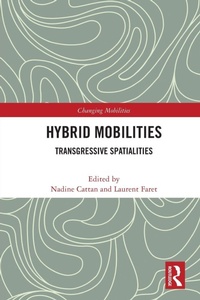
Hybrid Mobilities
Transgressive Spatialities
1st Edition
Published on 31. May 2023
Book
Paperback/Softback
282 pages
978-1-032-07108-4 (ISBN)
Description
Diverse factors like globalization, geopolitical tensions, and the transformation of lifestyles are strengthening the role of mobility as a structuring dimension of contemporary societies. Social-science research has taken note of these changes, but few studies cross the different forms of mobility, ranging from commuting to tourists and backpackers, and on to seasonal workers or international migrants. The diversity of mobility situations studied in this book highlights the contribution of the reality of mobility in the daily construction of urban, regional, and global spaces, as well as in the redefinition of socio-spatial concepts.
By using an interdisciplinary relational approach, the book revisits certain concepts such as exclusion, heritage, or distance, in order to understand spatialities beyond the oppositions of fixity/mobility, private/public, or here/elsewhere. The book sheds light on the capacities for resistance of mobile persons in Singapore, Dakar, Bangkok, Amman, Paris, New York, or Mexico by studying the power relationships that are established in situations of mobility. By deciphering the values that characterize regimes of (im)mobility, the contributors stress the normative injunctions of public policies and social practices.
The originality of the work lies in capturing the deployment of alternative spatialities and underlining how they are reshaped between sedentary and mobility regimes. It highlights the importance of fully associating mobility with its characteristics of ephemerality and fluidity, in our theorizations and understandings of spatialities. By taking a post-structuralist posture, the book makes it possible to establish a logic of 'and' to design a 'between' of things, and to reverse ontology. This allows the temporary and the connected to be rehabilitated, beyond distance, in our practical knowledge of spatialities and territorialities. As such, the volume will be of interest to scholars of geography, sociology, anthropology, and urban studies with interests in mobility, migration and relational thought.
By using an interdisciplinary relational approach, the book revisits certain concepts such as exclusion, heritage, or distance, in order to understand spatialities beyond the oppositions of fixity/mobility, private/public, or here/elsewhere. The book sheds light on the capacities for resistance of mobile persons in Singapore, Dakar, Bangkok, Amman, Paris, New York, or Mexico by studying the power relationships that are established in situations of mobility. By deciphering the values that characterize regimes of (im)mobility, the contributors stress the normative injunctions of public policies and social practices.
The originality of the work lies in capturing the deployment of alternative spatialities and underlining how they are reshaped between sedentary and mobility regimes. It highlights the importance of fully associating mobility with its characteristics of ephemerality and fluidity, in our theorizations and understandings of spatialities. By taking a post-structuralist posture, the book makes it possible to establish a logic of 'and' to design a 'between' of things, and to reverse ontology. This allows the temporary and the connected to be rehabilitated, beyond distance, in our practical knowledge of spatialities and territorialities. As such, the volume will be of interest to scholars of geography, sociology, anthropology, and urban studies with interests in mobility, migration and relational thought.
Reviews / Votes
"This book convincingly shows us why a mobility lens is crucial to understanding nation-states, cities, territories, neighbourhoods, homes and other spatial formations. Highly relevant in an age gripped by the contentious politics around borders and mobilities."Professor Brenda Yeo, National University of Singapore
"An edited collection that takes seriously the dialectical relationship between mobility and place through a vivid and diverse set of examples and approaches - through Marrakesh to Mexico City, from homes and heritage, to mobile and migrant subjects arriving, being driven, some stranded in-transit, in domestic labour, others leaving and tourists leaving things behind. Cattan and Faret have curated a series of wonderful entries sensitive to context, place, vehicle, and experience; to gendered and raced differentiations of mobility that condense around the material nuclei of mobility and stasis and stasis in mobility, in intimate practices, alternative belongings, policy formations and the spaces between them. A terrific and inspiring collection."
Professor Peter Adey, Royal Holloway University of London
More details
Series
Language
English
Place of publication
London
United Kingdom
Publishing group
Taylor & Francis Ltd
Target group
College/higher education
Postgraduate, Undergraduate Advanced, and Undergraduate Core
Illustrations
19 s/w Abbildungen, 16 s/w Photographien bzw. Rasterbilder, 3 s/w Zeichnungen, 12 s/w Tabellen
12 Tables, black and white; 3 Line drawings, black and white; 16 Halftones, black and white; 19 Illustrations, black and white
Dimensions
Height: 234 mm
Width: 156 mm
Thickness: 16 mm
Weight
459 gr
ISBN-13
978-1-032-07108-4 (9781032071084)
Copyright in bibliographic data and cover images is held by Nielsen Book Services Limited or by the publishers or by their respective licensors: all rights reserved.
Schweitzer Classification
Other editions
Additional editions
Book
09/2021
1st Edition
Routledge
€206.80
Shipment within 15-20 days
E-Book
07/2021
1st Edition
Routledge
€59.49
Available for download
E-Book
07/2021
1st Edition
Routledge
€59.49
Available for download
Persons
Nadine Cattan is research director in geography at the French National Center for Scientific Research (CNRS). She was previously director of a unit on territorial indicators and statistics at the OECD. She has also chaired an expert group on gateways at the DATAR, the French government's regional development planning agency. Her main research interests aim to understand how mobilities are likely to modify society's relationships to space and so lead to a reinterpretation of spatial concepts and theories. She has provided a critical overview on the issues of polycentrism and spatial integration in Europe. She has also developed spatial models to explain how metropolitan areas are being transformed. Her current research integrates gender to understand how genders contribute to reshaping territorialities and urban space. Her published works include: Cities and networks in Europe. A critical approach of polycentrism (2007) and Atlas mondial des sexualites. Libertes, plaisirs et interdits (2016).
Laurent Faret is a professor of geography at the University of Paris, a member of CESSMA, and currently on research leave at CIESAS (Centro de Investigaciones y Estudios Superiores en Antropologia Social) in Mexico City, with the Research Institute for Development (IRD). He is a member of the LMI MESO, an international collaborative program between France, Mexico, and Central American countries. His research interests include: the evolution of international migration dynamics and the related territorial and political transformations; the urban dynamics resulting from transit movements and settlement of mobile populations; and the production of transnational mobility spaces and their effects on the dynamics of development in the Global South, at different scales. He is the author or editor of various books on these themes, such as Migrant Protection and the City in the Americas (2021), Les circulations transnationales. Lire les turbulences migratoires contemporaines (2009), Migrants des Suds (2009), and Les territoires de la mobilite. Migration et communautes transnationales entre le Mexique et les Etats-Unis (2003).
Laurent Faret is a professor of geography at the University of Paris, a member of CESSMA, and currently on research leave at CIESAS (Centro de Investigaciones y Estudios Superiores en Antropologia Social) in Mexico City, with the Research Institute for Development (IRD). He is a member of the LMI MESO, an international collaborative program between France, Mexico, and Central American countries. His research interests include: the evolution of international migration dynamics and the related territorial and political transformations; the urban dynamics resulting from transit movements and settlement of mobile populations; and the production of transnational mobility spaces and their effects on the dynamics of development in the Global South, at different scales. He is the author or editor of various books on these themes, such as Migrant Protection and the City in the Americas (2021), Les circulations transnationales. Lire les turbulences migratoires contemporaines (2009), Migrants des Suds (2009), and Les territoires de la mobilite. Migration et communautes transnationales entre le Mexique et les Etats-Unis (2003).
Content
Introduction: When Mobilities Construct Spatialities Part I - A Relational Approach: Insights into the Building of Sociospatial Concepts 1. Tenements in New York and Riads in Marrakesh: Mobilities and the New Paradigm of Heritagization 2. Urban Mobilities and Power: Social Exclusion by Design in the City 3. Rethinking 'Ethnic Neighborhoods' after the Mobility Turn 4. Clouds and Movements 5. Transportation Vehicles in Africa: Between Autonomy and the Administration of Space Part II - Spatial Practices of the City: Power Relations and Agency 6. Migrant Women Servants in Amman and Backpackers in Bangkok: The 'Walking Interviews' Method for Studying Mobile Groups in Cities 7. Padlocks as Obscure Objects of Tourism. An Emotional Imprint in the City of Love 8. Transgressing the City-State: Migrant Domestic Workers in Singapore 9. Everyday Mobility and the Social Divisions of Space: A Space-Time Analysis of Mexico City Part III - Mobility Schemes, Values, and Norms: A Sociopolitical Perspective 10. Immobility as A Migration-Management Resource in Seasonal Agricultural-Worker Programs 11. Stranded Migrants, Mobile Subjects: The Spatiality and Social Order of 'Waiting' in Mexico 12. Facing the Environmental Transition: The Critical Issue of Grasping Mobile Spatialities at the Crossroads of (Un)Changing Practices and Policies 13. Work and High Mobility: Current Knowledge and Blind Spots Afterword: Hybridities, Transgressions, and Stranded Mobilities