

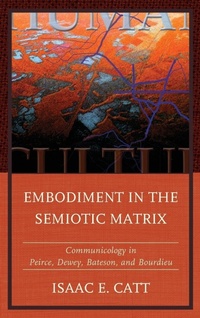
Embodiment in the Semiotic Matrix
Communicology in Peirce, Dewey, Bateson, and Bourdieu
Published on 22. September 2017
Book
Hardback
250 pages
978-1-61147-976-8 (ISBN)
Description
Communicology is widely accepted on the international scene as a new name for the study of human communication. It replaces several equivocal disciplinary conceptions such as "communication," which may fail to distinguish the science of communication from its object of investigation or the message-centered "communication studies," which often obfuscates information exchange with the experience of shared meaning in human encounters. Communicology differs from the American mainstream social science of communication not only because it is grounded in communication theory rather than information theory, but also because it advances a philosophically informed ecological perspective on human discourse. This book is intended as a contribution to the philosophy of communication and the human science of communicology. Semiotic phenomenology is thoroughly described as the synthetic logic that combines a philosophy of consciousness with a science of culture and conduct to explicate the lifeworld habitus. Consciousness is viewed as cultural-semiotic and experience as personal-phenomenological. This is a reciprocal, reflexive relationship in which culture is conceived as consciousness of communication and communication the manifest experience of culture. The book describes embodiment so conceived, including the history of the matrix idea in American pragmatism and European philosophy as they commingled in the United States to produce a unique discipline of communication, the science of embodied discourse. Important roots of this new discipline are described for the first time here in a unique synthesis of C. S. Peirce, John Dewey, Gregory Bateson, and Pierre Bourdieu. In addition, the semiotic relativity hypothesis is argued to be an important implication of this new discipline. Transcending the stale debate on language and thought, the limited conception of linguistic relativity is considerably broadened and deepened. The distinctive lifeworld of humans is argued to occur at the threshold of sign consciousness in the semiotic matrix of culture-society-person. Semiotic phenomenology is not only a synthesis of two great European philosophical movements, structuralism and phenomenology; it is also the essence of American pragmatism. This view culminates in the contemporary human science of communicology.
Reviews / Votes
Communication is talked about everywhere, yet it is seldom understood anywhere. Rather than the name of technology, communication is a human experience. Embodiment in the Semiotic Matrix gives us a cutting-edge, factual account of what human communication is, how it is taught and learned, why it is not a main category in the Library of Congress, and when we should be conscious of speaking to others. Culture and Consciousness are the horizon we step over with this must read book! -- Richard L. Lanigan, Laureate Fellow & Director, International Communicology Institute, Washington, DC, Fellow, Polish Academy of Science (Philology), and Senior Fulbright Fellow (China, Canada) Isaac Catt's book is a singularly impressive examination of the cultural framework of human expressive conduct-elucidating points of intersection between theorists that all too many people have comfortably stereotyped as working within their own limited fields (such as Harry Stack Sullivan, Edward Sapir, and Roman Jakobson) or expansive thinkers whose insights were previously thought to have had only limited impact on the development of the human sciences. He puts together a narrative of the human sciences that, chapter by chapter, has simply not been told before. Catt grounds his approach in a highly original conjunction of themes from Cassirer, Peirce, Dewey, Merleau-Ponty, Bateson, and Bourdieu. It is a masterful compendium of key concepts in the human sciences, and it is the most comprehensive book of theory in the field of human communication that has been written in a very long time. -- Frank J. Macke, Professor of Semiotics, Rhetoric and Communication Theory, Mercer University, Author of <i>The Experience of Human Communication: Body, Flesh, and Relationship</i> Isaac E. Catt thoughtfully and eloquently debunks a message-centered view of communication, emphasizing a semiotic phenomenology attentive to code constraints and perceptual embodiment. Catt emphasizes the contextual and experiential nature of communication that dwells in a signifying world between ineffability and intelligibility. Semiotic phenomenology interrogates consciousness of experience, yielding human meaning. Unlike information and messages, communication resides within embodied ambiguity, resistant to fixation of certainty. Semiotic phenomenology uncovers thought and action synthesized within communicative thought and action. Catt outlines the origin and implications of communicology responsive to semiotic phenomenology, which pursues and interrogates meaning that resides within the social world of practices. Communicology understands communication as central to a lifeworld receptive to the interplay of existential reality and imagination. Embodiment in the Semiotic Matrix is a masterful contribution to communication theory. -- Ronald C. Arnett, Chair and Professor, Duquesne University, The Patricia Doherty Yoder and Ronald Wolfe, Endowed Chair in Communication Ethics, and Author of <i>Levinas's Rhetorical Demand: The Unending Obligation of Communication Ethics</i>More details
Series
Language
English
Place of publication
Cranbury
United States
Publishing group
Associated University Presses
Target group
Professional and scholarly
Illustrations
1 b/w illustrations;
Dimensions
Height: 235 mm
Width: 157 mm
Thickness: 19 mm
Weight
565 gr
ISBN-13
978-1-61147-976-8 (9781611479768)
Copyright in bibliographic data and cover images is held by Nielsen Book Services Limited or by the publishers or by their respective licensors: all rights reserved.
Schweitzer Classification
Other editions
Additional editions
Isaac E. Catt
Embodiment in the Semiotic Matrix
Communicology in Peirce, Dewey, Bateson, and Bourdieu
E-Book
09/2017
1st Edition
Fairleigh Dickinson University Press,U.S.
€98.99
Available for download
Isaac E. Catt
Embodiment in the Semiotic Matrix
Communicology in Peirce, Dewey, Bateson, and Bourdieu
E-Book
09/2017
1st Edition
Bloomsbury eBooks US
€98.99
Available for download
Person
Isaac E. Catt is visiting scholar in Philosophy of Communication, Simon E. Silverman Phenomenology Center and Department of Communication & Rhetorical Studies, Duquesne University
Content
Chapter 1: Introduction: Philosophy of Communication and the Recompense of Human Science
Chapter 2: The Human Science of Embodied Discourse
Chapter 3: Body as Sign: The Semiotic Phenomenology Paradigm
Chapter 4: Recursive Logic in Communicology
Chapter 5: Ecological Communication: Bateson's "New Science"
Chapter 6: Habitus in the Matrix: From Peirce to Bourdieu
Chapter 7: Culture in Consciousness
Chapter 8: Conduct: Nature in Culture from Dewey to Bourdieu
Chapter 9: Cultures of Conduct: Linguistic Habitus and Semiotic Relativity
Bibliography
Chapter 2: The Human Science of Embodied Discourse
Chapter 3: Body as Sign: The Semiotic Phenomenology Paradigm
Chapter 4: Recursive Logic in Communicology
Chapter 5: Ecological Communication: Bateson's "New Science"
Chapter 6: Habitus in the Matrix: From Peirce to Bourdieu
Chapter 7: Culture in Consciousness
Chapter 8: Conduct: Nature in Culture from Dewey to Bourdieu
Chapter 9: Cultures of Conduct: Linguistic Habitus and Semiotic Relativity
Bibliography