

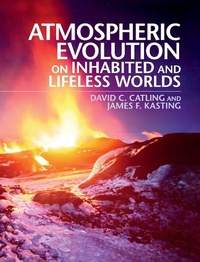
Atmospheric Evolution on Inhabited and Lifeless Worlds
Published on 13. April 2017
Book
Hardback
592 pages
978-0-521-84412-3 (ISBN)
Description
As the search for Earth-like exoplanets gathers pace, in order to understand them, we need comprehensive theories for how planetary atmospheres form and evolve. Written by two well-known planetary scientists, this text explains the physical and chemical principles of atmospheric evolution and planetary atmospheres, in the context of how atmospheric composition and climate determine a planet's habitability. The authors survey our current understanding of the atmospheric evolution and climate on Earth, on other rocky planets within our Solar System, and on planets far beyond. Incorporating a rigorous mathematical treatment, they cover the concepts and equations governing a range of topics, including atmospheric chemistry, thermodynamics, radiative transfer, and atmospheric dynamics, and provide an integrated view of planetary atmospheres and their evolution. This interdisciplinary text is an invaluable one-stop resource for graduate-level students and researchers working across the fields of atmospheric science, geochemistry, planetary science, astrobiology, and astronomy.
Reviews / Votes
'New books on the atmospheric sciences keep coming, ... The latest addition to the canon by David Catling and James Kasting is particularly noteworthy for its very comprehensive coverage of the subject, in nearly six hundred large pages, and for the eminence of its authors, both well-known and respected in the field. Much of the material covered is standard stuff - radiative transfer, photochemistry, thermodynamics, and so forth - but with a refreshingly clear treatment that will be of value to students, particularly those at the graduate level. The real strength, however, is in the coverage of evolutionary aspects: given the known physics, and the geological record, etc., what can we say about the Earth's atmosphere in the past, its origins, and how it evolved to what we see today? ... This is an excellent account of the current state of the art.' F. W. Taylor, The Observatory 'This volume concentrates on the structure, constituents and evolution of planetary atmospheres, which are clearly crucial to the potential for life on those worlds ... this book provides a detailed and comprehensive coverage of this fast-developing subject.' Room: The Space JournalMore details
Language
English
Place of publication
Cambridge
United Kingdom
Target group
Professional and scholarly
Illustrations
43 Tables, black and white; 13 Line drawings, color; 263 Line drawings, black and white
Dimensions
Height: 260 mm
Width: 208 mm
Thickness: 37 mm
Weight
1503 gr
ISBN-13
978-0-521-84412-3 (9780521844123)
Copyright in bibliographic data and cover images is held by Nielsen Book Services Limited or by the publishers or by their respective licensors: all rights reserved.
Schweitzer Classification
Other editions
Additional editions
David C. Catling
Atmospheric Evolution on Inhabited and Lifeless Worlds
E-Book
04/2017
Cambridge University Press
€60.49
Available for download
David C. Catling | James F. Kasting
Atmospheric Evolution on Inhabited and Lifeless Worlds
E-Book
03/2017
Cambridge University Press
€70.99
Available for download
Persons
David C. Catling is a Professor in Earth and Space Sciences at the University of Washington, studying planetary surfaces, atmospheres, and habitability. He actively participates in the research of NASA's Astrobiology Institute and is the author of Astrobiology: A Very Short Introduction (2013). He has taught courses in planetary atmospheres, planetary geology, astrobiology, and global environmental change at undergraduate and graduate levels. He was also an investigator for NASA's Phoenix Mars Lander, which successfully operated in the arctic of Mars during 2008. James F. Kasting is a Distinguished Professor of Geosciences at Pennsylvania State University, and an acknowledged expert on atmospheric and climate evolution. He is the author of How to Find a Habitable Planet (2010) and coauthor of the introductory textbook, The Earth System, 3rd edition (2009). Dr Kasting is a Fellow of the American Geophysical Union, the Geochemical Society, the International Society for the Study of the Origin of Life (ISSOL), the American Academy for the Advancement of Science, and the American Academy of Sciences. He received the Oparin Medal from International Society for the Study of the Origin of Life in 2008.
Content
Preface; Part I. Principles of Planetary Atmospheres: 1. The structure of planetary atmospheres; 2. Energy and radiation in planetary atmospheres; 3. Essentials of chemistry of planetary atmospheres; 4. Motions in planetary atmospheres; 5. Escape of atmospheres to space; Part II. Evolution of the Earth's Atmosphere: 6. Formation of Earth's atmosphere and oceans; 7. Volcanic outgassing and mantle redox evolution; 8. Atmospheric and global redox balance; 9. The prebiotic and early postbiotic atmosphere; 10. The rise of oxygen and ozone in Earth's atmosphere; 11. Long-term climate evolution; Part III. Atmospheres and Climates on Other Worlds: 12. Mars; 13. Evolution of Venus' atmosphere; 14. Giant planets and their satellites; 15. Exoplanets: habitability and characterization; Bibliography; Appendix A. One-dimensional climate model; Appendix B. Photochemical models; Appendix C. Atomic states and term symbols; Index.