

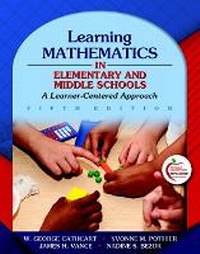
Learning Mathematics in Elementary and Middle Schools
A Learner-Centered Approach
5th Edition
Published on 10. February 2010
Book
Paperback/Softback
480 pages
978-0-13-242099-0 (ISBN)
Description
This popular text and it's new integrated online resource, MyEducationLab, promotes a learner-centered approach to teaching elementary and middle school mathematics. These resources provide valuable research-based instructional strategies, resources, and activities to help you learn to evaluate how children think mathematically and how to link that knowledge to developmentally appropriate teaching practices. A strong focus on NCTM Standards and developing critical tools to meet the individual needs of students ensures all students and teachers can be successful with math.
More details
Edition
5th edition
Language
English
Place of publication
United States
Publishing group
Pearson Education (US)
Target group
Professional and scholarly
Primary & secondary/elementary & high school
Dimensions
Height: 274 mm
Width: 218 mm
Thickness: 17 mm
Weight
860 gr
ISBN-13
978-0-13-242099-0 (9780132420990)
Copyright in bibliographic data and cover images is held by Nielsen Book Services Limited or by the publishers or by their respective licensors: all rights reserved.
Schweitzer Classification
Other editions
New editions
George Cathcart | George S. Cathcart | Yvonne M. Pothier
Learning Mathematics in Elementary and Middle Schools
Pearson New International Edition
Book
11/2013
5th Edition
Pearson Education Limited
€81.49
Shipment within 10-20 days
Previous edition
San Diego State University Foundation | Randy Philipp
Learning Math in Elementary and Middle School & IMAP Package
Book
05/2005
Pearson
€73.21
Article exhausted; check for reprint
Content
Table of Contents:
Chapter 1 Teaching Mathematics: Influences and Directives
Chapter 2 Learning and Teaching Mathematics
Chapter 3 Assessing Mathematics Understanding
Chapter 4 Developing Number Concepts
Chapter 5 Developing Understanding of Numeration
Chapter 6 Developing Whole-Number Operations:Meaning of Operations
Chapter 7 Developing Whole Number Operations: Mastering the Basic Facts
Chapter 8 Estimation and Computational Procedures for Whole Numbers
Chapter 9 Developing Fraction Concepts
Chapter 10 Developing Fraction Computation
Chapter 11 Developing Decimal Concepts and Computation
Chapter 12 Understanding Ratio, Proportion, and Percent
Chapter 13 Developing Geometric Thinking and Spatial Sense
Chapter 14 Developing Measurement Concepts and Skills
Chapter 15 Collecting, Organizing, and Interpreting Data
Chapter 16 Developing Algebraic Thinking
References
Appendix A Children's Literature Resources
Appendix B Guide to Blackline Masters
Perforated Manipulatives
1-3 Fraction Circles
4 Tangram
Chapter 1 Teaching Mathematics: Influences and Directives
Chapter 2 Learning and Teaching Mathematics
Chapter 3 Assessing Mathematics Understanding
Chapter 4 Developing Number Concepts
Chapter 5 Developing Understanding of Numeration
Chapter 6 Developing Whole-Number Operations:Meaning of Operations
Chapter 7 Developing Whole Number Operations: Mastering the Basic Facts
Chapter 8 Estimation and Computational Procedures for Whole Numbers
Chapter 9 Developing Fraction Concepts
Chapter 10 Developing Fraction Computation
Chapter 11 Developing Decimal Concepts and Computation
Chapter 12 Understanding Ratio, Proportion, and Percent
Chapter 13 Developing Geometric Thinking and Spatial Sense
Chapter 14 Developing Measurement Concepts and Skills
Chapter 15 Collecting, Organizing, and Interpreting Data
Chapter 16 Developing Algebraic Thinking
References
Appendix A Children's Literature Resources
Appendix B Guide to Blackline Masters
Perforated Manipulatives
1-3 Fraction Circles
4 Tangram