

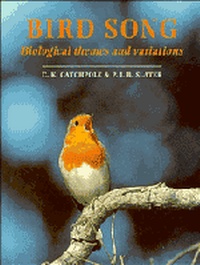
Bird Song
Biological Themes and Variations
Published on 30. October 2003
Book
Paperback/Softback
256 pages
978-0-521-54400-9 (ISBN)
Description
Bird Song has long been an inspiration to poets, and a delight to many other people, but why do birds sing? Bird song has been studied extensively in the past few decades, so that there is now hardly an area of animal behaviour on to which studies of song do not shed light. This book explores the study of bird song from the biological viewpoint, reviewing the literature written on the subject and considering its intricate nature. It is written with a wide readership in mind so that, while undergraduate and postgraduate students of biology may gain particularly from it, both professional biologists interested in bird behaviour and amateur ornithologists with some knowledge of biology will also find it a mine of information.
Reviews / Votes
'... an excellent contribution to the study of bird song. It deserves a wide readership, not only among students of biology and amateur ornithologists, but also among professional colleagues' Dr Torben Dabelsteen, IBISMore details
Language
English
Place of publication
Cambridge
United Kingdom
Target group
Professional and scholarly
Product notice
Paperback (trade)
Illustrations
3 Tables, unspecified; 91 Line drawings, unspecified
Dimensions
Height: 246 mm
Width: 190 mm
Thickness: 17 mm
Weight
477 gr
ISBN-13
978-0-521-54400-9 (9780521544009)
Copyright in bibliographic data and cover images is held by Nielsen Book Services Limited or by the publishers or by their respective licensors: all rights reserved.
Schweitzer Classification
Other editions
New editions
Book
05/2008
2nd Edition
Cambridge University Press
€95.70
Shipment within 15-20 days
Persons
Content
Introduction; 1. The study of bird song; 2. Production and perception; 3. How song develops; 4. Getting the message across; 5. When do birds sing?; 6. Recognition and territorial defence; 7. Sexual selection and female choice; 8. Themes and variations; 9. Variation in time and space; List of common and scientific names; References; Index.