


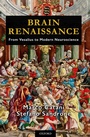
Brain Renaissance
From Vesalius to Modern Neuroscience
Published on 21. May 2015
Book
Hardback
304 pages
978-0-19-938383-2 (ISBN)
Description
Brain Renaissance, from Vesalius to modern neuroscience is published on the 500th anniversary of the birth and the 450th anniversary of the death of Vesalius. The authors translated those Latin chapters of the Fabrica dedicated to the brain, a milestone in the history of neuroscience. Many chapters are accompanied by a commentary tracking the discoveries that paved the way to our modern understanding of the brain - from the pineal gland that regulates sleep, the fornix and mammillary bodies for memory, the colliculi for auditory and visual perception, and the cerebellum for motor control, to the corpus callosum for interhemispheric cross-talk, the neural correlates of senses, and the methods for dissections. The chapters constitute a primer for those interested in the brain and history of neuroscience. The translation, written with modern anatomical terminology in mind, provides direct access to Vesalius' original work on the brain. Those interested in reading the words of the Renaissance master will find the book an invaluable addition to their Vesalian collection.
Brain Renaissance pays a tribute to the work of the pioneers of neuroscience and to the lives of those with brain disorders, through whose suffering most discoveries are made. It's an unforgettable journey inspired by the work of the great anatomist, whose words still resonate today.
Brain Renaissance pays a tribute to the work of the pioneers of neuroscience and to the lives of those with brain disorders, through whose suffering most discoveries are made. It's an unforgettable journey inspired by the work of the great anatomist, whose words still resonate today.
Reviews / Votes
Catani and Sandrone have produced a remarkable compilation of the history of neuroscience from Vesalius to the present day. The book highlights the complexity and wonder of the human body, specifically the brain and its functions. At the same time, the book honors the first physicians to observe and explore the human body like Vesalius. Catani and Sandrone's work is relevant both to students of medicine, and to those interested in Renaissance studies, medicine, and history. * Angela P. Pacheco, Purdue University. The British Society for Literature and Science * [This book is] a convincing attempt to use the fundamental discoveries of Andreas Vesalius as a key to start and develop multiple explorations of the brain. . . To have used an anatomist of five centuries ago as a guide through centuries of research on the brain is an original and somehow strange challenge. The fascination of Brain Renaissance, tells us that the goal was fully achieved. * Paolo Mazzarello, Department of Brain and Behavioral Sciences, and Historical Museum, Strada Nuova, Italy, in Studies in History and Philosophy of Biological and Biomedical Sciences XXX (2015) * This book is a compact and historically important contribution of interest to historians of science, especially biology. . . I feel it is even more valuable for those teaching neuroscience. . . [It helps] put our modern conceits as part of a long journey to understand mind and behaviour. * Gordon M. Burghardt, Professor in the departments of Psychology and Ecology and Evolutionary Biology at The University of Tennessee, in PsycCRITIQUES, Vol. 61, No. 2, January 2016 * In Brain Renaissance, neuroscientists Marco Catani and Stefano Sandrone present a translation from the Latin of the Fabricas last volume, which focuses on the brain..... Brain Renaissance is not the only English translation, but it is the only one available at a price that individuals might afford. Accompanying texts by Catani and Sandrone place the work in its historical and scientific context. * Alison Abbott, Nature *More details
Language
English
Place of publication
New York
United States
Target group
Professional and scholarly
Dimensions
Height: 240 mm
Width: 161 mm
Thickness: 21 mm
Weight
619 gr
ISBN-13
978-0-19-938383-2 (9780199383832)
Copyright in bibliographic data and cover images is held by Nielsen Book Services Limited or by the publishers or by their respective licensors: all rights reserved.
Schweitzer Classification
Other editions
Additional editions
E-Book
04/2015
1st Edition
OUP eBook
€59.49
Available for download
E-Book
04/2015
1st Edition
OUP eBook
€59.49
Available for download
Persons
Marco Catani
Neuroanatomy and Tractography Brain Laboratory
Department of Forensic and Neurodevelopmental Sciences
Institute of Psychiatry
Stefano Sandrone
Neuroanatomy and Tractography Brain Laboratory
Department of Forensic and Neurodevelopmental Sciences
Institute of Psychiatry
Neuroanatomy and Tractography Brain Laboratory
Department of Forensic and Neurodevelopmental Sciences
Institute of Psychiatry
Stefano Sandrone
Neuroanatomy and Tractography Brain Laboratory
Department of Forensic and Neurodevelopmental Sciences
Institute of Psychiatry
Content
- Preface ; -Introduction 1: The Anatomy of an anatomist ; - Introduction 2: A brief history of neuroscience from Vesalius to the connectome ; - Chapter 1: The brain is fabricated for the sake of the supreme spirit, the senses, and also the movement that depends upon our will ; - Chapter 2: On the dura membrane that surrounds the brain, and the small membrane covering the skull under the skin ; - Chapter 3: On the tenuis cerebral membranes ; - Chapter 4: On the number, position, shape, convolutions and substance of the brain and cerebellum ; Commentary: Scratching the surface of complexity ; - Chapter 5: On the corpus callosum of the brain and the septum of the right and left ventricles ; Commentary: A tale of anarchic hands and split brains ; - Chapter 6: On the cerebral ventricle ; Commentary: The liquor of our souls ; - Chapter 7: On the brain structure that expert dissectors have compared to a tortoise-like vault ; Commentary: A memory thread in the brain ; - Chapter 8: On the cerebral gland resembling a pine nut ; Commentary: From the seat of the soul to the SAD lamps ; - Chapter 9: On the testes [i.e. superior colliculi] and buttocks [i.e. inferior colliculi] of the brain ; Commentary: Sex on the hills ; - Chapter 10: On the processes of that [part of the] cerebellum that resembles a worm [i.e. vermis], and the tendons that contain them ; Commentary: More than a little brain ; - Chapter 11: On the infundibulum, the glandule that receives the cerebral phlegm and the other ducts that cleanse it ; Commentary: The axis of survival ; - Chapter 12: On the networks of the brain believed to be similar to the reticular plexus and the placenta ; Commentary: The net of wonder ; - Chapter 13: On the organ of smell ; - Chapter 14: On the eye, the instrument of vision ; - Chapter 15: On the organ of hearing ; - Chapter 16: On the organ of taste ; - Chapter 17: On the organ of touch ; - Chapter 18: How to dissect the brain and all the organs referred to in this brain ; -Appendix: Select Figures from Andreas Vesalius ; - Index