

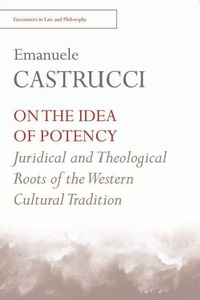
On the Idea of Potency
Juridical and Theological Roots of the Western Cultural Tradition
Published on 18. July 2016
Book
Paperback/Softback
200 pages
978-1-4744-1185-1 (ISBN)
Description
Sweeping through the history of Western philosophy of law, Emanuele Castrucci deals with the metaphysical idea of potency as defined by Spinoza and Nietzsche, upsetting entrenched theories of jurisprudence. From classical Greek philosophy to Jewish biblical exegesis, via Christianity; from Aristotle's Metaphysics to its Arabic interpretations; from the genesis of natural law theory (Augustine, Aquinas, Duns Scotus, Ockham), to Kant and Enlightenment natural law theory, to Carl Schmitt, Castrucci shows how philosophical rationalism has failed to contain absolute power in a juridical sense.
More details
Series
Language
English
Place of publication
Edinburgh
United Kingdom
Target group
Professional and scholarly
Product notice
Paperback (trade)
Unsewn / adhesive bound
Illustrations
4 black and white tables
Dimensions
Height: 213 mm
Width: 137 mm
Thickness: 10 mm
Weight
249 gr
ISBN-13
978-1-4744-1185-1 (9781474411851)
Copyright in bibliographic data and cover images is held by Nielsen Book Services Limited or by the publishers or by their respective licensors: all rights reserved.
Schweitzer Classification
Person
Emanuele Castrucci is Professor of Philosophy of Law at the University of Siena. He taught previously at the Universities of Florence and Genoa. His studies mainly concern the domain of the history of legal and political ideas, which include such areas as the sources and forms of modern European legal thought, the reconstruction of the legal theory of the early 20th century German State and the theological roots of the cultural tradition of Western civilization. He has contributed to the diffusion in Italy of the thought of Carl Schmitt, editing the Italian edition of Der Nomos der Erde im Voelkerrecht des Jus publicum Europaeum (1991).
Content
Preface
I. The Logos of Potency. A theoretical Introduction
II. Logos of 'Potentia Dei'
III. 'Ordained potency' vs. 'Absolute Potency'
IV. Political Theology Reconsidered
V. Genealogies of Constituent Potency. Schmitt, Nietzsche, Spinoza
Corollaries: I. On the Origins of Conventionalist Political Philosophy in the Seventeenth Century
II. The Problem of a Political Theology
III. Rhetoric of Ethical Universalism. Juergen Habermas and the Dissolution of Political Realism
Bibliography
Index of names
I. The Logos of Potency. A theoretical Introduction
II. Logos of 'Potentia Dei'
III. 'Ordained potency' vs. 'Absolute Potency'
IV. Political Theology Reconsidered
V. Genealogies of Constituent Potency. Schmitt, Nietzsche, Spinoza
Corollaries: I. On the Origins of Conventionalist Political Philosophy in the Seventeenth Century
II. The Problem of a Political Theology
III. Rhetoric of Ethical Universalism. Juergen Habermas and the Dissolution of Political Realism
Bibliography
Index of names