

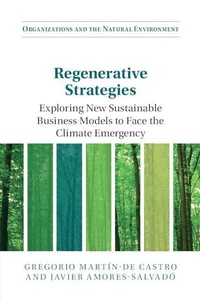
Regenerative Strategies
Exploring New Sustainable Business Models to Face the Climate Emergency
Published on 29. May 2025
Book
Paperback/Softback
260 pages
978-1-009-26194-4 (ISBN)
Description
In the current climate emergency, it is no longer enough for businesses to simply employ environmental strategy typologies focused on 'greening the business' and maintaining the 'business-as-usual' logic. Gregorio Martin-de Castro and Javier Amores-Salvado argue that disruptive business models and solutions are now required, and they propose a new regenerative strategy linking climate science to management studies. The main features of this strategy are:cutting-edge climate science solutions (capturing and utilizing atmospheric carbon dioxide to produce net-zero or net-negative emissions and positive environmental externalities) and a redefined firm purpose under an ecological, ethical and moral paradigm (integrating ecoemotional wealth, environmental performance, systemic socioecological resilience, wider stakeholder management and a very long-term perspective). They demonstrate that, by applying this strategy, companies can not only reduce their negative environmental externalities and create positive environmental externalities, but also reverse current environmental degradation through a new sustainable capitalism.
Reviews / Votes
'The climate emergency demands that we radically reinvent both the institutions of capitalism and the raison d'etre of business. Regenerative Strategies provides business and government leaders the requisite roadmap to achieve a truly sustainable form of commerce.' Stuart L. Hart, Co-Founder, University of Vermont's Sustainable Innovation MBA Program and author of 'Beyond Shareholder Primacy' 'Regenerative Strategies is a useful addition to recent discussions about the urgency of net positive carbon emission strategies versus reduction or mitigation carbon strategies. Without net positive or regenerative carbon strategies, the world does not currently have a pathway to ensure that average temperature increases are maintained below 2 percent in the 21st Century. The book adds a review of the extant academic literature on the topic and provides examples that will be useful for firms looking for ideas to generate net positive emissions.' Sanjay Sharma, Dean and Professor of Management. Grossman School of Business, University of Vermont 'Recommended.' J. Tuwun, ChoiceMore details
Series
Language
English
Place of publication
Cambridge
United Kingdom
Target group
Professional and scholarly
Product notice
Paperback (trade)
Illustrations
Worked examples or Exercises
Dimensions
Height: 229 mm
Width: 152 mm
Thickness: 14 mm
Weight
356 gr
ISBN-13
978-1-009-26194-4 (9781009261944)
Copyright in bibliographic data and cover images is held by Nielsen Book Services Limited or by the publishers or by their respective licensors: all rights reserved.
Schweitzer Classification
Other editions
Additional editions
Gregorio Martin-de Castro | Javier Amores-Salvado
Regenerative Strategies
Exploring New Sustainable Business Models to Face the Climate Emergency
Book
04/2024
Cambridge University Press
€121.50
Shipment within 15-20 days
Persons
Gregorio Martin-de Castro is Professor of Management at the Complutense University of Madrid. His research focus is on the intersection between business strategy and the natural environment. He is currently the President of the Business & Society Division of ACEDE - The Spanish Academy of Management. Javier Amores-Salvado is Associate Professor in the Management Department at the Complutense University of Madrid. His research focus is on the study of firms' environmental strategy and environmental innovation from the strategic management perspective.
Content
1. Introduction; 2. Assessing the response to the climate grand challenge: institutions, governments, business practice and management research; 3. Business-as-usual: a review of environmental strategies; 4. Sustainable business models; 5. Climate emergency in the anthropocene era; 6. The regenerative strategy; 7. Regenerative strategy: facing the climate emergency; 8. Concluding remarks.