

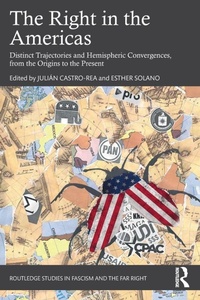
The Right in the Americas
Distinct Trajectories and Hemispheric Convergences, from the Origins to the Present
1st Edition
Published on 14. July 2023
Book
Paperback/Softback
250 pages
978-1-032-38695-9 (ISBN)
Description
The Right in the Americas discusses the origins, development, and current state of conservative and right-wing movements in ten countries in the Americas.
The growth of the right is one of the most important issues of the moment in global politics. Within the context of democracy erosion, rejection of traditional politics, and economic uncertainty, right and extreme-right actors are capable of offering misguided answers and hope to a significant part of a country's population, who will trust their promises and bring them to power with their vote. This dynamic has repeated itself in an astonishingly consistent pattern across the Americas. This book analyses eight Latin American countries-Argentina, Brazil, Chile, Colombia, Honduras, Mexico, Uruguay, and Venezuela-along with Canada and the United States, two G7 countries. It demonstrates that conservatism is in fact a hemispheric phenomenon, promoted and invigorated by the regional hegemon-the United States of America-both as government and as civil society. Beyond this regional scope, the peculiarities of each case study are explored in detail, providing solid historical background, while at the same time uncovering their commonalities and cross-pollination.
This study will be of great interest to scholars of conservatism, right-wing politics, comparative politics, and North American and Latin American politics.
The growth of the right is one of the most important issues of the moment in global politics. Within the context of democracy erosion, rejection of traditional politics, and economic uncertainty, right and extreme-right actors are capable of offering misguided answers and hope to a significant part of a country's population, who will trust their promises and bring them to power with their vote. This dynamic has repeated itself in an astonishingly consistent pattern across the Americas. This book analyses eight Latin American countries-Argentina, Brazil, Chile, Colombia, Honduras, Mexico, Uruguay, and Venezuela-along with Canada and the United States, two G7 countries. It demonstrates that conservatism is in fact a hemispheric phenomenon, promoted and invigorated by the regional hegemon-the United States of America-both as government and as civil society. Beyond this regional scope, the peculiarities of each case study are explored in detail, providing solid historical background, while at the same time uncovering their commonalities and cross-pollination.
This study will be of great interest to scholars of conservatism, right-wing politics, comparative politics, and North American and Latin American politics.
Reviews / Votes
'Academic research on the far right has traditionally focused on such movements in Western Europe and North America. This volume shifts the focus to cover the entire American continent, addressing differences, similarities and connections. Of particular interest is the role of US governments and conservative movements to promote and support far right and authoritarian regimes and movements in Latin America. This is an important contribution.'Tore Bjorgo, Director, Center for Research on Extremism (C-REX), University of Oslo, Norway
'This volume could not be more timely. The resilience of an extreme nationalist right throughout the Western Hemisphere is an abiding fact of the twenty-first century. It manifests itself in terms of political economy, in the "culture wars" (these days look at the transnational attacks on "woke" gender-based thinking) and in electoral politics. This right's resilience derives from two sources-the self interest to preserve its privileges among wealthy classes, and from a sense of being "left behind" or "replaced" on the part of a cultural and economic "precariat". But it also depends on a right-wing infrastructure that well predates contemporary controversies. Illuminating these enduring sources of the political right is the great virtue of this collection. The ten country-by-country studies in The Right in the Americas tie today's extreme right ascendency to its predecessors and their continuing and often shape-shifting role, and to the uninterrupted influence of US hegemonic power. For readers, for political thinkers and for political actors, the book is a caution against facile convictions of the right's vulnerabilities and about the limitations of short-term political thinking and strategies.'
Lawrence Rosenthal, Chair, Berkeley Center for Right-Wing Studies, USA
'The ascent of the new right, in particular in its extreme variants, has raised red flags around the world, especially in our Hemisphere. It results from the crisis affecting democracy, particularly at its traditional sources, which has been unable to catch up with new demands and has lost space vis-a-vis these emergent forms. This is why this book is important, the authors in their respective fields explore the roots and the new processes explaining the right's ascent in national case studies that cover significant geographical areas, presenting their similarities and substantial differences. The authors transcend the frontiers of politics and address economic, social and cultural issues, offering analyses from diverse perspectives that this volume manages to reconcile. One of its merits rests in the authors' ability to challenge old understandings, reworking arguments that address the complexity of contemporary crises, as well as having perceived the inroads that new technologies are opening in the ideological dispute; allowing political actors to even capture discursive and organizational tools from their adversaries.'
Hernan Ramirez, Research Professor, Universidade do Vale do Rio dos Sinos (UNISINOS), Brazil
'In line with the wave of conservative groups, neoliberal sectors, and anti-communist and neo-fascist organizations that have nurtured the right-wing and the European New Right during the current century in the Americas, we have also noted a strong activism from various social and political actors, and the strengthening of governments that reinforce the worldview and the values that define this sector of the international political geometry. In that landscape, this text represents an excellent and important collective effort of academics from various countries of the Americas that present the particularities of varying right-wing lineages and discover the elements that unify them, especially, throughout the 20th and 21st centuries. Altogether, these works reveal a broad right-wing geopolitical strategy, a process in which the United States keeps playing a central role, as the source from which key ideas emerge and networks with a decisive influence are strengthened along the continent. The book is an obligatory reference for those who wish to understand the development of a broad front of actors that compete with the left for the economic, political and social powers in the Americas. In the contest for hegemony in the continent, the right persists on showing its capability for reorganizing and for exercising the government, and for that, they utilize old narratives and mechanisms of political articulation, but they also succeed in incorporating unprecedented discursive and programmatic repertoires, that prove appealing to large social sectors.'
Tania Hernandez, Director, Permanent Seminar on the Right in Mexico, National Institute of Anthropology and History (INAH), Mexico
More details
Series
Language
English
Place of publication
London
United Kingdom
Publishing group
Taylor & Francis Ltd
Target group
College/higher education
Postgraduate
Illustrations
8 s/w Abbildungen, 1 farbige Abbildung, 1 s/w Photographie bzw. Rasterbild, 1 Farbfoto bzw. farbiges Rasterbild, 7 s/w Zeichnungen, 4 s/w Tabellen
4 Tables, black and white; 7 Line drawings, black and white; 1 Halftones, color; 1 Halftones, black and white; 1 Illustrations, color; 8 Illustrations, black and white
Dimensions
Height: 234 mm
Width: 156 mm
Thickness: 15 mm
Weight
421 gr
ISBN-13
978-1-032-38695-9 (9781032386959)
Copyright in bibliographic data and cover images is held by Nielsen Book Services Limited or by the publishers or by their respective licensors: all rights reserved.
Schweitzer Classification
Other editions
Additional editions
Julian Castro-Rea | Esther Solano
The Right in the Americas
Distinct Trajectories and Hemispheric Convergences, from the Origins to the Present
E-Book
07/2023
1st Edition
Routledge
€53.99
Available for download
Julian Castro-Rea | Esther Solano
The Right in the Americas
Distinct Trajectories and Hemispheric Convergences, from the Origins to the Present
E-Book
07/2023
1st Edition
Routledge
€53.99
Available for download
Julian Castro-Rea | Esther Solano
The Right in the Americas
Distinct Trajectories and Hemispheric Convergences, from the Origins to the Present
Book
07/2023
1st Edition
Routledge
€216.70
Shipment within 10-20 days
Persons
Julian Castro-Rea is Professor in the Department of Political Science at the University of Alberta, Canada.
Esther Solano is Professor of International Relations at Federal University of Sao Paulo, Brazil.
Esther Solano is Professor of International Relations at Federal University of Sao Paulo, Brazil.
Content
Introduction: The Right in the Americas Part I: The Americas as Right-Wing Transnational Space 1. United States: The Mecca of Conservatism in the Americas and its International Projection Part II: Genesis and Development of Right-Wing Actors 2. Argentina: Democracy, Authoritarianism and the Pursuit of Order 3. Canada: The Evolution, Transformation, and Diversity of Conservatism 4. Colombia: Matrices, Tensions and Contexts for Explaining the Origin and Change of Right-Wing Politics 5. Honduras: The Problem of the Origin of Political Ideas on the Right 6. Mexico: The Right, from Opposition to Power and Back 7. Uruguay: The Political Right and Some Landmark Moments in History, from the Foundational Anti-Jacobinism to the Reemergence of the Militaristic Far-Right Part III: Contemporary Expressions of the Right 8. Brazil: The New Right and the Rise of Jair Bolsonaro 9. Chile: Orthodoxy and Heterodoxy on the Right 10. Venezuela: Democracy as Market, or How the Right-Wing Opposition Confused the Two in its Quest for Power Part IV: Conclusions The Right in the Americas: Concluding Remarks