

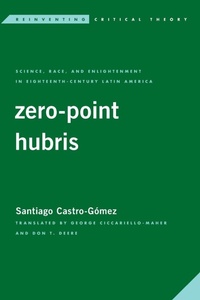
Zero-Point Hubris
Science, Race, and Enlightenment in Eighteenth-Century Latin America
Published on 16. December 2021
Book
Paperback/Softback
330 pages
978-1-78661-377-6 (ISBN)
Description
Operating within the framework of postcolonial studies and decolonial theory, this important work starts from the assumption that the violence exercised by European colonialism was not only physical and economic, but also 'epistemic'. Santiago Castro-Gomez argues that toward the end of the eighteenth century, this epistemic violence of the Spanish Empire assumed a specific form: zero-point hubris. The 'many forms of knowing' were integrated into a chronological hierarchy in which scientific-enlightened knowledge appears at the highest point on the cognitive scale, while all other epistemes are seen as constituting its past. Enlightened criollo thinkers did not hesitate to situate the Black, Indigenous, and mestizo peoples of New Granada in the lowest position on this cognitive scale. Castro-Gomez argues that in the colonial periphery of the Spanish Americas, Enlightenment constituted not only the position of epistemic distance separating science from all other knowledges, but also the position of ethnic distance separating the criollos from the 'castes'. Epistemic violence-and not only physical violence-is thereby found at the very origin of Colombian nationality.
Reviews / Votes
With its focus on bio-politics and the creation of an imperial science, Zero-Point Hubris takes decolonial theory to the next level. By focusing on the practices of coloniality in Latin America, Castro-Gomez troubles the rigidity of the binary between center and periphery. He shows how Criollo elites in Latin America fashioned a distinctive form of whiteness, naturalizing inequality and their own privilege. This is a critically important work. -- Linda Martin Alcoff, professor of philosophy, City University of New York Santiago Castro-Gomez is undoubtedly one of the most original Latin American philosophers of the last two decades. Through a series of brilliant books, some of which are finally appearing in English, he has carved a distinct path between the historicizing history of ideas (which gave us Latinamericanism) and an ontologizing decolonial theorizing (which gave us the coloniality of power). Provincializing and localizing the genealogical method Castro-Gomez has forged a powerful analytical method that focuses on epistemic, governmentality, and racializing practices and regimes that renders legible the dialectics between coloniality and modernity. After Zero-Point Hubris we can talk about decolonizing genealogies and we will have to read both Immanuel Kant and Michel Foucault differently. -- Eduardo Mendieta, Pennsylvania State UniversityMore details
Series
Language
English
Place of publication
United Kingdom
Publishing group
Bloomsbury Publishing PLC
Target group
Professional and scholarly
Illustrations
6 b/w illustrations;
Dimensions
Height: 229 mm
Width: 152 mm
Thickness: 18 mm
Weight
482 gr
ISBN-13
978-1-78661-377-6 (9781786613776)
Copyright in bibliographic data and cover images is held by Nielsen Book Services Limited or by the publishers or by their respective licensors: all rights reserved.
Schweitzer Classification
Other editions
Additional editions
Santiago Castro-Gomez
Zero-Point Hubris
Science, Race, and Enlightenment in Eighteenth-Century Latin America
E-Book
12/2021
1st Edition
Rowman & Littlefield Publishers
€43.49
Available for download
Persons
Santiago Castro-Gomez is professor of philosophy at the University of Santo Tomas and the University Javeriana in Bogota, Colombia. He has taught as visiting professor at Duke University, Pittsburgh University, and the University of Frankfurt. His book, Critique of Latin American Reason is now a classic text of Latin American philosophy. His many other publications include La hybris del punto cero, Tejidos oniricos, History of Governmentality, Volumes I & II, and Revolutions without Subject.
George Ciccariello-Maher is Visiting Associate Professor of Political Science at Vassar College.
Don T. Deere is Visiting Assistant Professor of Philosophy at Wesleyan University.
George Ciccariello-Maher is Visiting Associate Professor of Political Science at Vassar College.
Don T. Deere is Visiting Assistant Professor of Philosophy at Wesleyan University.
Content
Translator's Introduction / 1. Places of Enlightenment: Colonial Discourse and Geopolitics of Knowledge in the Century of Enlightenment / 2. Purus ab omnia macula sanguinis: The colonial imaginary of whiteness in New Granada / 3. Imperial Biopolitics: Health and sickness in the framework of Bourbonic reforms / 4. Illegitimate Knowledges: The Enlightenment as mechanism of epistemic expropriation / 5. Striated Spaces: Geography, territorial politics, and population control / Epilogue / Appendix (to the 2nd edition) / Bibliography / Index