

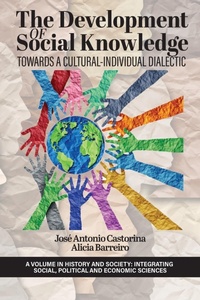
The Development of Social Knowledge
Towards a Cultural-Individual Dialectic
Published on 17. August 2023
Book
Paperback/Softback
208 pages
979-8-88730-254-6 (ISBN)
Description
The result of a deep research work sustained for more than two decades, this book studies the construction of social knowledge from a constructivist perspective inherited from Piagetian thought. It thus advances in a process of revision and discussion, while maintaining crucial aspects of this current for the approach to the construction of the subject and the object of knowledge, in the search for the elaboration of an explanatory theory for the formation of new knowledge. A collaborative proposal between different disciplines of potential interest for the different actors who study and intervene in this field.
More details
Series
Language
English
Place of publication
United States
Publishing group
Emerald Publishing Inc
Target group
Professional and scholarly
Dimensions
Height: 234 mm
Width: 156 mm
Thickness: 11 mm
Weight
324 gr
ISBN-13
979-8-88730-254-6 (9798887302546)
Copyright in bibliographic data and cover images is held by Nielsen Book Services Limited or by the publishers or by their respective licensors: all rights reserved.
Schweitzer Classification
Other editions
Additional editions
José Antonio Castorina | Alicia Barreiro
The Development of Social Knowledge
Towards a Cultural-individual Dialectic
E-Book
08/2023
1st Edition
IAP - Information Age Publishing
€80.60
Available for download
Content
Introduction: The Development of Social Knowledge: Towards a Cultural-Individual Dialectic; Jose Antonio Castorina and Alicia Barreiro.
Chapter 1. The Concept of Epistemic Frame: Variety of Applications and Challenges; Gaston Becerra and Jose Antonio Castorina.
Chapter 2. Historical Conditions of Knowledge Construction: A Foucauldian Perspective; Tomas Baquero Cano.
Chapter 3. Uses and Meanings of Context in Studies on Children's Knowledge: A Viewpoint From Anthropology and Constructivist Psychology; Mariana Garci-a Palacios, Paula Shabel, Axel Horn, and Jose Antonio Castorina.
Chapter 4. The Contribution of Social Representations Theory to the Study of Moral Development; Jose Antonio Castorina and Alicia Barreiro.
Chapter 5. Dialectical Inferences in the Ontogenesis of Social Representations; Alicia Barreiro and Jose Antonio Castorina.
Chapter 6. Representation and Silencing of Social Meanings in Cartography: The Case of the Conquest of the Desert; Cristian Parellada, Jose Antonio Castorina, and Alicia Barreiro.
Chapter 7. Cognitive Polyphasia, Social Representations and Political Participation in Adolescents; Daniela Bruno and Alicia Barreiro.
Chapter 8. The Government, the President, and the Police: Politics According to Children Living in a Squatted House; Paula Nurit Shabel.
Chapter 9. The Right to Privacy in Secondary School: Ideas of Adolescents; Mariela Helman, Axel Horn, and Jose Antonio Castorina.
Biographies.
Chapter 1. The Concept of Epistemic Frame: Variety of Applications and Challenges; Gaston Becerra and Jose Antonio Castorina.
Chapter 2. Historical Conditions of Knowledge Construction: A Foucauldian Perspective; Tomas Baquero Cano.
Chapter 3. Uses and Meanings of Context in Studies on Children's Knowledge: A Viewpoint From Anthropology and Constructivist Psychology; Mariana Garci-a Palacios, Paula Shabel, Axel Horn, and Jose Antonio Castorina.
Chapter 4. The Contribution of Social Representations Theory to the Study of Moral Development; Jose Antonio Castorina and Alicia Barreiro.
Chapter 5. Dialectical Inferences in the Ontogenesis of Social Representations; Alicia Barreiro and Jose Antonio Castorina.
Chapter 6. Representation and Silencing of Social Meanings in Cartography: The Case of the Conquest of the Desert; Cristian Parellada, Jose Antonio Castorina, and Alicia Barreiro.
Chapter 7. Cognitive Polyphasia, Social Representations and Political Participation in Adolescents; Daniela Bruno and Alicia Barreiro.
Chapter 8. The Government, the President, and the Police: Politics According to Children Living in a Squatted House; Paula Nurit Shabel.
Chapter 9. The Right to Privacy in Secondary School: Ideas of Adolescents; Mariela Helman, Axel Horn, and Jose Antonio Castorina.
Biographies.