

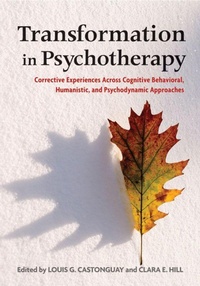
Transformation in Psychotherapy
Corrective Experiences Across Cognitive Behavioral, Humanistic, and Psychodynamic Approaches
Will be published approx. on 15. June 2012
Book
Hardback
390 pages
978-1-4338-1159-3 (ISBN)
Description
Veteran psychotherapy scholars Louis G. Castonguay and Clara E. Hill team up again for this comprehensive look at corrective experiences across the main psychotherapeutic approaches.
Presented in two parts, this edited volume brings together leading scholar-practitioners to map out the theoretical bases of corrective experiences (Part I) and new research on transformative events across various client perspectives, different psychotherapeutic schools, and treatments for specific clinical problems, such as generalized anxiety disorder and anorexia nervosa (Part II).
Written for the therapist as well as the clinical researcher, Transformation in Psychotherapy provides conceptually sophisticated and clinically rich perspectives of the process of change that will appeal to scholars and graduate students specializing in psychotherapy practice and research.
Presented in two parts, this edited volume brings together leading scholar-practitioners to map out the theoretical bases of corrective experiences (Part I) and new research on transformative events across various client perspectives, different psychotherapeutic schools, and treatments for specific clinical problems, such as generalized anxiety disorder and anorexia nervosa (Part II).
Written for the therapist as well as the clinical researcher, Transformation in Psychotherapy provides conceptually sophisticated and clinically rich perspectives of the process of change that will appeal to scholars and graduate students specializing in psychotherapy practice and research.
More details
Language
English
Place of publication
Washington DC
United States
Target group
Professional and scholarly
Product notice
Unsewn / adhesive bound
Paper over boards
Dimensions
Height: 261 mm
Width: 182 mm
Thickness: 27 mm
Weight
883 gr
ISBN-13
978-1-4338-1159-3 (9781433811593)
Copyright in bibliographic data and cover images is held by Nielsen Book Services Limited or by the publishers or by their respective licensors: all rights reserved.
Schweitzer Classification
Persons
Louis G. Castonguay, PhD, completed his doctorate in clinical psychology at State University of New York amp ndash Stony Brook a clinical internship at University of California, Berkeley and a postdoctorate at Stanford University. He is currently a professor in the Department of Psychology at Penn State University. With more than 2 publications (including four coedited books), his scholarly work and research focus on different aspects of the process of change and training, especially within the context of psychotherapy integration. He is also involved in the investigation of the efficacy of new integrative treatments for generalized anxiety disorder and depression, and the development of practice research networks aimed at facilitating the collaboration between clinicians and researchers. He has received several awards, including the Early Career Contribution Award from the Society of Psychotherapy Research and the David Shakow Award from APA's Division 2 (Society of Clinical Psychology). He has also received four recognitions from the APA Division 29 (Division of Psychotherapy): the Jack D. Krasner Memorial Award, the Award for Distinguished Contributions to Teaching and Mentoring, the Distinguished Research Publications Award, and the Distinguished Psychologist Award for his lifetime contributions to the field of psychotherapy. He also served as president of the North American Society for Psychotherapy Research and the International Society for Psychotherapy Research.
Clara E. Hill, PhD, completed her doctorate in counseling psychology at Southern Illinois University and a clinical internship at the University of Florida. She is currently a professor in the Department of Psychology at the University of Maryland, College Park. With more than 25 publications (including books), her scholarly work and research focus on psychotherapy process, therapist interventions, therapist training, dream work, and qualitative research methods. She has received several awards, including the Leona Tyler Award from APA Division 7 (Society of Counseling Psychology), the Distinguished Psychologist Award from APA Division 29 (Psychotherapy), the Outstanding Lifetime Achievement Award from the Section of Counseling and Psychotherapy Process and Outcome Research of the Society for Counseling Psychology, and the Distinguished Research Career Award, Society for Psychotherapy Research. She served as editor of the Journal of Counseling Psychology and Psychotherapy Research, and also served as the president of the North American Society for Psychotherapy Research and the International Society for Psychotherapy Research.
Clara E. Hill, PhD, completed her doctorate in counseling psychology at Southern Illinois University and a clinical internship at the University of Florida. She is currently a professor in the Department of Psychology at the University of Maryland, College Park. With more than 25 publications (including books), her scholarly work and research focus on psychotherapy process, therapist interventions, therapist training, dream work, and qualitative research methods. She has received several awards, including the Leona Tyler Award from APA Division 7 (Society of Counseling Psychology), the Distinguished Psychologist Award from APA Division 29 (Psychotherapy), the Outstanding Lifetime Achievement Award from the Section of Counseling and Psychotherapy Process and Outcome Research of the Society for Counseling Psychology, and the Distinguished Research Career Award, Society for Psychotherapy Research. She served as editor of the Journal of Counseling Psychology and Psychotherapy Research, and also served as the president of the North American Society for Psychotherapy Research and the International Society for Psychotherapy Research.
Content
Contributors
Acknowledgements
Corrective Experiences in Psychotherapy: An Introduction
Louis G. Castonguay and Clara E. Hill
I. Theoretical Perspectives on Corrective Experiences
The Corrective Experience: A Core Principle for Therapeutic Change
Marvin R. Goldfried
Corrective Emotional Experiences From a Psychodynamic Perspective
Brian A. Sharpless and Jacques P. Barber
The Corrective Emotional Experience: A Relational Perspective and Critique
Christopher Christian, Jeremy D. Safran, and J. Christopher Muran
A Cognitive Behavioral Perspective on Corrective Experiences
Adele M. Hayes, J. Gayle Beck, and Carly Yasinski
Corrective Experience From a Humanistic amp ndash Experiential Perspective
Leslie S. Greenberg and Robert Elliott
Corrective (Emotional) Experience in Person-Centered Therapy: Carl Rogers and Gloria Redux
Barry A. Farber, Arthur C. Bohart, and William B. Stiles
An Expectancy-Based Approach to Facilitating Corrective Experiences in Psychotherapy
Michael J. Constantino and Henny A. Westra
Corrective Experiences: What Can We Learn From Different Models and Research in Basic Psychology?
Franz Caspar and Thomas Berger
II. Empirical Investigations of Corrective Experiences
Clients' Perspectives on Corrective Experiences in Psychotherapy
Laurie Heatherington, Michael J. Constantino, Myrna L. Friedlander, Lynne E. Angus, and Stanley B. Messer
Corrective Relational Experiences: Client Perspectives
Sarah Knox, Shirley A. Hess, Clara E. Hill, Alan W. Burkard, and Rachel E. Crook-Lyon
Relational Events in Acceptance and Commitment Therapy for Three Clients With Anorexia Nervosa: What Is Corrective?
Margit I. Berman, Clara E. Hill, Jingqing Liu, John Jackson, Wonjin Sim, and Patricia Spangler
Corrective Experiences in Cognitive Behavioral and Interpersonal amp ndash Emotional Processing Therapies: A Qualitative Analysis of a Single Case
Louis G. Castonguay, Dana L. Nelson, James F. Boswell, Samuel S. Nordberg, Andrew A. McAleavey, Michelle G. Newman, and Thomas D. Borkovec
Varieties of Corrective Experiencing in Context: A Study of Contrasts
Timothy Anderson, Benjamin M. Ogles, Bernadette D. Heckman, and Peter MacFarlane
The Stream of Corrective Experiences in Action: Big Bang and Constant Dripping
Martin Grosse Holtforth, and Christoph Fl amp uuml ckiger
Corrective Relational Experiences in Supervision
Nicholas Ladany, Arpana G. Inman, Clara E. Hill, Sarah Knox, Rachel E. Crook-Lyon, Barbara J. Thompson, Alan W. Burkard, Shirley A. Hess, Elizabeth Nutt Williams, and Jessica A. Walker
III. Conclusions
Corrective Experiences in Psychotherapy: Definitions, Processes, Consequences, and Research Directions
Clara E. Hill, Louis G. Castonguay, Barry A. Farber, Sarah Knox, William B. Stiles, Timothy Anderson, Lynne E. Angus, Jacques P. Barber, J. Gayle Beck, Arthur C. Bohart, Franz Caspar, Michael J. Constantino, Robert Elliott, Myrna L. Friedlander, Marvin R. Goldfried, Leslie S. Greenberg, Martin Grosse Holtforth, Adele M. Hayes, Jeffrey A. Hayes, Laurie Heatherington, Nicholas Ladany, Kenneth N. Levy, Stanley B. Messer, J. Christopher Muran, Michelle G. Newman, Jeremy D. Safran, and Brian A. Sharpless
Index
About the Editors
Acknowledgements
Corrective Experiences in Psychotherapy: An Introduction
Louis G. Castonguay and Clara E. Hill
I. Theoretical Perspectives on Corrective Experiences
The Corrective Experience: A Core Principle for Therapeutic Change
Marvin R. Goldfried
Corrective Emotional Experiences From a Psychodynamic Perspective
Brian A. Sharpless and Jacques P. Barber
The Corrective Emotional Experience: A Relational Perspective and Critique
Christopher Christian, Jeremy D. Safran, and J. Christopher Muran
A Cognitive Behavioral Perspective on Corrective Experiences
Adele M. Hayes, J. Gayle Beck, and Carly Yasinski
Corrective Experience From a Humanistic amp ndash Experiential Perspective
Leslie S. Greenberg and Robert Elliott
Corrective (Emotional) Experience in Person-Centered Therapy: Carl Rogers and Gloria Redux
Barry A. Farber, Arthur C. Bohart, and William B. Stiles
An Expectancy-Based Approach to Facilitating Corrective Experiences in Psychotherapy
Michael J. Constantino and Henny A. Westra
Corrective Experiences: What Can We Learn From Different Models and Research in Basic Psychology?
Franz Caspar and Thomas Berger
II. Empirical Investigations of Corrective Experiences
Clients' Perspectives on Corrective Experiences in Psychotherapy
Laurie Heatherington, Michael J. Constantino, Myrna L. Friedlander, Lynne E. Angus, and Stanley B. Messer
Corrective Relational Experiences: Client Perspectives
Sarah Knox, Shirley A. Hess, Clara E. Hill, Alan W. Burkard, and Rachel E. Crook-Lyon
Relational Events in Acceptance and Commitment Therapy for Three Clients With Anorexia Nervosa: What Is Corrective?
Margit I. Berman, Clara E. Hill, Jingqing Liu, John Jackson, Wonjin Sim, and Patricia Spangler
Corrective Experiences in Cognitive Behavioral and Interpersonal amp ndash Emotional Processing Therapies: A Qualitative Analysis of a Single Case
Louis G. Castonguay, Dana L. Nelson, James F. Boswell, Samuel S. Nordberg, Andrew A. McAleavey, Michelle G. Newman, and Thomas D. Borkovec
Varieties of Corrective Experiencing in Context: A Study of Contrasts
Timothy Anderson, Benjamin M. Ogles, Bernadette D. Heckman, and Peter MacFarlane
The Stream of Corrective Experiences in Action: Big Bang and Constant Dripping
Martin Grosse Holtforth, and Christoph Fl amp uuml ckiger
Corrective Relational Experiences in Supervision
Nicholas Ladany, Arpana G. Inman, Clara E. Hill, Sarah Knox, Rachel E. Crook-Lyon, Barbara J. Thompson, Alan W. Burkard, Shirley A. Hess, Elizabeth Nutt Williams, and Jessica A. Walker
III. Conclusions
Corrective Experiences in Psychotherapy: Definitions, Processes, Consequences, and Research Directions
Clara E. Hill, Louis G. Castonguay, Barry A. Farber, Sarah Knox, William B. Stiles, Timothy Anderson, Lynne E. Angus, Jacques P. Barber, J. Gayle Beck, Arthur C. Bohart, Franz Caspar, Michael J. Constantino, Robert Elliott, Myrna L. Friedlander, Marvin R. Goldfried, Leslie S. Greenberg, Martin Grosse Holtforth, Adele M. Hayes, Jeffrey A. Hayes, Laurie Heatherington, Nicholas Ladany, Kenneth N. Levy, Stanley B. Messer, J. Christopher Muran, Michelle G. Newman, Jeremy D. Safran, and Brian A. Sharpless
Index
About the Editors