

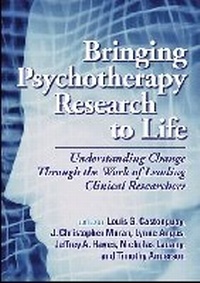
Bringing Psychotherapy Research to Life
Understanding Change Through the Work of Leading Clinical Researchers
Will be published approx. on 15. May 2010
Book
Hardback
378 pages
978-1-4338-0774-9 (ISBN)
Description
Many clinicians today are unaware of the implications of psychotherapy research for their practice. And while they know where to find details on methods and statistical procedures, today amp rsquo s clinicians may not grasp the larger picture of psychotherapy research from the past 5 years.
Bringing Psychotherapy Research to Life attempts to bridge these gaps by highlighting the work of 28 distinguished psychotherapy researchers, showing how their research programs changed the way we think about and practice psychotherapy.
Bringing Psychotherapy Research to Life attempts to bridge these gaps by highlighting the work of 28 distinguished psychotherapy researchers, showing how their research programs changed the way we think about and practice psychotherapy.
More details
Language
English
Place of publication
Washington DC
United States
Target group
Professional and scholarly
Dimensions
Height: 254 mm
Width: 178 mm
ISBN-13
978-1-4338-0774-9 (9781433807749)
Copyright in bibliographic data and cover images is held by Nielsen Book Services Limited or by the publishers or by their respective licensors: all rights reserved.
Schweitzer Classification
Persons
Louis G. Castonguay, PhD, is a professor of psychology at Penn State University. His work focuses on the process, outcome, and training of psychotherapy, as well as on the development of practice amp ndash research networks. He has coedited three books: on psychotherapy integration (with Conrad Lecomte), on principles of therapeutic change (with Larry Beutler), and on insight in psychotherapy (with Clara Hill).
J. Christopher Muran, PhD, is associate dean and professor, Derner Institute, Adelphi University, and director, Brief Psychotherapy Research Program, Beth Israel Medical Center. His research has concentrated on alliance ruptures and resolution processes and has resulted several book collaborations, including Negotiating the Therapeutic Alliance, Self-Relations in the Psychotherapy Process, Dialogues on Difference, and Therapeutic Alliance.
Lynne Angus, PhD, is a professor of psychology at York University in Toronto, Canada. She is the senior editor of the Handbook of Narrative and Psychotherapy (with John McLeod). Her research focuses on the investigation of narrative and emotion processes in psychotherapy, and she has developed the Narrative Processes Coding System (with Heidi Levitt and Karen Hardtke) for application in differing treatment approaches.
Jeffrey A. Hayes, PhD, is a professor of counseling psychology at Penn State University. His scholarship focuses on the psychotherapy relationship, with an emphasis on therapist factors and the integration of spirituality and psychology. He has coauthored two books with Charles Gelso, The Psychotherapy Relationship and Countertransference and the Therapists' Inner Experience: Perils and Possibilities.
Nicholas Ladany, PhD, is a professor of counseling psychology at Lehigh University in Bethlehem, Pennsylvania. He is the author of three books on supervision and training: Critical Events in Psychotherapy Supervision: An Interpersonal Approach Counselor Supervision: Principles, Process, and Practice and Practicing Counseling and Psychotherapy: Insights from Trainees, Clients, and Supervisors.
Timothy Anderson, PhD, is an associate professor of psychology at Ohio University in Athens. His current research is on the identification of common therapist factors that predict therapy processes and outcome. He is the recipient of the 2 4 Distinguished Early Career Award from the International Society for Psychotherapy Research.
J. Christopher Muran, PhD, is associate dean and professor, Derner Institute, Adelphi University, and director, Brief Psychotherapy Research Program, Beth Israel Medical Center. His research has concentrated on alliance ruptures and resolution processes and has resulted several book collaborations, including Negotiating the Therapeutic Alliance, Self-Relations in the Psychotherapy Process, Dialogues on Difference, and Therapeutic Alliance.
Lynne Angus, PhD, is a professor of psychology at York University in Toronto, Canada. She is the senior editor of the Handbook of Narrative and Psychotherapy (with John McLeod). Her research focuses on the investigation of narrative and emotion processes in psychotherapy, and she has developed the Narrative Processes Coding System (with Heidi Levitt and Karen Hardtke) for application in differing treatment approaches.
Jeffrey A. Hayes, PhD, is a professor of counseling psychology at Penn State University. His scholarship focuses on the psychotherapy relationship, with an emphasis on therapist factors and the integration of spirituality and psychology. He has coauthored two books with Charles Gelso, The Psychotherapy Relationship and Countertransference and the Therapists' Inner Experience: Perils and Possibilities.
Nicholas Ladany, PhD, is a professor of counseling psychology at Lehigh University in Bethlehem, Pennsylvania. He is the author of three books on supervision and training: Critical Events in Psychotherapy Supervision: An Interpersonal Approach Counselor Supervision: Principles, Process, and Practice and Practicing Counseling and Psychotherapy: Insights from Trainees, Clients, and Supervisors.
Timothy Anderson, PhD, is an associate professor of psychology at Ohio University in Athens. His current research is on the identification of common therapist factors that predict therapy processes and outcome. He is the recipient of the 2 4 Distinguished Early Career Award from the International Society for Psychotherapy Research.
Content
Contributors
Preface
A Brief Introduction to Psychotherapy Research
-J. Christopher Muran, Louis G. Castonguay, and Berhnard Strauss
I. Establishing the Foundation for the Scientific Study of Psychotherapy
Carl Rogers: Idealistic Pragmatist and Psychotherapy Research Pioneer
-Robert Elliott and Barry A. Farber
Jerome D. Frank: Psychotherapy Researcher and Humanitarian
-Bruce E. Wampold and Joel Weinberger
Lester Luborsky: A Trailblazer in Empirical Research on Psychoanalytic Therapy
-Paul Crits-Christoph, Jacques P. Barber, Brin F. S. Grenyer, and Louis Diguer
Hans Strupp: A Founder's Contributions to a Scientific Basis for Psychotherapy Practice
-Karla Moras, Timothy Anderson, and William E. Piper
Aaron T. Beck: The Cognitive Revolution in Theory and Therapy
-Steven D. Hollon
II. Does Psychotherapy Work?
Irene Elkin: amp quot The Data Are Always Friendly amp quot
-Karla Moras and M. Tracie Shea
Kenneth I. Howard: The Best Friend That Psychotherapy Research Ever Had.
-David E. Orlinsky, Merton S. Krause, Fredrick L. Newman, Robert J. Lueger, and Wolfgang Lutz
Allen E. Bergin: Consummate Scholar and Charter Member of the Society for Psychotherapy Research
-Michael J. Lambert, Alan S. Gurman, and P. Scott Richards
Klaus Grawe: On a Constant Quest for a Truly Integrative and Research-Based Psychotherapy
-Franz Caspar and Martin Grosse Holtforth
III. How Does Psychotherapy Work?
A. Therapist Contributions
Marvin R. Goldfried: Pioneering Spirit and Integrative Force
-Louis G. Castonguay and John C. Norcross
Michael J. Lambert: Building Confidence in Psychotherapy
-Benjamin M. Ogles and Jeffrey A. Hayes
Clara E. Hill: A Rebel With Several Causes
-Sarah Knox
B. Client Contributions
Eugene Gendlin: Experiential Philosophy and Psychotherapy
-David L. Rennie, Arthur C. Bohart, and Alberta E. Pos
Laura Rice: Natural Observer of Psychotherapy Process
-Jeanne C. Watson and Hadas Wiseman
Leslie Greenberg: Emotional Change Leads to Positive Outcome
-Rhonda N. Goldman, Lynne Angus, and Jeremy D. Safran
C. Relationship Variables
Edward S. Bordin: Innovative Thinker, Influential Investigator, and Inspiring Teacher
-Michael J. Constantino, Nicholas Ladany, and Thomas D. Borkovec
Donald J. Kiesler: Interpersonal Manifesto
-Christopher C. Wagner and Jeremy D. Safran
Lorna Smith Benjamin: Love, Loyalty, and Learning in Close Attachment Relationships
-Kenneth L. Critchfield
David E. Orlinsky: Developing Psychotherapy Research, Researching Psychotherapist Development
-Micheal Helge R amp oslash nnestad, Ulrike Willutzki, and Margarita Tarragona
D. Integration of Multiple Variables
Horst K amp auml chele: Bringing Research, Practice, and People Together
-Bernhard Strauss
Enrico Jones: Appreciating Complexity
-Tai Katzenstein, Peter Fonagy, and J. Stuart Ablon
David A. Shapiro: Psychotherapeutic Investigations
-Michael Barkham, Glenys Parry, and Gillian E. Hardy
Robert Elliott: Commitment to Experience
-Rhea Partyka
William B. Stiles: Empathic Reflections, Voices, and Theory-Building
-Meredith Glick Brinegar and Katerine Osatuke
IV. What Works For Whom?
Sol L. Garfield: A Pioneer in Bringing Science to Clinical Psychology
-Larry E. Beutler and Anne D. Simons
Larry E. Beutler: A Matter of Principles
-Paulo P. P. Machado, H amp eacute ctor Fern amp aacute ndez amp Aacute lvarez, and John F. Clarkin
Sidney J. Blatt: Relatedness, Self-Definition, and Mental Representation
-John S. Auerbach, Kenneth N. Levy, and Carrie E. Schaffer
William E. Piper: Negotiating the Complexities of Psychotherapy
-John S. Ogrodniczuk
V. Conclusion
Future Directions: Emerging Opportunities and Challenges in Psychotherapy Research
-Lynne Angus, Jeffrey A. Hayes, Timothy Anderson, Nicholas Ladany, Louis G. Castonguay, and J. Christopher Muran
Index
About the Editors
Preface
A Brief Introduction to Psychotherapy Research
-J. Christopher Muran, Louis G. Castonguay, and Berhnard Strauss
I. Establishing the Foundation for the Scientific Study of Psychotherapy
Carl Rogers: Idealistic Pragmatist and Psychotherapy Research Pioneer
-Robert Elliott and Barry A. Farber
Jerome D. Frank: Psychotherapy Researcher and Humanitarian
-Bruce E. Wampold and Joel Weinberger
Lester Luborsky: A Trailblazer in Empirical Research on Psychoanalytic Therapy
-Paul Crits-Christoph, Jacques P. Barber, Brin F. S. Grenyer, and Louis Diguer
Hans Strupp: A Founder's Contributions to a Scientific Basis for Psychotherapy Practice
-Karla Moras, Timothy Anderson, and William E. Piper
Aaron T. Beck: The Cognitive Revolution in Theory and Therapy
-Steven D. Hollon
II. Does Psychotherapy Work?
Irene Elkin: amp quot The Data Are Always Friendly amp quot
-Karla Moras and M. Tracie Shea
Kenneth I. Howard: The Best Friend That Psychotherapy Research Ever Had.
-David E. Orlinsky, Merton S. Krause, Fredrick L. Newman, Robert J. Lueger, and Wolfgang Lutz
Allen E. Bergin: Consummate Scholar and Charter Member of the Society for Psychotherapy Research
-Michael J. Lambert, Alan S. Gurman, and P. Scott Richards
Klaus Grawe: On a Constant Quest for a Truly Integrative and Research-Based Psychotherapy
-Franz Caspar and Martin Grosse Holtforth
III. How Does Psychotherapy Work?
A. Therapist Contributions
Marvin R. Goldfried: Pioneering Spirit and Integrative Force
-Louis G. Castonguay and John C. Norcross
Michael J. Lambert: Building Confidence in Psychotherapy
-Benjamin M. Ogles and Jeffrey A. Hayes
Clara E. Hill: A Rebel With Several Causes
-Sarah Knox
B. Client Contributions
Eugene Gendlin: Experiential Philosophy and Psychotherapy
-David L. Rennie, Arthur C. Bohart, and Alberta E. Pos
Laura Rice: Natural Observer of Psychotherapy Process
-Jeanne C. Watson and Hadas Wiseman
Leslie Greenberg: Emotional Change Leads to Positive Outcome
-Rhonda N. Goldman, Lynne Angus, and Jeremy D. Safran
C. Relationship Variables
Edward S. Bordin: Innovative Thinker, Influential Investigator, and Inspiring Teacher
-Michael J. Constantino, Nicholas Ladany, and Thomas D. Borkovec
Donald J. Kiesler: Interpersonal Manifesto
-Christopher C. Wagner and Jeremy D. Safran
Lorna Smith Benjamin: Love, Loyalty, and Learning in Close Attachment Relationships
-Kenneth L. Critchfield
David E. Orlinsky: Developing Psychotherapy Research, Researching Psychotherapist Development
-Micheal Helge R amp oslash nnestad, Ulrike Willutzki, and Margarita Tarragona
D. Integration of Multiple Variables
Horst K amp auml chele: Bringing Research, Practice, and People Together
-Bernhard Strauss
Enrico Jones: Appreciating Complexity
-Tai Katzenstein, Peter Fonagy, and J. Stuart Ablon
David A. Shapiro: Psychotherapeutic Investigations
-Michael Barkham, Glenys Parry, and Gillian E. Hardy
Robert Elliott: Commitment to Experience
-Rhea Partyka
William B. Stiles: Empathic Reflections, Voices, and Theory-Building
-Meredith Glick Brinegar and Katerine Osatuke
IV. What Works For Whom?
Sol L. Garfield: A Pioneer in Bringing Science to Clinical Psychology
-Larry E. Beutler and Anne D. Simons
Larry E. Beutler: A Matter of Principles
-Paulo P. P. Machado, H amp eacute ctor Fern amp aacute ndez amp Aacute lvarez, and John F. Clarkin
Sidney J. Blatt: Relatedness, Self-Definition, and Mental Representation
-John S. Auerbach, Kenneth N. Levy, and Carrie E. Schaffer
William E. Piper: Negotiating the Complexities of Psychotherapy
-John S. Ogrodniczuk
V. Conclusion
Future Directions: Emerging Opportunities and Challenges in Psychotherapy Research
-Lynne Angus, Jeffrey A. Hayes, Timothy Anderson, Nicholas Ladany, Louis G. Castonguay, and J. Christopher Muran
Index
About the Editors