

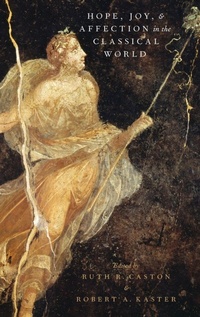
Hope, Joy, and Affection in the Classical World
Published on 1. June 2016
Book
Hardback
296 pages
978-0-19-027829-8 (ISBN)
Description
The emotions have long been an interest for those studying ancient Greece and Rome. But while the last few decades have produced excellent studies of individual emotions and the different approaches to them by the major philosophical schools, the focus has been almost entirely on negative emotions. This might give the impression that the Greeks and Romans had little to say about positive emotion, something that would be misguided. As the chapters in this collection
indicate, there are representations of positive emotions extending from archaic Greek poetry to Augustine, and in both philosophical works and literary genres as wide-ranging as lyric poetry, forensic oratory, comedy, didactic poetry, and the novel. Nor is the evidence uniform: while many of the
literary representations give expression to positive emotion but also describe its loss, the philosophers offer a more optimistic assessment of the possibilities of attaining joy or contentment in this life.
The positive emotions show some of the same features that all emotions do. But unlike the negative emotions, which we are able to describe and analyze in great detail because of our preoccupation with them, positive emotions tend to be harder to articulate. Hence the interest of the present study, which considers how positive emotions are described, their relationship to other emotions, the ways in which they are provoked or upset by circumstances, how they complicate and enrich our
relationships with other people, and which kinds of positive emotion we should seek to integrate. The ancient works have a great deal to say about all of these topics, and for that reason deserve more study, both for our understanding of antiquity and for our understanding of the positive emotions in
general.
indicate, there are representations of positive emotions extending from archaic Greek poetry to Augustine, and in both philosophical works and literary genres as wide-ranging as lyric poetry, forensic oratory, comedy, didactic poetry, and the novel. Nor is the evidence uniform: while many of the
literary representations give expression to positive emotion but also describe its loss, the philosophers offer a more optimistic assessment of the possibilities of attaining joy or contentment in this life.
The positive emotions show some of the same features that all emotions do. But unlike the negative emotions, which we are able to describe and analyze in great detail because of our preoccupation with them, positive emotions tend to be harder to articulate. Hence the interest of the present study, which considers how positive emotions are described, their relationship to other emotions, the ways in which they are provoked or upset by circumstances, how they complicate and enrich our
relationships with other people, and which kinds of positive emotion we should seek to integrate. The ancient works have a great deal to say about all of these topics, and for that reason deserve more study, both for our understanding of antiquity and for our understanding of the positive emotions in
general.
Reviews / Votes
-This handsome volume in honor of David Konstan brims appropriately with insightful, authoritative scholarship of considerable breadth, spanning the classical world from Archaic Greek poetry through St. Augustine. A richly textured collection, it expands the category of emotion to encompass diffuse affect and attitudes such as goodwill or positive outlook. At the same time, its focus on hope, joy, and affection begins to counterbalance the grave and occasionally morose emphasis previous scholars have placed on negative emotions arising from situations of conflict, suffering, and loss (e.g. Braund 2003, D. Cohen 1995, Sternberg 2005). All foreign terms are translated and/or transliterated as needed...As yet another of David Konstan's devoted admirers, I find this volume a fitting compliment to the wise, generous, and brilliant man who has done so much to establish the study of emotion in antiquity and encourage younger scholars.- --Rachel Sternberg, NECJ-The volume aspires to shed light on representations of positive emotions in the classical (Graeco-Roman) world and it does an excellent job. It has a broad scope and provides excellent in-depth studies.- --Anders Klostergaard Petersen, Bryn Mawr Classical Review-Responding to the emotional -turn- in literary and historical studies of antiquity and later periods, these 11 innovative essays consider positive emotional states. In their useful introduction Caston (Univ. of Michigan) and Kaster (Princeton) explain how we know about classical Greek and Roman feelings-the personal and the social, the civic uses of goodwill, and philosophic debates about legitimate happiness. Contributor Douglas Cairns points out that emotion and the list of emotions still lack stable definition (pity?)...One also misses mercy, gratitude, and generosity, but an essay collection cannot cover all possible positive emotions. Dedicated to David Konstan (emer., Brown), whose justly famous oeuvre has explored ancient emotion theories, this volume expands boundaries of study of early emotion.- --D. Lateiner, CHOICE-In this volume, Ruth Caston and Bob Kaster have redressed the balance in the study of the emotions in classical antiquity towards the positive emotions with a stellar cast of contributors. The volume is at once a celebration and a provocation to future study.- --Susanna Braund, University of British Columbia-Anger, hatred, fear, jealousy--these frequently harmful reactions are the usual focus of studies of the emotions in antiquity. But even such dangerous passions could encourage beneficent response. It's these- hope, joy, kindness-that are tackled by a distinguished panel in this fascinating collection.- -Peter Toohey, University of Calgary-The authors give us fascinating and unexpected insights into positive emotions that hitherto escaped the attention of scholars. Each chapter breaks new ground and is necessary reading for classical scholars of the emotions.- -Paul Woodruff, The University of Texas at AustinMore details
Other editions
Additional editions
Ruth R. Caston | Robert A. Kaster
Hope, Joy, and Affection in the Classical World
E-Book
05/2016
1st Edition
OUP eBook
€53.49
Available for download
Ruth R. Caston | Robert A. Kaster
Hope, Joy, and Affection in the Classical World
E-Book
05/2016
1st Edition
OUP eBook
€53.49
Available for download
Persons
Ruth R. Caston is an Associate Professor of Classical Studies at the University of Michigan and the author of Elegiac Passion: Jealousy in Roman Love Elegy.
Robert A. Kaster is the Kennedy Foundation Professor of Latin Language and Literature and Professor of Classics at Princeton University.
Robert A. Kaster is the Kennedy Foundation Professor of Latin Language and Literature and Professor of Classics at Princeton University.
Editor
Associate Professor of Classical StudiesAssociate Professor of Classical Studies, University of Michigan
Kennedy Foundation Professor of Latin Language and Literature and Professor of ClassicsKennedy Foundation Professor of Latin Language and Literature and Professor of Classics, Princeton University