

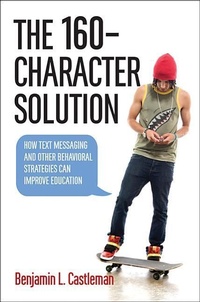
The 160-Character Solution
How Text Messaging and Other Behavioral Strategies Can Improve Education
Published on 10. January 2016
Book
Hardback
160 pages
978-1-4214-1874-2 (ISBN)
Description
For decades schools have invested substantial resources in boosting educational outcomes for disadvantaged students, but those investments have not always generated positive outcomes. Although many communities have expanded school choice, for example, families often choose to keep their children in failing schools. And while the federal government has increased the size of Pell Grants, many college-bound students who would be eligible for aid never apply. Then there is the troubling trend of "summer melt," in which up to 40 percent of high school graduates who have been accepted to college, mostly from under served communities, fail to show up for the fall semester. In The 160-Character Solution, Benjamin L Castleman shows how insights from behavioral economics-the study of how social, cognitive, and emotional factors affect our decisions - can be leveraged to help students complete assignments, perform to their full potential on tests, and choose schools and colleges where they are well-positioned for success.
By employing behavioral strategies or "nudges," Castleman shows, administrators, teachers, and parents can dramatically improve educational outcomes from preschool to college. Castleman applies the science of decision making to explain why inequalities persist at various stages in education and to identify innovative solutions to improve students' academic achievement and attainment. By focusing on behavioral changes, Castleman demonstrates that small changes in how we ask questions, design applications, and tailor reminders can have remarkable impacts on student and school success.
By employing behavioral strategies or "nudges," Castleman shows, administrators, teachers, and parents can dramatically improve educational outcomes from preschool to college. Castleman applies the science of decision making to explain why inequalities persist at various stages in education and to identify innovative solutions to improve students' academic achievement and attainment. By focusing on behavioral changes, Castleman demonstrates that small changes in how we ask questions, design applications, and tailor reminders can have remarkable impacts on student and school success.
Reviews / Votes
The 160-Character Solution... argues text messages can be used as one of several behavioral strategies, or 'nudges,' that can help students make informed decisions at key points during their educational careers. Inside Higher Ed ...Castleman proposes simple solutions for big problems. He links empirical research to practical applications that make "interventions highly customized" to facilitate access to a college education more equitably. The book will serve as a starting point for stakeholders interested in exploring ways to improve the college application processes and student retention rates. ChoiceMore details
Language
English
Place of publication
Baltimore, MD
United States
Product notice
sewn/stitched
Cloth over boards
Dimensions
Height: 231 mm
Width: 147 mm
Thickness: 18 mm
Weight
295 gr
ISBN-13
978-1-4214-1874-2 (9781421418742)
DOI
10.1353/book.72248
Copyright in bibliographic data and cover images is held by Nielsen Book Services Limited or by the publishers or by their respective licensors: all rights reserved.
Schweitzer Classification
Other editions
Additional editions
Benjamin L. Castleman
The 160-Character Solution
How Text Messaging and Other Behavioral Strategies Can Improve Education
E-Book
01/2016
Johns Hopkins University Press
€17.49
Available for download
Person
Benjamin L. Castleman is an assistant professor of education and public policy at the University of Virginia.
Content
Introduction
1. The Cost of Complexity
2. Starting with the Status Quo
3. Encouraging Active Decisions
4. Following Our Friends-or Not
Conclusion
Acknowledgments
Notes
Works Cited
Index
1. The Cost of Complexity
2. Starting with the Status Quo
3. Encouraging Active Decisions
4. Following Our Friends-or Not
Conclusion
Acknowledgments
Notes
Works Cited
Index