

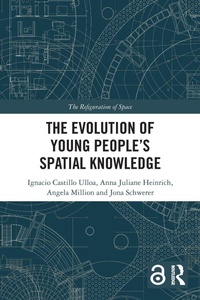
The Evolution of Young People's Spatial Knowledge
1st Edition
Published on 18. December 2024
Book
Paperback/Softback
268 pages
978-0-367-56866-5 (ISBN)
Description
Young people imagine, perceive, experience, talk about, use, and produce space in a wide variety of ways. In doing so, they acquire and produce stocks of spatial knowledge. A quite dynamic and ever-changing process by nature, young people's production and acquisition of spatial knowledge are susceptible to many kinds of conditions-from those that shape their everyday routines to those that constitute historical turning points. Against this backdrop and drawing on a qualitative metaanalysis, the authors set out to discover what changes the spatial knowledge of young people has undergone during the past five decades. To that end, sixty published studies were sampled, analyzed, and synthesized to offer a meta-interpretation in terms of both the evolution of young people's spatial knowledge and the refiguration of spaces. As such, this book will appeal to scholars conducting spatial research on childhood and youth as well as scholars interested in urban studies from diverse disciplines such as sociology, anthropology, geography, architecture, urban planning, and design.
The Open Access version of this book, available at http://www.taylorfrancis.com, has been made available under a Creative Commons Attribution-Non Commercial-No Derivatives 4.0 license. The Open Access fee was funded by Technische Universitaet Berlin
The Open Access version of this book, available at http://www.taylorfrancis.com, has been made available under a Creative Commons Attribution-Non Commercial-No Derivatives 4.0 license. The Open Access fee was funded by Technische Universitaet Berlin
More details
Series
Language
English
Place of publication
London
United Kingdom
Publishing group
Taylor & Francis Ltd
Target group
College/higher education
Postgraduate
Illustrations
18 s/w Abbildungen, 1 s/w Photographie bzw. Rasterbild, 17 s/w Zeichnungen, 2 s/w Tabellen
2 Tables, black and white; 17 Line drawings, black and white; 1 Halftones, black and white; 18 Illustrations, black and white
Dimensions
Height: 234 mm
Width: 156 mm
Thickness: 15 mm
Weight
433 gr
ISBN-13
978-0-367-56866-5 (9780367568665)
Copyright in bibliographic data and cover images is held by Nielsen Book Services Limited or by the publishers or by their respective licensors: all rights reserved.
Schweitzer Classification
Other editions
Additional editions
Ignacio Castillo Ulloa | Anna Juliane Heinrich | Angela Million
The Evolution of Young People's Spatial Knowledge
E-Book
09/2023
1st Edition
Routledge
€0.00
Available for download
Ignacio Castillo Ulloa | Anna Juliane Heinrich | Angela Million
The Evolution of Young People's Spatial Knowledge
Book
09/2023
1st Edition
Routledge
€206.60
Shipment within 15-20 days
Ignacio Castillo Ulloa | Anna Juliane Heinrich | Angela Million
The Evolution of Young People's Spatial Knowledge
E-Book
09/2023
1st Edition
Routledge
€0.00
Available for download
Persons
Ignacio Castillo Ulloa, PhD, is Researcher and Lecturer in the Institute of Urban and Regional Planning at Technische Universitaet Berlin, Germany, and co-editor of Spatial Transformations: Kaleidoscopic Perspectives on the Re-Figuration of Spaces. He is Researcher at the CRC 1265 "Re-Figuration of Spaces."
Anna Juliane Heinrich, PhD, is Researcher and Lecturer in the Institute of Urban and Regional Planning at Technische Universitaet Berlin, Germany, and the co-editor of Education, Space and Urban Planning: Education as a Component of the City. She is PI at the CRC 1265 "Re-Figuration of Spaces."
Angela Million, PhD, is Professor of Urban Design and Urban Development at Technische Universitaet Berlin, Germany. She is the co-editor of Spatial Transformations: Kaleidoscopic Perspectives on the Refiguration of Spaces and Education, Space and Urban Planning: Education as a Component of the City. She is PI at the CRC 1265 "Re-Figuration of Spaces."
Jona Schwerer is Research Assistant in the Research Center "Transformations of Political Violence" at the Chair of Urban Sociology and Sociology of Space at the Technical University of Darmstadt. He is an associate member of the CRC 1265 "Re-Figuration of Spaces."
Anna Juliane Heinrich, PhD, is Researcher and Lecturer in the Institute of Urban and Regional Planning at Technische Universitaet Berlin, Germany, and the co-editor of Education, Space and Urban Planning: Education as a Component of the City. She is PI at the CRC 1265 "Re-Figuration of Spaces."
Angela Million, PhD, is Professor of Urban Design and Urban Development at Technische Universitaet Berlin, Germany. She is the co-editor of Spatial Transformations: Kaleidoscopic Perspectives on the Refiguration of Spaces and Education, Space and Urban Planning: Education as a Component of the City. She is PI at the CRC 1265 "Re-Figuration of Spaces."
Jona Schwerer is Research Assistant in the Research Center "Transformations of Political Violence" at the Chair of Urban Sociology and Sociology of Space at the Technical University of Darmstadt. He is an associate member of the CRC 1265 "Re-Figuration of Spaces."
Content
1 Finding Change: Identifying and Explaining How Young People's Spatial Knowledge is Refigured 2 Investigating the Refiguration of Spaces by Means of Young People's Spatial Knowledge: A Conceptual Introduction 3 Second-Level Empiricism, or Learning to Read Between Interpretative Orders: A Snapshot of Our Qualitative Meta-Analysis 4 Young People's Spatialities: From Physical-Material Rigidity to Virtual Versatility 5 Spatial Perception: Assessments of Today and What a Spatial Future Might Look Like 6 Learning Arenas and Agencies of Spatial Knowledge: Physical-Sensory Production, Scholastic Acquisition, and a Varied In-Between 7 The Domestication of Young People's Spatial Knowledge: Social Control and Spatial Pedagogization 8 The Evolution of Young People's Spatial Knowledge: Overarching Findings, Connections, and Takeaways