

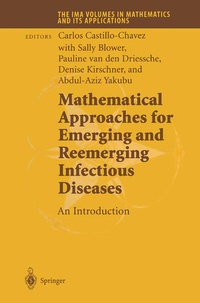
Mathematical Approaches for Emerging and Reemerging Infectious Diseases: An Introduction
Published on 6. December 2010
Book
Paperback/Softback
X, 368 pages
978-1-4419-2967-9 (ISBN)
Description
This book covers tutorial and research contributions on the use of dynamical systems and stochastic models in disease dynamics. Beginning graduate students in applied mathematics, scientists, or mathematicians who want to enter the fields of mathematical and theoretical epidemiology will find this book useful.
Reviews / Votes
From the reviews:
"This two-volume set is based on a week-long workshop sponsored by the Institute of Mathematics and its Applications (the IMA) and held at the University of Minnesota in May 1999. . There is a lot of valuable work in this two-volume set which could meet the intended aim of introducing people to research-level mathematical epidemiology." (Geoff Aldis, UK Nonlinear News, November 2002)
More details
Series
Edition
Softcover reprint of hardcover 1st ed. 2002
Language
English
Place of publication
New York
United States
Target group
Professional and scholarly
Research
Illustrations
X, 368 p.
Dimensions
Height: 235 mm
Width: 155 mm
Thickness: 21 mm
Weight
587 gr
ISBN-13
978-1-4419-2967-9 (9781441929679)
DOI
10.1007/978-1-4757-3667-0
Schweitzer Classification
Other editions
Additional editions
Carlos Castillo-Chavez | Sally Blower | Pauline van den Driessche
Mathematical Approaches for Emerging and Reemerging Infectious Diseases: An Introduction
Book
05/2002
Springer
€160.49
Shipment within 5-7 days
Content
New directions in the mathematics of infectious disease.- Fred Brauer: The man and his mathematics.- Kenneth L. Cooke: Researcher, educator par excellence.- Basic ideas of mathematical epidemiology.- Extensions of the basic models.- New vaccination strategies for pertussis.- Time delay in epidemic models.- Nonlocal response in a simple epidemiological model.- Discrete-time S-I-S models with simple and complex population dynamics.- Intraspecific competition, dispersal and disease dynamics in discrete-time patchy environments.- The impact of long-range dispersal on the rate of spread in population and epidemic models.- Endemicity, persistence, and quasi-stationarity.- On the computation of R0 and its role in global stability.- Nonlinear mating models for populations with discrete generations.- Center manifolds and normal forms in epidemic models.- Remarks on modeling host-viral dynamics and treatment.- A multiple compartment model for the evolution of HIV-1 after highly active antiretroviral therapy.- Modeling cancer as an infectious disease: The epidemiology of Helicobacter pylori.- Frequency dependent risk of infection and the spread of infectious diseases.- Long-term dynamics and re-emergence of tuberculosis.- Epilogue.- List of tutorial/workshop participants.- IMA volume 126 contents: Mathematical approaches for emerging and reemerging infectious diseases: models, methods and theory.