

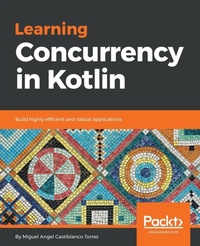
Learning Concurrency in Kotlin
Build highly efficient and robust applications
Published on 28. July 2018
Book
Paperback/Softback
266 pages
978-1-78862-716-0 (ISBN)
Description
Take advantage of Kotlin's concurrency primitives to write efficient multithreaded applications
Key Features
Learn Kotlin's unique approach to multithreading
Work through practical examples that will help you write concurrent non-blocking code
Improve the overall execution speed in multiprocessor and multicore systems
Book DescriptionThe primary requirements of modern-day applications are scalability, speed, and making the most use of hardware. Kotlin meets these requirements with its immense support for concurrency. Many concurrent primitives of Kotlin, such as channels and suspending functions, are designed to be non-blocking and efficient. This allows for new approaches to concurrency and creates unique challenges for the design and implementation of concurrent code. Learning Concurrency in Kotlin addresses those challenges with real-life examples and exercises that take advantage of Kotlin's primitives. Beginning with an introduction to Kotlin's coroutines, you will learn how to write concurrent code and understand the fundamental concepts needed to be able to write multithreaded software in Kotlin. You'll explore how to communicate between and synchronize your threads and coroutines to write asynchronous applications that are collaborative. You'll also learn how to handle errors and exceptions, as well as how to leverage multi-core processing. In addition to this, you'll delve into how coroutines work internally, allowing you to see the bigger picture. Throughout the book you'll build an Android application - an RSS reader - designed and implemented according to the different topics covered in the book
What you will learn
Understand Kotlin's approach to concurrency
Implement sequential and asynchronous suspending functions
Create suspending data sources that are resumed on demand
Explore the best practices for error handling
Use channels to communicate between coroutines
Uncover how coroutines work under the hood
Who this book is forIf you're a Kotlin or Android developer interested in learning how to program concurrently to enhance the performance of your applications, this is the book for you.
Key Features
Learn Kotlin's unique approach to multithreading
Work through practical examples that will help you write concurrent non-blocking code
Improve the overall execution speed in multiprocessor and multicore systems
Book DescriptionThe primary requirements of modern-day applications are scalability, speed, and making the most use of hardware. Kotlin meets these requirements with its immense support for concurrency. Many concurrent primitives of Kotlin, such as channels and suspending functions, are designed to be non-blocking and efficient. This allows for new approaches to concurrency and creates unique challenges for the design and implementation of concurrent code. Learning Concurrency in Kotlin addresses those challenges with real-life examples and exercises that take advantage of Kotlin's primitives. Beginning with an introduction to Kotlin's coroutines, you will learn how to write concurrent code and understand the fundamental concepts needed to be able to write multithreaded software in Kotlin. You'll explore how to communicate between and synchronize your threads and coroutines to write asynchronous applications that are collaborative. You'll also learn how to handle errors and exceptions, as well as how to leverage multi-core processing. In addition to this, you'll delve into how coroutines work internally, allowing you to see the bigger picture. Throughout the book you'll build an Android application - an RSS reader - designed and implemented according to the different topics covered in the book
What you will learn
Understand Kotlin's approach to concurrency
Implement sequential and asynchronous suspending functions
Create suspending data sources that are resumed on demand
Explore the best practices for error handling
Use channels to communicate between coroutines
Uncover how coroutines work under the hood
Who this book is forIf you're a Kotlin or Android developer interested in learning how to program concurrently to enhance the performance of your applications, this is the book for you.
More details
Language
English
Place of publication
Birmingham
United Kingdom
Target group
Professional and scholarly
Dimensions
Height: 235 mm
Width: 191 mm
Thickness: 14 mm
Weight
503 gr
ISBN-13
978-1-78862-716-0 (9781788627160)
Copyright in bibliographic data and cover images is held by Nielsen Book Services Limited or by the publishers or by their respective licensors: all rights reserved.
Schweitzer Classification
Other editions
Additional editions
Miguel Angel Castiblanco Torres
Learning Concurrency in Kotlin
Build highly efficient and scalable applications
E-Book
09/2024
1st Edition
Packt Publishing Limited
€34.99
Available for download
Person
Miguel Angel Castiblanco Torres is a software engineer living in the United States. He works as a full-stack technical leader and software designer at Globant, where he has led many successful projects for a Forbes' Top Ten World's Most Valuable Brand and Top Five Regarded Company. Passionate about what's next, Miguel was an early adopter of Kotlin, writing about Kotlin's concurrency primitives from the first beta release of coroutines. He always keeps an eye on the new and upcoming features of Kotlin.
Content
Table of Contents
Hello Concurrent World!
Coroutines in Action
Lifecycle and Error Handling
Suspending Functions and The Coroutine Context
Generators: Iterators and Sequences_noimages
Channels: Share Memory by Communicating
Thread Confinement, Actors, and Mutexes
Testing Concurrent Code
How Coroutines Work?
Hello Concurrent World!
Coroutines in Action
Lifecycle and Error Handling
Suspending Functions and The Coroutine Context
Generators: Iterators and Sequences_noimages
Channels: Share Memory by Communicating
Thread Confinement, Actors, and Mutexes
Testing Concurrent Code
How Coroutines Work?