

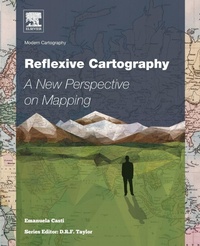
Reflexive Cartography: Volume 6
A New Perspective in Mapping
Published on 19. August 2015
Book
Paperback/Softback
288 pages
978-0-12-803509-2 (ISBN)
Description
Reflexive Cartography addresses the adaptation of cartography, including its digital forms (GIS, WebGIS, PPGIS), to the changing needs of society, and outlines the experimental context aimed at mapping a topological space. Using rigorous scientific analysis based on statement consistency, relevance of the proposals, and model accessibility, it charts the transition from topographical maps created by state agencies to open mapping produced by citizens.
Adopting semiotic theory to uncover the complex communicative mechanisms of maps and to investigate their ability to produce their own messages and new perspectives, Reflexive Cartography outlines a shift in our way of conceptualizing maps: from a plastic metaphor of reality, as they are generally considered, to solid tools that play the role of agents, assisting citizens as they think and plan their own living place and make sense of the current world.
Adopting semiotic theory to uncover the complex communicative mechanisms of maps and to investigate their ability to produce their own messages and new perspectives, Reflexive Cartography outlines a shift in our way of conceptualizing maps: from a plastic metaphor of reality, as they are generally considered, to solid tools that play the role of agents, assisting citizens as they think and plan their own living place and make sense of the current world.
Reviews / Votes
"...the central tenet of the book is interesting and raises questions about how, as scientists, we present information to both the research community and the general public more widely." --The Holocene, Reflexive Cartography"...a research book seeking to advance the science. Extensive footnotes with comments and a glossary to better define these new concepts are included." --The Leading Edge, Reflexive Cartography
"... this is an academic book written for other researchers working on the same problem." --The Leading Edge, Reflexive Cartography
More details
Series
Language
English
Place of publication
United States
Target group
Professional and scholarly
Product notice
Paperback (trade)
Dimensions
Height: 235 mm
Width: 191 mm
Thickness: 15 mm
Weight
504 gr
ISBN-13
978-0-12-803509-2 (9780128035092)
Copyright in bibliographic data and cover images is held by Nielsen Book Services Limited or by the publishers or by their respective licensors: all rights reserved.
Schweitzer Classification
Other editions
Additional editions
E-Book
08/2015
Elsevier
€85.95
Available for download
Persons
Emanuela Casti is full professor of Geography at the University of Bergamo where she directs the CST-Centro Studi sul Territorio, is responsible of the DiathesisLab (www.unibg.it/diathesis) and is President of the MA in Geourbanistica. Considered and innovator in cartographic theories studies, she has formalize a semiotic theory that investigates the relationship between cartography and geography, extending it to the new systems of cybercartography in the book of theory Reflexive Cartography published in the Modern Cartography Series by Elsevier. Her researches concern the historical context (the prehistoric cartography in Valcamonica, the renaissance and modern cartography of Venice, the Italian and French colonial cartography in Africa) as well as the contemporary one: mapping of movement, of conservation (http://multimap.unibg.it/; https://orobiemap.unibg.it/), for the governance (www.bgopenmapping.it; www.bgpublicspace.it, https://cittaaltaplurale.unibg.it/) and the regeneration of urban peripheries (www.rifoit.org). She has published more that a hundred of essays, among which the books: Reality as representation. The semiotics of cartography and the generation of meaning (Bergamo University Press, 2000); Reflexive Cartography. A New Perspective on Mapping (Elsevier, 2015). Dr D. R. Fraser Taylor is Chancellor's Distinguished Research Professor and Director of the Geomatics and Cartographic Research Centre at Carleton University, Ottawa, Canada. He has been recognized as one of the world's leading cartographers and a pioneer in the introduction of the use of the computer in cartography. He has served as the president of the International Cartographic Association from 1987 to 1995. Also, in 2008, he was elected a fellow of the Royal Society of Canada in recognition of his achievements. He was awarded the Carl Mannerfelt Gold Medal in August 2013. This highest award of the International Cartographic Association honours cartographers of outstanding merit who have made significant contributions of an original nature to the field of cartography.He produced two of the world's first computer atlases in 1970. His many publications continue to have a major impact on the field. In 1997, he introduced the innovative new paradigm of cybercartography. He and his team are creating a whole new genre of online multimedia and multisensory atlases including several in cooperation with indigenous communities. He has also published several influential contributions to development studies and many of his publications deal with the relationship between cartography and development in both a national and an international context.
Content
PART ONE 1. Cartographic interpretation between continuity and renewal: on the trail of chora2. The triumph of topos in colonial cartography: topographic metrics3. Landscape as a cartographic icon
PART TWO4. Technology in action: participatory cartographic systems5. Chorographic horizon: landscape cartography6. Coming full circle: towards a Chorography
PART TWO4. Technology in action: participatory cartographic systems5. Chorographic horizon: landscape cartography6. Coming full circle: towards a Chorography