

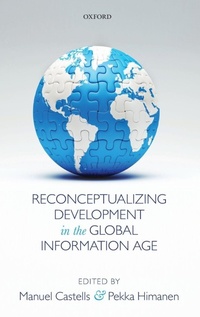
Reconceptualizing Development in the Global Information Age
Published on 28. August 2014
Book
Hardback
384 pages
978-0-19-871608-2 (ISBN)
Description
The conditions in which 'development'--the process by which people, individually and collectively, enhance their capacities to improve their lives according to their values and interests--operates have significantly changed in the global information age, a period characterized by the technological revolution in information and communication, the rise of the networking form of social organization, and the global interdependence of economies and societies. This volume aims to redefine the means and goals of development in this new context: first, by characterizing the specific mode of development, informational development, that the authors consider to be the driver of the creation of material wealth in the twenty-first century; secondly, by reconceptualizing human development as the fulfilment of human wellbeing in the multidimensionality of the human experience, ultimately affirming dignity as the supreme value of development; thirdly, by examining the relationship between informational development and human development.
After first setting out its analytical framework, the book brings together a diverse set of empirically-rich case studies to illustrate this investigation from across the globe--Silicon Valley, Costa Rica, Chile, South Africa, Finland, the European Union, and China--and concludes by attempting to reconceptualize development. It raises important questions and provides observations, including examining the concept of 'dignity as development', to contribute to a policy debate that should provide specific answers linked to the conditions of each society, and be enacted by democratic institutions in a concerted global effort to save humankind while there is still time.
After first setting out its analytical framework, the book brings together a diverse set of empirically-rich case studies to illustrate this investigation from across the globe--Silicon Valley, Costa Rica, Chile, South Africa, Finland, the European Union, and China--and concludes by attempting to reconceptualize development. It raises important questions and provides observations, including examining the concept of 'dignity as development', to contribute to a policy debate that should provide specific answers linked to the conditions of each society, and be enacted by democratic institutions in a concerted global effort to save humankind while there is still time.
Reviews / Votes
This book stands out as one of the most provocative insights into the impact of the Global Information Age on all dimensions of the human experience. This book is a landmark in the area of human sciences. * Fernando Henrique Cardoso, Professor Emeritus of Political Science, University of Sao Paulo and Former President of Brazil * Castells and Himanen reject the classical definition of development as the growth of available resources. They participate in Amartya Sens Intellectual Coup: not resources but access to resources define development, which is synonymous with Human Dignity, and the conditions of development are as much cultural and social as technological. This book will definitely make Dignity the most creative and respected word in the XXIst centurys vocabulary, as Solidarity was in the nineteenth and Reason in the seventeenth. * Alain Touraine, Professor of Sociology Emeritus, Ecole des Hautes Etudes en Sciences Sociales, Paris *More details
Language
English
Place of publication
Oxford
United Kingdom
Target group
College/higher education
Professional and scholarly
Dimensions
Height: 240 mm
Width: 161 mm
Thickness: 25 mm
Weight
737 gr
ISBN-13
978-0-19-871608-2 (9780198716082)
Copyright in bibliographic data and cover images is held by Nielsen Book Services Limited or by the publishers or by their respective licensors: all rights reserved.
Schweitzer Classification
Other editions
Additional editions
Manuel Castells | Pekka Himanen
Reconceptualizing Development in the Global Information Age
E-Book
08/2014
1st Edition
OUP eBook
€33.99
Available for download
Manuel Castells | Pekka Himanen
Reconceptualizing Development in the Global Information Age
E-Book
08/2014
1st Edition
OUP Oxford
€57.89
Available for download
Persons
Manuel Castells is University Professor and the Wallis Annenberg Chair in Communication Technology and Society at the University of Southern California, Los Angeles. He is also Professor Emeritus of Sociology and of City and Regional Planning, University of California, Berkeley, as well as Director of Research in the Department of Sociology, and Fellow of St. John's College, University of Cambridge. He has been Professor and Director of the Internet Interdisciplinary Institute, Open University of Catalonia, Barcelona. He has published 26 books, including the trilogy The Information Age: Economy, Society and Culture (Blackwell 1996-2003) and Communication Power (Oxford University Press 2009). He received the 2011 Erasmus Medal from Academia Europaea, the 2012 Holberg Memorial Prize from the Parliament of Norway, and the 2013 Balzan Prize from the Balzan Foundation.
Pekka Himanen is Professor at Aalto University in Helsinki and a Visiting Scholar at UC Berkeley. His books include The Hacker Ethic and the Spirit of the Information Age (2001) and The Information Society and the Welfare State (co-authored with Manuel Castells, OUP 2002). Himanen's work has been recognized with several awards, such as the World Economic Forum's respected Global Leader for Tomorrow Award in 2003 and his appointment by the WEF as a Young Global Leader in 2005. Himanen has advised leading global organizations and corporations from the United Nations to Silicon Valley companies, and is also a co-founder of the Global Dignity initiative.
Pekka Himanen is Professor at Aalto University in Helsinki and a Visiting Scholar at UC Berkeley. His books include The Hacker Ethic and the Spirit of the Information Age (2001) and The Information Society and the Welfare State (co-authored with Manuel Castells, OUP 2002). Himanen's work has been recognized with several awards, such as the World Economic Forum's respected Global Leader for Tomorrow Award in 2003 and his appointment by the WEF as a Young Global Leader in 2005. Himanen has advised leading global organizations and corporations from the United Nations to Silicon Valley companies, and is also a co-founder of the Global Dignity initiative.
Content
Introduction ; PART I: ANALYTICAL FRAMEWORK ; 1. Models of Development in the Global Information Age: Constructing an Analytical Framework ; PART II: CASE STUDIES ; 2. The Silicon Valley Model: Economic Dynamism, Social Exclusion ; 3. Reconstructing the Finnish Model 2.0: Building a Sustainable Development Model? ; 4. Toward a Welfare State 2.0: Crisis and Renewal of the European Welfare State? ; 5. Development as Culture: Human Development and Information Development in China ; 6. South Africa Informational Development and Human Development: Rights vs. Capabilities ; 7. Development, Democracy, and Social Change in Chile ; 8. Pacifism, Human Development, and Informational Development: The Costa Rican Model ; PART III: RECONCEPTUALIZING DEVELOPMENT ; 9. Rethinking Human Development ; 10. Dignity as Development: The Cultural Link Between Informational and Human Development