

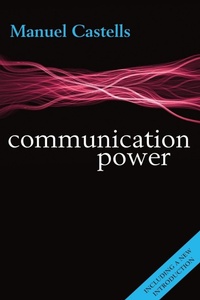
Communication Power
2nd Edition
Published on 29. August 2013
Book
Paperback/Softback
624 pages
978-0-19-968193-8 (ISBN)
Description
We live in the midst of a revolution in communication technologies that affects the way in which people feel, think, and behave. The media have become the space where power strategies are played out. In the current technological context mass communication goes beyond traditional media and includes the Internet and mobile communication.
In this wide-ranging and powerful book, Manuel Castells analyses the transformation of the global media industry by this revolution in communication technologies. He argues that a new communication system, mass self-communication, has emerged, and power relationships have been profoundly modified by the emergence of this new communication environment. Created in the commons of the Internet this communication can be locally based, but globally connected. It is built through messaging, social networks sites, and blogging, and is now being used by the millions around the world who have access to the Internet.
Drawing on a wide range of social and psychological theories, Castells presents original research on political processes and social movements. He applies this analysis to numerous recent events--the misinformation of the American public on the Iraq War, the global environmental movement to prevent climate change, the control of information in China and Russia, Barak Obama's internet-based presidential campaigns, and (in this new edition) responses to recent political and economic crises such as the Arab Spring and the Occupy movement. On the basis of these case studies he proposes a new theory of power in the information age based on the management of communication networks
Justly celebrated for his analysis of the network society, Castells here builds on that work, offering a well grounded and immensely challenging picture of communication and power in the 21st century. This is a book for anyone who wants to understand the dynamics and character of the modern world.
In this wide-ranging and powerful book, Manuel Castells analyses the transformation of the global media industry by this revolution in communication technologies. He argues that a new communication system, mass self-communication, has emerged, and power relationships have been profoundly modified by the emergence of this new communication environment. Created in the commons of the Internet this communication can be locally based, but globally connected. It is built through messaging, social networks sites, and blogging, and is now being used by the millions around the world who have access to the Internet.
Drawing on a wide range of social and psychological theories, Castells presents original research on political processes and social movements. He applies this analysis to numerous recent events--the misinformation of the American public on the Iraq War, the global environmental movement to prevent climate change, the control of information in China and Russia, Barak Obama's internet-based presidential campaigns, and (in this new edition) responses to recent political and economic crises such as the Arab Spring and the Occupy movement. On the basis of these case studies he proposes a new theory of power in the information age based on the management of communication networks
Justly celebrated for his analysis of the network society, Castells here builds on that work, offering a well grounded and immensely challenging picture of communication and power in the 21st century. This is a book for anyone who wants to understand the dynamics and character of the modern world.
Reviews / Votes
Review from previous edition Manuel Castells has shaped himself into the most prominent and influential theorist and analyst of the modern communications and network age. He is the Marshall McLuhan of our time. * John Lloyd, Financial Times * a challenging and intriguing work [in its] ambitions, scope and concepts. * Paschal Preston, Media, Culture & Society, Volume 32 (6), 2010 * A sustained inquiry into the nature of political and economic power in the modern world. * Steven Livingston, Political Communicatoin (27) * Castells has done it again, a masterpiece of global perspective and enviable erudition. Moving beyond his trilogy on the information age, Castells focuses on how cultural, economic and particularly political power relationships are constituted and sustained through systematic communication flows. A new line of analysis draws on neuroscience and cognitive psychology to track the role of emotion in political communication. Case studies include global media deregulation, the politics of scandal, framing the war in Iraq, ecological social movements, the Obama presidential candidacy and a fascinating comparison of media control dynamics in Russia and China. * Advance praise from W. Russell Neuman, Evans Professor of Media Technology, University of Michigan * How could Manuel Castells have predicted that now is the time of the perfect storm? I do not know. But I do know that his new book coincides with the largest downturn in global economies since the 1930s, with the most important American election since the 1960s, with a most radical transformation of world politics in many generations, and with the most profound reevaluation of the lives of modern citizens, from what they value to how they communicate. We have become used to Castells' careful scholarship and penetrating analyses but in this new book he cuts deeper into the heart of the matter. Sometimes he provides illuminating answers and where he cannot, he frames the questions that must be answered. This is a powerful and much needed book for a world in crisis. * Advance praise from Antonio Damasio, David Dornsife Professor of Neuroscience, Director, Brain and Creativity Institute, University of Southern California * Manuel Castells unites the mind of a social scientist with the soul of an artist. His trilogy took us to the edge of the millennium. This book takes us beyond to the critical crossroads of the 21st century, where technology, communication, and power converge. * Advance praise from Rosalind Williams, Dibner Professor and Director, Program on Science, Technology and Society, Massachusetts Institute of Technology * In this timely book, Professor Castells turns his attention from the impact of the internet on the economy to its impact on communications and politics. I can warmly recommend it to all communications practitioners. But his clear analysis and vivid case studies make this book of interest to anyone who wants to understand the nature of power in today's democracy and the meaning of the campaign that swept Barack Obama into the White House. * Advance praise from Margot Wallstroem, Vice-President of the European Commission responsible for Communication Policy *More details
Edition
2nd Revised edition
Language
English
Place of publication
Oxford
United Kingdom
Target group
College/higher education
Anyone interested in how communication and technology affects our lives and society; Academics and advanced students across the social sciences interested in the political, social, and psychological role of modern ICTs and the Internet.
Edition type
Revised edition
Dimensions
Height: 234 mm
Width: 156 mm
Thickness: 37 mm
Weight
1047 gr
ISBN-13
978-0-19-968193-8 (9780199681938)
Copyright in bibliographic data and cover images is held by Nielsen Book Services Limited or by the publishers or by their respective licensors: all rights reserved.
Schweitzer Classification
Other editions
Additional editions
Previous edition
Manuel Castells
Communication Power
Book
12/2011
Oxford University Press
€18.56
Article exhausted; check for reprint
Person
Manuel Castells is University Professor and the Wallis Annenberg Chair of Communication Technology and Society at the University of Southern California. He is also Professor Emeritus of Sociology and Planning, University of California, Berkeley, where he taught for 24 years. He is a Fellow of the American Academy of Political and Social Science, of the Academia Europaea, of the Spanish Royal Academy of Economics, and of the British Academy. His main books include the trilogy The Information Age: Economy, Society, and Culture (Blackwell, 1996-2003), Communication Power (OUP, 2009), and Networks of Outrage and Hope (Polity, 2012). He was a founding member of the board of the European Research Council and is a member of the Governing Board of the European Institute of Innovation and Technology.
Content
Opening ; Introduction to the Revised Edition ; 1. Power in the Network Society ; 2. Communication in the Digital Age ; 3. Networks of Mind and Power ; 4. Programming Communication Networks: Media Politics, Scandal Politics, and the Crisis of Democracy ; 5. Reprogramming Communication Networks: Social Movements, Insurgent Politics, and the New Public Space ; 6. Toward a Communication Theory of Power