

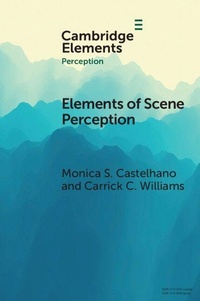
Elements of Scene Perception
Published on 11. November 2021
Book
Paperback/Softback
96 pages
978-1-108-93271-4 (ISBN)
Description
Visual cognitive processes have traditionally been examined with simplified stimuli, but generalization of these processes to the real-world is not always straightforward. Using images, computer-generated images, and virtual environments, researchers have examined processing of visual information in the real-world. Although referred to as scene perception, this research field encompasses many aspects of scene processing. Beyond the perception of visual features, scene processing is fundamentally influenced and constrained by semantic information as well as spatial layout and spatial associations with objects. In this review, we will present recent advances in how scene processing occurs within a few seconds of exposure, how scene information is retained in the long-term, and how different tasks affect attention in scene processing. By considering the characteristics of real-world scenes, as well as different time windows of processing, we can develop a fuller appreciation for the research that falls under the wider umbrella of scene processing.
More details
Series
Language
English
Place of publication
Cambridge
United Kingdom
Product notice
Paperback (trade)
Illustrations
Worked examples or Exercises
Dimensions
Height: 229 mm
Width: 152 mm
Thickness: 6 mm
Weight
153 gr
ISBN-13
978-1-108-93271-4 (9781108932714)
Copyright in bibliographic data and cover images is held by Nielsen Book Services Limited or by the publishers or by their respective licensors: all rights reserved.
Schweitzer Classification
Other editions
Additional editions
Monica S. Castelhano
Scene Perception
E-Book
11/2021
Cambridge University Press
€15.49
Available for download
Monica S. Castelhano | Carrick C. Williams
Elements of Scene Perception
E-Book
10/2021
Cambridge University Press
€15.49
Available for download
Persons
Content
1. Introduction; 2. Initial Scene Understanding; 3. Online Scene Representations; 4. Long-term Memory for Scenes; 5. Eye Movements and Scenes; 6. Searching through Scenes; 7. Spatial Representations and Navigation; 8. Conclusion.