

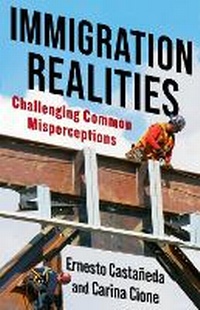
Immigration Realities
Challenging Common Misperceptions
Published on 5. November 2024
Book
Paperback/Softback
368 pages
978-0-231-20375-3 (ISBN)
Description
Immigrants are less likely to commit crimes. They are eager to learn local languages. Immigration is not a burden on social services. Border walls do not work. There is no unmanageable refugee crisis. Yet many such misinformed assumptions and harmful misconceptions pervade conversations about immigration.
This timely book is a practical, evidence-based primer on immigrants and immigration. Each chapter debunks a frequently encountered claim and answers common questions. Presenting the latest findings and decades of interdisciplinary research in an accessible way, Ernesto Castaneda and Carina Cione emphasize the expert consensus that immigration is vital to the United States and many other countries around the world. Featuring original insights from research conducted in El Paso, Texas, Immigration Realities considers a wide range of places, ethnic groups, and historical eras. It provides the key data and context to understand how immigration affects economies, crime rates, and social welfare systems, and it sheds light on contentious issues such as the safety of the U.S.-Mexico border and the consequences of Brexit. This book is an indispensable guide for all readers who want to counter false claims about immigration and are interested in what the research shows.
This timely book is a practical, evidence-based primer on immigrants and immigration. Each chapter debunks a frequently encountered claim and answers common questions. Presenting the latest findings and decades of interdisciplinary research in an accessible way, Ernesto Castaneda and Carina Cione emphasize the expert consensus that immigration is vital to the United States and many other countries around the world. Featuring original insights from research conducted in El Paso, Texas, Immigration Realities considers a wide range of places, ethnic groups, and historical eras. It provides the key data and context to understand how immigration affects economies, crime rates, and social welfare systems, and it sheds light on contentious issues such as the safety of the U.S.-Mexico border and the consequences of Brexit. This book is an indispensable guide for all readers who want to counter false claims about immigration and are interested in what the research shows.
Reviews / Votes
There's an abyss between what people think about immigration and what the evidence shows. Immigration Realities bridges that abyss by setting the record straight on critical topics like the border, crime, assimilation, welfare, remittances, and refugees. This is an important book for all audiences. -- Zeke Hernandez, author of <i>The Truth About Immigration: Why Successful Societies Welcome Newcomers</i> Immigration Realities is the reality check everyone in the country should read right now. Castaneda and Cione cracked the code on how to connect the latest research on immigration with a broad public that is worried about immigration but doesn't know whom to trust for honest information. This book cuts through the deluge of immigration misinformation by patiently taking readers on a journey through some of the biggest questions and providing data-driven answers that are both compassionate and unapologetic. Immigration Realities is your ultimate immigration field guide. -- Austin Kocher, Syracuse University Castaneda and Cione have produced a powerfully written and persuasive statement against several of the most common stereotypes about contemporary immigration. It is a particularly timely book given the wave of nativism and anti-immigrant rhetoric now sweeping the political scene of the United States and other developed countries. -- Alejandro Portes, Princeton University Immigration Realities brings together a wealth of research evidence to convincingly refute prevalent misinformation about immigration. The book is accessible for students and the broader public, while also highlighting for scholars where common research practices may amplify public misperceptions. -- Abigail Fisher Williamson, author of <i>Welcoming New Americans? Local Governments and Immigrant Incorporation</i> Immigration Realities challenges common misconceptions, presenting carefully curated research to better understand immigration issues. The book excels in centering the experiences of disadvantaged migrants, building on an original survey of El Paso's Latin communities and offering fresh insights into contemporary policy debates in America and elsewhere. -- Alexander Kustov, author of <i>In Our Interest: How to Make Immigration Popular</i> Ernesto Castaneda and Carina Cione do a masterful job of challenging existing myths on immigration and showing how immigrants have contributed to a more vibrant and successful society throughout the course of U.S. history and especially today. This is essential reading for anyone interested in today's immigration debates and in understanding what scholarship on immigration actually shows us. -- Andrew Selee, President, Migration Policy Institute Immigration Realities is a timely and necessary addition to the literature on international migration. Through dispelling damaging myths and shedding light on the actual experiences and dreams of immigrants, Castaneda and Cione have crafted a must-read book that crosses borders and disciplines. -- Teresa Mares, author of <i>Life on the Other Border: Farmworkers and Food Justice in Vermont</i> While the book's perspective may not align with all viewpoints, its well-supported insights make it a valuable resource for readers interested in a nuanced, evidence-based understanding of migration, encouraging a thoughtful approach to policy and public dialogue. * European Center for Populism Studies *More details
Language
English
Place of publication
New York
United States
Product notice
Paperback (trade)
Illustrations
16 b&w photos and charts
Dimensions
Height: 235 mm
Width: 156 mm
ISBN-13
978-0-231-20375-3 (9780231203753)
Copyright in bibliographic data and cover images is held by Nielsen Book Services Limited or by the publishers or by their respective licensors: all rights reserved.
Schweitzer Classification
Other editions
Additional editions
E-Book
01/2025
1st Edition
Columbia University Press
€29.49
Available for download
Persons
Ernesto Castaneda is the director of the Immigration Lab and the Center for Latin American and Latino Studies at American University. His books include A Place to Call Home: Immigrant Exclusion and Urban Belonging in New York, Paris, and Barcelona (2018); Building Walls: Excluding Latin People in the United States (2019); and Reunited: Family Separation and Central American Youth Migration (2024).
Carina Cione is a sociologist and writer based out of Baltimore, MD. Their work has been featured by the International Journal of Environmental Research and Public Health, Trauma Care, El Paso News, and American University's Center for Latin American & Latino Studies Working Paper Series.
Carina Cione is a sociologist and writer based out of Baltimore, MD. Their work has been featured by the International Journal of Environmental Research and Public Health, Trauma Care, El Paso News, and American University's Center for Latin American & Latino Studies Working Paper Series.
Content
Acknowledgments
Introduction: Immigration as a History of Exclusion and Homemaking
1. The Southern Border Is Safe, but Border Enforcement Makes It Unsafe for Many
2. Border Walls Do Not Keep Immigrants Out of a Country
3. Immigrants Commit Less Crime than Native-Born People
4. Immigrants Want to, and Do, Learn the Local Language
5. Immigrants Do Not Depend on Welfare Programs More than Native-Born People
6. Remittances Do Not Drain Host Countries' Economies and Are Not Like Foreign Aid
7. There Is No Refugee Crisis
8. Globalization and Migration Are Independent Processes
9. Brexit Did Not Halt Immigration to the United Kingdom
10. Immigrants Can Integrate While Maintaining Their Identities
Notes
References
Index
Introduction: Immigration as a History of Exclusion and Homemaking
1. The Southern Border Is Safe, but Border Enforcement Makes It Unsafe for Many
2. Border Walls Do Not Keep Immigrants Out of a Country
3. Immigrants Commit Less Crime than Native-Born People
4. Immigrants Want to, and Do, Learn the Local Language
5. Immigrants Do Not Depend on Welfare Programs More than Native-Born People
6. Remittances Do Not Drain Host Countries' Economies and Are Not Like Foreign Aid
7. There Is No Refugee Crisis
8. Globalization and Migration Are Independent Processes
9. Brexit Did Not Halt Immigration to the United Kingdom
10. Immigrants Can Integrate While Maintaining Their Identities
Notes
References
Index