

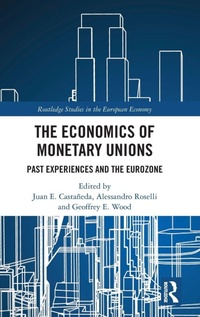
The Economics of Monetary Unions
Past Experiences and the Eurozone
1st Edition
Published on 18. March 2020
Book
Hardback
250 pages
978-0-367-34786-4 (ISBN)
Description
In this book, a historical analysis of the precedents of the euro is examined within the context of the current issues affecting the Eurozone and the long-term effects of the institutional changes implemented since 2010.
The book begins by placing the Eurozone challenges in the historical context of previous monetary unions, drawing on the experience of the gold standard. It then specifically focuses on the problems arising from the running of permanent trade imbalances within the Eurozone. The authors explore the advantages and disadvantages of being a member of the Eurozone and attempt to measure the optimality of a currency area by the calculation of an index on internal macroeconomic asymmetries. They address the proposals recently made in favour of a fiscal union in the Euro zone; including the economic and political feasibility of fiscal transfers in the Eurozone. The final two papers discuss whether the monetary union is in fact more than just that, and whether it will lead inevitably to some form of political union if it is to survive.
With chapters by leading experts from both Europe and the UK, this book will appeal to students in Economics, Finance, Politics, EU integration and European studies; as well as academics and professional economists doing research in EU integration, the Euro zone, monetary history and monetary and banking unions in Europe, the UK and elsewhere.
The book begins by placing the Eurozone challenges in the historical context of previous monetary unions, drawing on the experience of the gold standard. It then specifically focuses on the problems arising from the running of permanent trade imbalances within the Eurozone. The authors explore the advantages and disadvantages of being a member of the Eurozone and attempt to measure the optimality of a currency area by the calculation of an index on internal macroeconomic asymmetries. They address the proposals recently made in favour of a fiscal union in the Euro zone; including the economic and political feasibility of fiscal transfers in the Eurozone. The final two papers discuss whether the monetary union is in fact more than just that, and whether it will lead inevitably to some form of political union if it is to survive.
With chapters by leading experts from both Europe and the UK, this book will appeal to students in Economics, Finance, Politics, EU integration and European studies; as well as academics and professional economists doing research in EU integration, the Euro zone, monetary history and monetary and banking unions in Europe, the UK and elsewhere.
More details
Series
Language
English
Place of publication
London
United Kingdom
Publishing group
Taylor & Francis Ltd
Target group
College/higher education
Illustrations
34 s/w Abbildungen, 34 s/w Zeichnungen, 14 s/w Tabellen
14 Tables, black and white; 34 Line drawings, black and white; 34 Illustrations, black and white
Dimensions
Height: 240 mm
Width: 161 mm
Thickness: 19 mm
Weight
575 gr
ISBN-13
978-0-367-34786-4 (9780367347864)
Copyright in bibliographic data and cover images is held by Nielsen Book Services Limited or by the publishers or by their respective licensors: all rights reserved.
Schweitzer Classification
Other editions
Additional editions
Juan E. Castaneda | Alessandro Roselli | Geoffrey E. Wood
The Economics of Monetary Unions
Past Experiences and the Eurozone
Book
12/2021
1st Edition
Routledge
€65.50
Shipment within 10-20 days
Juan E. Castaneda | Alessandro Roselli | Geoffrey E. Wood
The Economics of Monetary Unions
Past Experiences and the Eurozone
E-Book
03/2020
1st Edition
Routledge
€59.49
Available for download
Juan E. Castaneda | Alessandro Roselli | Geoffrey E. Wood
The Economics of Monetary Unions
Past Experiences and the Eurozone
E-Book
03/2020
1st Edition
Routledge
€59.49
Available for download
Persons
Juan E. Castaneda is Director of the Institute of International Monetary Research and a Senior Lecturer in Economics at the University of Buckingham. He has worked with the European Parliament's Committee of Economic and Monetary Affairs and has been an Honorary Senior Visiting Fellow in Cass Business School, visiting researcher at the Centre of Monetary and Financial Alternatives at Cato, and lecturer at UNED University in Madrid. He is a member of the IEA's Shadow Monetary Policy Committee.
Alessandro Roselli is a visiting fellow at Cass Business School, City University, London and at the University of Buckingham, UK. He has spent most of his career at the central Bank of Italy and has been A.C. Jemolo fellow at Nuffield College, University of Oxford. He has written extensively on banking, finance and economic history.
Geoffrey E. Wood is Professor in Monetary Economics, University of Buckingham and Emeritus Professor in Economics, Cass Business School. He has lectured in Economics at the University of Warwick and in Banking and Finance at City University, London, where he has been Professor since 1986. He worked at the Bank of England as Economist, and later as Special Adviser on Financial Stability.
Alessandro Roselli is a visiting fellow at Cass Business School, City University, London and at the University of Buckingham, UK. He has spent most of his career at the central Bank of Italy and has been A.C. Jemolo fellow at Nuffield College, University of Oxford. He has written extensively on banking, finance and economic history.
Geoffrey E. Wood is Professor in Monetary Economics, University of Buckingham and Emeritus Professor in Economics, Cass Business School. He has lectured in Economics at the University of Warwick and in Banking and Finance at City University, London, where he has been Professor since 1986. He worked at the Bank of England as Economist, and later as Special Adviser on Financial Stability.
Content
1 Introduction PART 1 Lessons from previous currency and monetary unions 2 The flexibility of the classical gold standard (1870s-1914): any lessons for the eurozone? 3 A measurement of asymmetry in the running of the classical gold standard PART 2 Financing imbalances in a single monetary area: an assessment of TARGET2 4 Payment systems in a multinational currency union - is a reform of TARGET2 necessary? 5 The credit mechanics of monetary unions: a review of the eurosystem PART 3 When may monetary unions fail? 6 Pros and cons of being a euro country: a behavioral political economy perspective 7 An optimality index of the single currency: internal asymmetries within the eurozone since 1999 PART 4 Preserving unions: the eurozone 8 Public support for the euro and trust in the ECB: the first two decades of the common currency 9 Debt restructuring for the eurozone 10 The rationale for a safe asset and fiscal capacity for the eurozone PART 5 The eurozone: not just a monetary union? 11 Can the euro succeed without European political union? The organizational challenges facing a multi-government monetary union in the "managed currency" era 12 Proposals for reforming the eurozone: a critique