

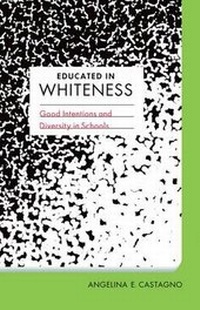
Educated in Whiteness
Good Intentions and Diversity in Schools
Published on 1. March 2014
Book
Hardback
240 pages
978-0-8166-8163-1 (ISBN)
Description
Educators across the nation are engaged in well-meaning efforts to address diversity in schools given the current context of NCLB, Race to the Top, and the associated pressures of standardization and accountability. Through rich ethnographic accounts of teachers in two demographically different secondary schools in the same urban district, Angelina E. Castagno investigates how whiteness operates in ways that thwart (and sometimes co-opt) even the best intentions and common sense-thus resulting in educational policies and practices that reinforce the status quo and protect whiteness rather than working toward greater equity.
Whereas most discussions of the education of diverse students focus on the students and families themselves, Educated in Whiteness highlights the structural and ideological mechanisms of whiteness. In schools, whiteness remains dominant by strengthening and justifying the status quo while simultaneously preserving a veneer of neutrality, equality, and compassion. Framed by critical race theory and whiteness studies, this book employs concepts like interest convergence, a critique of liberalism, and the possessive investment in whiteness to better understand diversity-related educational policy and practice.
Although in theory most diversity-related educational policies and practices are intended to bring about greater equity, too often in practice they actually maintain, legitimate, and so perpetuate whiteness. Castagno not only sheds light on this disconnect between the promises and practices of diversity-related initiatives but also provides insight into why the disconnect persists.
Whereas most discussions of the education of diverse students focus on the students and families themselves, Educated in Whiteness highlights the structural and ideological mechanisms of whiteness. In schools, whiteness remains dominant by strengthening and justifying the status quo while simultaneously preserving a veneer of neutrality, equality, and compassion. Framed by critical race theory and whiteness studies, this book employs concepts like interest convergence, a critique of liberalism, and the possessive investment in whiteness to better understand diversity-related educational policy and practice.
Although in theory most diversity-related educational policies and practices are intended to bring about greater equity, too often in practice they actually maintain, legitimate, and so perpetuate whiteness. Castagno not only sheds light on this disconnect between the promises and practices of diversity-related initiatives but also provides insight into why the disconnect persists.
More details
Language
English
Place of publication
Minnesota
United States
Target group
Professional and scholarly
Illustrations
2
Dimensions
Height: 216 mm
Width: 140 mm
Thickness: 25 mm
ISBN-13
978-0-8166-8163-1 (9780816681631)
Copyright in bibliographic data and cover images is held by Nielsen Book Services Limited or by the publishers or by their respective licensors: all rights reserved.
Schweitzer Classification
Person
Angelina E. Castagno is associate professor of educational leadership in the College of Education at Northern Arizona University.
Content
Contents
Introduction: Whiteness, Diversity, and Educators' Good Intentions
1. "Equity Has to Be a Priority": Converging Interests and Displacing Responsibility2. Engaging Multicultural Education: Safety in Sameness or Drawing Out Difference?3. Practicing Politeness through Meaningful Silences4. "It Isn't Even Questioned": Equality as Foundational to Schooling and Whiteness5. Obscuring Whiteness with Liberalism: Winners and Losers in Federal School Reform
Conclusion: Engagement and Struggle within the "Culture of Nice"
AcknowledgmentsNotesBibliographyIndex
Introduction: Whiteness, Diversity, and Educators' Good Intentions
1. "Equity Has to Be a Priority": Converging Interests and Displacing Responsibility2. Engaging Multicultural Education: Safety in Sameness or Drawing Out Difference?3. Practicing Politeness through Meaningful Silences4. "It Isn't Even Questioned": Equality as Foundational to Schooling and Whiteness5. Obscuring Whiteness with Liberalism: Winners and Losers in Federal School Reform
Conclusion: Engagement and Struggle within the "Culture of Nice"
AcknowledgmentsNotesBibliographyIndex