

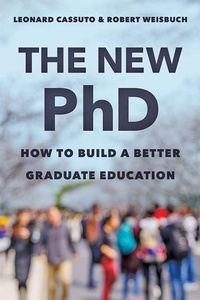
The New PhD
How to Build a Better Graduate Education
Published on 16. March 2021
Book
Hardback
408 pages
978-1-4214-3976-1 (ISBN)
Description
This book examines the failed graduate school reforms of the past and presents a plan for a practical and sustainable PhD.
For too many students, today's PhD is a bridge to nowhere. Imagine an entering cohort of eight doctoral students. By current statistics, four of the eight-50%!-will not complete the degree. Of the other four, two will never secure full-time academic positions. The remaining pair will find full-time teaching jobs, likely at teaching-intensive institutions. And maybe, just maybe, one of them will garner a position at a research university like the one where those eight students began graduate school. But all eight members of that original group will be trained according to the needs of that single one of them who might snag a job at a research university. Graduate school has been preparing students for jobs that don't exist-and preparing them to want those jobs above all others.
In The New PhD, Leonard Cassuto and Robert Weisbuch argue that universities need to ready graduate students for the jobs they will get, not just the academic ones. Connecting scholarly training to the vast array of career options open to graduates requires a PhD that looks outside the walls of the university, not one that turns inward-a PhD that doesn't narrow student minds but unlocks and broadens them practically as well as intellectually. Cassuto and Weisbuch document the growing movement for a student-centered, career-diverse graduate education, and they highlight some of the most promising innovations that are taking place on campuses right now. They also review for the first time the myriad national reform efforts, sponsored by major players like Carnegie and Mellon, that took place between 1990 and 2010, look at why these attempts failed, and ask how we can do better this time around.
A more humane and socially dynamic PhD experience, the authors assert, is possible. This new PhD reconceives of graduate education as a public good, not a hermetically sealed cloister-and it won't happen by itself. Throughout the book, Cassuto and Weisbuch offer specific examples of how graduate programs can work to:
* reduce the time it takes students to earn a degree;
* expand career opportunities after graduation;
* encourage public scholarship;
* create coherent curricula and rethink the dissertation;
* attract a truly representative student cohort; and
* provide the resources-financial, cultural, and emotional-that students need to successfully complete the program.
The New PhD is a toolbox for practical change that will teach readers how to achieve consensus on goals, garner support, and turn talk to action. Speaking to all stakeholders in graduate education-faculty, administrators, and students-it promises that graduates can become change agents throughout our world. By fixing the PhD, we can benefit the entire educational system and the life of our society along with it.
For too many students, today's PhD is a bridge to nowhere. Imagine an entering cohort of eight doctoral students. By current statistics, four of the eight-50%!-will not complete the degree. Of the other four, two will never secure full-time academic positions. The remaining pair will find full-time teaching jobs, likely at teaching-intensive institutions. And maybe, just maybe, one of them will garner a position at a research university like the one where those eight students began graduate school. But all eight members of that original group will be trained according to the needs of that single one of them who might snag a job at a research university. Graduate school has been preparing students for jobs that don't exist-and preparing them to want those jobs above all others.
In The New PhD, Leonard Cassuto and Robert Weisbuch argue that universities need to ready graduate students for the jobs they will get, not just the academic ones. Connecting scholarly training to the vast array of career options open to graduates requires a PhD that looks outside the walls of the university, not one that turns inward-a PhD that doesn't narrow student minds but unlocks and broadens them practically as well as intellectually. Cassuto and Weisbuch document the growing movement for a student-centered, career-diverse graduate education, and they highlight some of the most promising innovations that are taking place on campuses right now. They also review for the first time the myriad national reform efforts, sponsored by major players like Carnegie and Mellon, that took place between 1990 and 2010, look at why these attempts failed, and ask how we can do better this time around.
A more humane and socially dynamic PhD experience, the authors assert, is possible. This new PhD reconceives of graduate education as a public good, not a hermetically sealed cloister-and it won't happen by itself. Throughout the book, Cassuto and Weisbuch offer specific examples of how graduate programs can work to:
* reduce the time it takes students to earn a degree;
* expand career opportunities after graduation;
* encourage public scholarship;
* create coherent curricula and rethink the dissertation;
* attract a truly representative student cohort; and
* provide the resources-financial, cultural, and emotional-that students need to successfully complete the program.
The New PhD is a toolbox for practical change that will teach readers how to achieve consensus on goals, garner support, and turn talk to action. Speaking to all stakeholders in graduate education-faculty, administrators, and students-it promises that graduates can become change agents throughout our world. By fixing the PhD, we can benefit the entire educational system and the life of our society along with it.
Reviews / Votes
Just in time comes a new book that suggests a set of reforms and innovations meant to transform doctoral education into a more student-centered, career-diverse, socially engaged enterprise that enlarges the possibilities for students and expands the benefits for society.-Forbes
More details
Language
English
Place of publication
Baltimore, MD
United States
Target group
Professional and scholarly
Product notice
sewn/stitched
Cloth over boards
Dimensions
Height: 231 mm
Width: 152 mm
Thickness: 36 mm
Weight
680 gr
ISBN-13
978-1-4214-3976-1 (9781421439761)
DOI
10.1353/book.81097
Copyright in bibliographic data and cover images is held by Nielsen Book Services Limited or by the publishers or by their respective licensors: all rights reserved.
Schweitzer Classification
Other editions
Additional editions
E-Book
03/2021
Johns Hopkins University Press
€34.49
Available for download
Persons
Leonard Cassuto is a professor of English and American Studies at Fordham University. He is the author of The Graduate Adviser column for The Chronicle of Higher Education, which inspired his book, The Graduate School Mess: What Caused It and How We Can Fix It. Robert Weisbuch, formerly a professor of English, department chair, and dean at the University of Michigan, served as the president of the Woodrow Wilson National Fellowship Foundation and the eleventh president of Drew University.
Content
Introduction. Why We Need a New PhD and How We Can Create One
Chapter 1. Then and Now: Two Recent Eras of Reform
Chapter 2. Purpose, Then Path: A Practical Guide to Starting the Conversation
Chapter 3. Career Diversity: A Liberal Arts Approach to the PhD
Chapter 4. Admissions and Attrition
Chapter 5. Student Support and Time to Degree
Chapter 6. Curing the Curriculum and Examining the Exam
Chapter 7. Advising
Chapter 8. Students as Teachers
Chapter 9. Degrees: What Should They Look Like? What Should They Do?
Chapter 10. Public Scholarship: What It Is, Where It Came From, and What It Requires
Conclusion. From Words to Actions
Postscript
Acknowledgments
Notes
Index
Chapter 1. Then and Now: Two Recent Eras of Reform
Chapter 2. Purpose, Then Path: A Practical Guide to Starting the Conversation
Chapter 3. Career Diversity: A Liberal Arts Approach to the PhD
Chapter 4. Admissions and Attrition
Chapter 5. Student Support and Time to Degree
Chapter 6. Curing the Curriculum and Examining the Exam
Chapter 7. Advising
Chapter 8. Students as Teachers
Chapter 9. Degrees: What Should They Look Like? What Should They Do?
Chapter 10. Public Scholarship: What It Is, Where It Came From, and What It Requires
Conclusion. From Words to Actions
Postscript
Acknowledgments
Notes
Index