

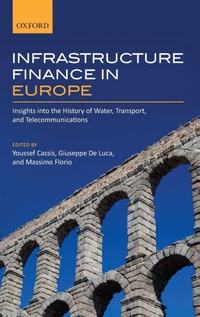
Infrastructure Finance in Europe
Insights into the History of Water, Transport, and Telecommunications
Published on 14. January 2016
Book
Hardback
382 pages
978-0-19-871341-8 (ISBN)
Description
Funding infrastructure has always been a challenging issue in any country and at any time, yet the topic is still largely unexplored. The social returns of investment in water, roads, railways, or more recently telegraph or communication satellites are often apparent in the long run, but this distant horizon poses special problems to governments and investors. This volume provides a broad overview of the main financing solutions implemented in Europe to support infrastructures from the fall of the Roman Empire up to the end of the 20th century.
It explores the diverse historical paths pursued in order to solve the problem of infrastructure finance in various European countries, and draws upon the findings of an international and interdisciplinary research project. It brings together case studies by economic historians, economists, and engineers, and the clear taxonomy guides the reader through the financing solutions that have been developed to fund infrastructure over almost three thousand years. The volume is organized into four parts; after an introductory chapter by the editors, Part One offers 'horizontal' contributions that cover the history of European infrastructure finance. Parts Two, Three, and Four each focus on a single sector, namely water, transport, and telecommunications. The findings show how history can inform thinking on contemporary infrastructure problems.
It explores the diverse historical paths pursued in order to solve the problem of infrastructure finance in various European countries, and draws upon the findings of an international and interdisciplinary research project. It brings together case studies by economic historians, economists, and engineers, and the clear taxonomy guides the reader through the financing solutions that have been developed to fund infrastructure over almost three thousand years. The volume is organized into four parts; after an introductory chapter by the editors, Part One offers 'horizontal' contributions that cover the history of European infrastructure finance. Parts Two, Three, and Four each focus on a single sector, namely water, transport, and telecommunications. The findings show how history can inform thinking on contemporary infrastructure problems.
More details
Other editions
Additional editions
Youssef Cassis | Giuseppe De Luca | Massimo Florio
Infrastructure Finance in Europe
Insights into the History of Water, Transport, and Telecommunications
E-Book
01/2016
1st Edition
OUP eBook
€124.99
Available for download
Persons
Youssef Cassis is Professor of Economic History at the European University Institute, Florence. His work mainly focuses on banking and financial history, as well as business history more generally. His numerous publications on the subject include City Bankers, 1890-1914 (Cambridge University Press, 1994), Big Business. The European Experience in the Twentieth Century (Oxford University Press, 1997), Capitals of Capital. A History of International Financial Centres, 1780-2005 (Cambridge University Press, 2006), and Crises and Opportunities. The Shaping of Modern Finance (Oxford University Press, 2011). He was the cofounder, in 1994, of Financial History Review (Cambridge University Press) and is a past President (2005-2007) of the European Business History Association.
Giuseppe De Luca is Associate Professor of Economic History at the University of Milan. He holds a PhD in Economic and Social History from the University Bocconi and has been visiting professor at the Complutense University of Madrid and at the University of Valladolid. He is a specialist in early modern European finance and financing, with a focus on Italy and the Spanish Empire. He is currently collaborating on cross-country comparisons of informal credit markets, on a Spanish National Research Council project on 'Banks in Madrid and Milan under the Habsburgs'.
Massimo Florio is Professor of Public Economics and the Jean Monnet Chair 'ad personam' of EU Industrial Policy at the University of Milan, where he has also been the head of the Department of Economics, Business, and Statistics. He has been a visiting scholar at the London School of Economics, where he started his research on privatisation, leading to his books The Great Divestiture (MIT Press, 2004) and more recently Network Industries and Social Welfare (OUP, 2013). For more than 20 years, Professor Florio has advised the European Commission and other international organisations on social cost-benefit analysis of infrastructure projects.
Giuseppe De Luca is Associate Professor of Economic History at the University of Milan. He holds a PhD in Economic and Social History from the University Bocconi and has been visiting professor at the Complutense University of Madrid and at the University of Valladolid. He is a specialist in early modern European finance and financing, with a focus on Italy and the Spanish Empire. He is currently collaborating on cross-country comparisons of informal credit markets, on a Spanish National Research Council project on 'Banks in Madrid and Milan under the Habsburgs'.
Massimo Florio is Professor of Public Economics and the Jean Monnet Chair 'ad personam' of EU Industrial Policy at the University of Milan, where he has also been the head of the Department of Economics, Business, and Statistics. He has been a visiting scholar at the London School of Economics, where he started his research on privatisation, leading to his books The Great Divestiture (MIT Press, 2004) and more recently Network Industries and Social Welfare (OUP, 2013). For more than 20 years, Professor Florio has advised the European Commission and other international organisations on social cost-benefit analysis of infrastructure projects.
Editor
Professor of Economic History, Joint Chair RSCAS/Department of History and Civilization, European University Institute, Florence
Professor of Economic History, Department of Economics, Management and Quantitative Methods, University of Milan
Professor of Public Economics and Jean Monnet Chair "Ad personam " of EU Industrial Policy, Department of Economics, Management and Quantitative Methods, University of Milan
Content
PART ONE: THE HISTORY OF EUROPEAN INFRASTRUCTURE FINANCE: FROM THE MIDDLE AGES TO THE PRESENT ERA; PART TWO: WATER; PART THREE: TRANSPORT; PART FOUR: TELECOMMUNICATIONS