

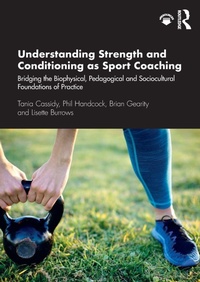
Understanding Strength and Conditioning as Sport Coaching
Bridging the Biophysical, Pedagogical and Sociocultural Foundations of Practice
1st Edition
Published on 14. May 2020
Book
Paperback/Softback
192 pages
978-1-138-30182-5 (ISBN)
Description
Contemporary strength and conditioning coaching is, for the most part, informed by the exercise sciences, with little engagement being made with sociocultural and pedagogical perspectives which have emerged in sports coaching research over the last two decades. In Understanding Strength and Conditioning as Sport Coaching: Bridging the Biophysical, Pedagogical and Sociocultural Foundations of Practice, the authors - whose expertise span strength and conditioning, sports coaching and pedagogy - help students and coaches to integrate perspectives from these disciplines to enhance their strength and conditioning coaching practice.
The book encourages readers to add moral, ethical and political considerations to the technical aspects of their coaching practice. It discusses and applies concepts to a full range of strength and conditioning settings, including elite performance, young athletes, ageing athletes and returning to play following injury.
Featuring an eResource, and structured around rich, narrative pedagogical cases reflecting the issues faced by practising strength and conditioning coaches, the book offers a thoroughly engaging introduction to pedagogical and sociocultural concepts and literature in a strength and conditioning context. This is a vital book for students of strength and conditioning, and an important resource for practising strength and conditioning coaches and sport science staff.
The book encourages readers to add moral, ethical and political considerations to the technical aspects of their coaching practice. It discusses and applies concepts to a full range of strength and conditioning settings, including elite performance, young athletes, ageing athletes and returning to play following injury.
Featuring an eResource, and structured around rich, narrative pedagogical cases reflecting the issues faced by practising strength and conditioning coaches, the book offers a thoroughly engaging introduction to pedagogical and sociocultural concepts and literature in a strength and conditioning context. This is a vital book for students of strength and conditioning, and an important resource for practising strength and conditioning coaches and sport science staff.
Reviews / Votes
We are only ever uncovering "truths for now". Understanding Strength and Conditioning as Sport Coaching challenges these truths, challenges our everyday practices and asks us to actively engage in our own critical thinking. Participating in these processes are integral to growth and mastery. Worthy ambitions"-Jason Cowman, Head of Athletic Performance, National Team, Irish Rugby Football Union.
"Until now, the role of the coach in strength and conditioning has been overlooked. This book looks at strength and conditioning from a coaching perspective, covering the key interdisciplinary knowledge that a successful coach requires. This type of thinking will change our perspective of strength and conditioning and help develop the coach of the future."
- Ian Jeffreys NSCA board member, Professor, University of South Wales, Strength and Conditioning Coach
"Understanding Strength and Conditioning as Sport Coaching is unlike any other book in the field of strength and conditioning. The authors take their approach from pedagogy, sport coaching, and strength and conditioning coaching to provide a comprehensive look inside what it takes to improve athletes physical development and preparation."
- Scott Caulfield, Director of Strength and Conditioning, Colorado College and Former Head Strength and Conditioning Coach NSCA
More details
Language
English
Place of publication
London
United Kingdom
Publishing group
Taylor & Francis Ltd
Target group
College/higher education
Professional and scholarly
Further/Vocational Education, Postgraduate, Professional, and Undergraduate
Illustrations
4 s/w Tabellen
4 Tables, black and white
Dimensions
Height: 246 mm
Width: 174 mm
Thickness: 11 mm
Weight
370 gr
ISBN-13
978-1-138-30182-5 (9781138301825)
Copyright in bibliographic data and cover images is held by Nielsen Book Services Limited or by the publishers or by their respective licensors: all rights reserved.
Schweitzer Classification
Other editions
Additional editions
Tania Cassidy | Phil Handcock | Brian Gearity
Understanding Strength and Conditioning as Sport Coaching
Bridging the Biophysical, Pedagogical and Sociocultural Foundations of Practice
Book
05/2020
1st Edition
Routledge
€206.10
Shipment within 10-20 days
Tania Cassidy | Phil Handcock | Brian Gearity
Understanding Strength and Conditioning as Sport Coaching
Bridging the Biophysical, Pedagogical and Sociocultural Foundations of Practice
E-Book
05/2020
1st Edition
Routledge
€55.49
Available for download
Tania Cassidy | Phil Handcock | Brian Gearity
Understanding Strength and Conditioning as Sport Coaching
Bridging the Biophysical, Pedagogical and Sociocultural Foundations of Practice
E-Book
05/2020
1st Edition
Routledge
€55.49
Available for download
Persons
Tania Cassidy is Associate Professor in Sport Pedagogy at the School of Physical Education, Sport and Exercise Sciences, University of Otago, New Zealand.
Phil Handcock is Lecturer in the Prescription of Physical Activity and Exercise, Athletic Training and Conditioning at the Institute of Sport, Exercise and Health, Otago Polytechnic, Dunedin, New Zealand.
Brian Gearity is Assistant Professor and Director of Online Graduate Programs in Sport, Strength and Conditioning, and Psychology of Coaching at the Graduate School of Professional Psychology at the University of Denver, USA.
Lisette Burrows is Professor of Community Health at Te Huataki Waiora School of Health, University of Waikato, New Zealand.
Phil Handcock is Lecturer in the Prescription of Physical Activity and Exercise, Athletic Training and Conditioning at the Institute of Sport, Exercise and Health, Otago Polytechnic, Dunedin, New Zealand.
Brian Gearity is Assistant Professor and Director of Online Graduate Programs in Sport, Strength and Conditioning, and Psychology of Coaching at the Graduate School of Professional Psychology at the University of Denver, USA.
Lisette Burrows is Professor of Community Health at Te Huataki Waiora School of Health, University of Waikato, New Zealand.
Content
Section 1: Setting the Scene
1. Introduction
2. Mapping the construction of strength and conditioning knowledge
3. Concepts and frameworks - Putting strength and conditioning under the microscope
Section 2: Elite Sport Performance
4. Measurement, Assessment and Testing - What does it all mean?
5. Training volume - Fear of missing out (FOMO)
6. 'Helicopter' strength and conditioning - Questioning the role of monitoring.
Introduction
Section 3: Developing as a Strength and Conditioning Professional
7. Developing as a competent strength and conditioning professional
8. Women and strength and conditioning coaching
9. Finding a professional voice and collaborating.
Section 4: Conditioning Across the Lifespan
10. Healthy development of youth for sport.
11. Talent identification and development and creating an environment for success.
12. Older and wiser?
Section 5: Health, Injury and Wellbeing
13. Conditioning for protection?
14. Return to play following injury
15. Looking after yourself as a strength and conditioning coach
1. Introduction
2. Mapping the construction of strength and conditioning knowledge
3. Concepts and frameworks - Putting strength and conditioning under the microscope
Section 2: Elite Sport Performance
4. Measurement, Assessment and Testing - What does it all mean?
5. Training volume - Fear of missing out (FOMO)
6. 'Helicopter' strength and conditioning - Questioning the role of monitoring.
Introduction
Section 3: Developing as a Strength and Conditioning Professional
7. Developing as a competent strength and conditioning professional
8. Women and strength and conditioning coaching
9. Finding a professional voice and collaborating.
Section 4: Conditioning Across the Lifespan
10. Healthy development of youth for sport.
11. Talent identification and development and creating an environment for success.
12. Older and wiser?
Section 5: Health, Injury and Wellbeing
13. Conditioning for protection?
14. Return to play following injury
15. Looking after yourself as a strength and conditioning coach